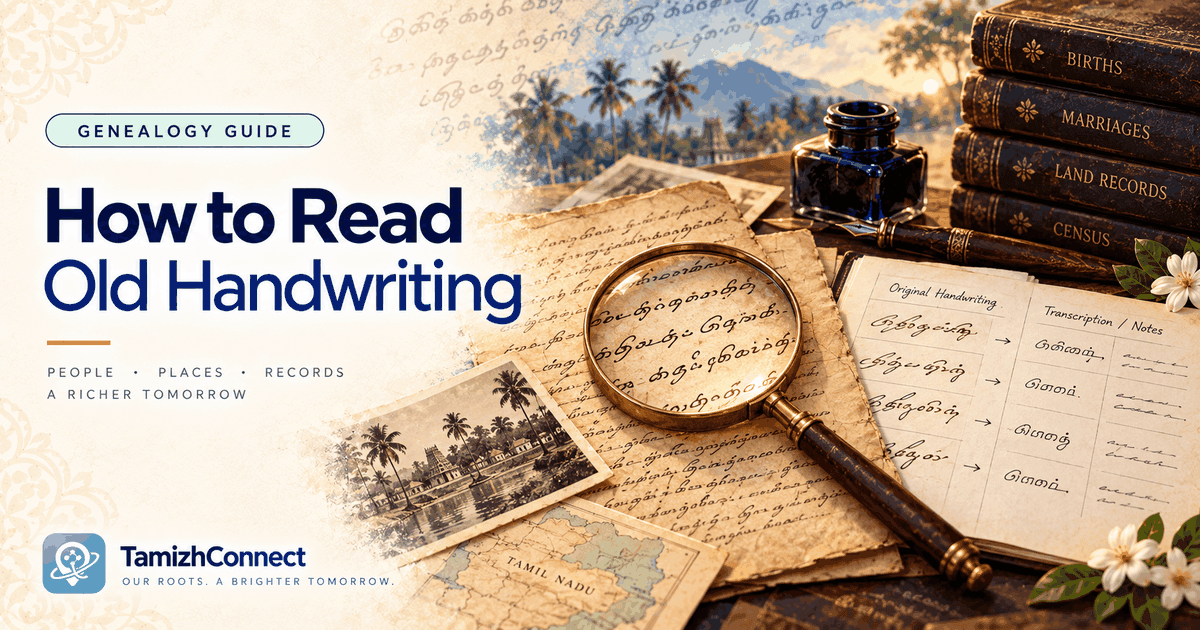
Colonial-era handwriting is often the single biggest obstacle between a researcher and a record that would otherwise unlock the family tree. A clerk sitting at a table in Durban in 1875, writing at speed with a dip pen and fatigue, produced a shorthand that reads as unrelenting scrawl to a modern eye. The words are English (or occasionally Tamil, Bengali, Marathi, or Dutch), but the letter shapes belong to a scribal tradition that has died out.
This guide covers the specific hurdles a Tamil-ancestry researcher faces when working with colonial records: the letter-shape conventions of nineteenth-century British copperplate, the specific abbreviations used in indenture depot registers, the way Tamil-language names were transliterated by non-Tamil-speaking clerks, and the shorthand marks that meant something to a colonial administrator but read as random marks today.
Copperplate script: the base layer
Most nineteenth-century colonial records use some variant of copperplate (also called round hand or English round hand). It was taught in British schools and colonial training institutes; clerks were expected to produce it uniformly. The letter shapes that trip up modern readers most are:
Lowercase “s” appearing as a long stroke. In initial and medial positions within a word, lowercase s was often written as a long descending stroke (ſ) that looks like a modern lowercase f without the crossbar. A word like “class” appears as “claſs” or “claſſ”. This convention faded through the 1880s but survives in records into the 1900s. Rule of thumb: if you see what looks like an “f” without a crossbar and it’s in the middle of a word, read it as s.
Lowercase “e” that looks like a Greek epsilon. The nineteenth-century e was often written with a completely open top loop and a strong horizontal midbar, making it look like the Greek letter ε rather than a modern e. A word like “Tirunelveli” written in this script has multiple ε-shapes stacked together.
Capital letters with elaborate flourishes. Capital M, N, and W often carry large decorative flourishes at the top that can look like accent marks or superscript letters. The flourish is decorative — read the base letter.
Terminal-y with an underloop that spans several letters. Words ending in y often had a large descending loop under y that swept back leftward, sometimes underlining the entire word. This is a decoration, not a mark of meaning.
Indenture depot register-specific conventions
Depot register clerks used specific shorthand to speed up the entry-taking process. The abbreviations you’ll see most often:
“do.” means “ditto” — repeat the value from the row above. If the previous row’s ship column reads “Truro” and this row reads “do.”, this labourer also came on the Truro. Careful: “do.” can chain across dozens of rows in a depot register (all labourers on the same voyage were entered in sequence and marked ditto for the ship column).
“S/o”, “D/o”, “W/o” stand for “son of”, “daughter of”, “wife of”. These appear in the “father’s name” or “spouse’s name” fields as prefixes. “S/o Muthusamy” means “son of Muthusamy”.
“Do. do.” is stacked ditto — both this column and the next column repeat from the previous row. In a depot register, “do. do.” might mean same ship AND same voyage year.
Numeric shorthand in age columns. Ages were sometimes written with a numerator/denominator convention where “35/40” meant “estimated 35 but possibly 40” (used when the labourer didn’t know their exact age, common for adult recruits from rural areas). This is different from the fraction format used in child ages, where “2 1/2” meant two and a half years.
Caste/religion abbreviations. “H.” for Hindu, “M.” or “Mahom.” for Muslim (from “Mahomedan”), “C.” for Christian, “P.” for Parsee. These preceded a labourer’s community or sub-caste identifier in Natal and Fiji depot registers particularly.
Tamil-name transliteration in the hands of non-Tamil clerks
The Tamil consonant and vowel inventory doesn’t map cleanly to English orthography. Clerks who didn’t speak Tamil applied best-guess phonetic English spellings that vary wildly across depot, region, and even individual clerk. The dominant patterns:
Aspirated consonants (Th, Ch, Dh) dropped or doubled. Tamil doesn’t distinguish aspirated and unaspirated stops the way Sanskrit-derived scripts do. A clerk hearing “Muthusamy” (Tamil: முத்துசாமி) might write Mutu Sami, Muddoosami, Moottoosami, or Mootoosamy depending on which consonant they emphasised.
Vowel doubling for length. Long vowels in Tamil were often written with doubled English letters. “Naidu” becomes “Naidoo” if the clerk heard the terminal -u as long; “Kumaresan” becomes “Koomareesan” with two doublings.
Terminal-l retroflex problems. Tamil’s retroflex l (ழ / ல) has no English equivalent. Clerks improvised with “ll”, “zh”, or a silent letter. “Perumal” appears variously as Perumal, Perumall, Peroumal, Perumaul.
French orthographic overlay for Karaikal/Puducherry labourers. Labourers recruited through French-administered Karaikal or Puducherry carry names transliterated through French phonetics. “Ramasamy” becomes “Ramassamy” (double consonant), “Kannan” becomes “Cannane”, “Chetty” becomes “Chetti” or “Chetty” with an alternate spelling.
Voiceless-to-voiced consonant swaps. Tamil t and d, k and g are contextually determined but often the same phoneme. Clerks hearing “Padmanabhan” might write Padmanaben or Batmanapan (with t→d, m→b flipped).
The two-pass reading technique
Most researchers try to read a challenging record letter-by-letter and get stuck at the first ambiguity. The reliable technique is two-pass reading:
Pass one: read the whole document at speed for gist. Don’t stop at individual letters. Identify the record structure (which column is which), the type of information in each column, and any obviously readable words (dates, ship names, common English words like “Native” or “District”). The gist tells you what genre of record you’re looking at and what the ambiguous words are LIKELY to be.
Pass two: return to the difficult words with the context from pass one. If the record is an arrival register and the word in the “ship” column looks like “Twr—” the first three letters plus context strongly suggest “Truro” (a common Natal ship). If a word in the “father’s name” column looks like “Mnth—” and the family surname is Muthusamy, “Muthu—” is the likely reading.
The mistake most researchers make is trying to be certain about every letter before moving on. In practice, colonial handwriting is systematically ambiguous — even a professional transcriber accepts a 5-10% guessing rate on the harder pages.
Specific tools that help
Beyond the two-pass technique, three tools materially help:
Zoom aggressively. If the record is a scan, zoom to 200-400% of the source resolution. Ambiguities that are invisible at 100% often resolve at 300%. The extra pixels let you see whether a stroke has a hook, a serif, or a crossbar.
Compare across the same page. A clerk’s handwriting is consistent within a page. If you can identify the same letter clearly in a nearby row, use that as a reference for the ambiguous instance you’re trying to read. “Every M this clerk wrote has a hooked top-left” — apply that rule to the ambiguous letter.
Cross-reference against other rows of the same register. Depot registers were often entered by the same clerk over multiple days, and the same names recur across days as siblings and cousins arrived on subsequent ships. If you find your ancestor’s name clearly on one page, the same spelling in the same hand a few pages later is a stronger lead than a fresh attempt at a different page.
When to give up and use technology
OCR (optical character recognition) is unreliable for handwritten records — even the best modern engines have accuracy well under 50% on nineteenth-century copperplate. But two technology-assisted approaches are worth trying:
The FamilySearch community indexing project has a large volunteer transcriber base that has already worked through many of the major indenture record sets. Search FamilySearch.org for the specific archive you’re working with — if the register has been indexed, the transcribed text is usually good enough to skip the handwriting problem entirely.
For records not yet indexed, an LLM-assisted transcription (using GPT-4 vision or Gemini) can produce a first draft. The draft will have errors, but the errors are usually in the ambiguous letters (which you’d have missed anyway) rather than in the obvious ones. Treat the LLM output as a starting point and correct against the original.
Neither approach replaces the manual reading, but together they reduce the difficult portion of the record from “the whole document” to “just the fields the LLM got wrong”. That’s a manageable fraction rather than an overwhelming one.
The final tip: don’t over-invest in perfect certainty
The purpose of reading old handwriting is to extract enough information to advance the family tree. Not every letter has to be transcribed perfectly. A colonial record that reads “Native District: Chinglepoot” almost certainly means Chingleput regardless of the spelling drift, and treating that field as confirmed is fine even if the last three letters are ambiguous. Perfection at letter-level accuracy is a poor use of time when the point is to identify a village or a ship name that then unlocks the next step in the research.
The exception is names of people you can’t cross-check. If a father’s name is ambiguous and no other record confirms it, that ambiguity is worth recording (both possible readings, with a note about the uncertainty) rather than committing to a guess. Family trees compound errors — one confidently-wrong father’s name at generation three becomes a wrong grandmother at generation four and a wrong great-grandfather at generation five. Naming the uncertainty and leaving it open is genealogically honest.
The good news: modern researchers are working with much better tools than the paper researchers of thirty years ago. Between digitised registers, community transcription projects, and LLM-assisted reading, the fraction of colonial records that can’t be worked through is smaller every year. The obstacle isn’t going away, but it’s shrinking.