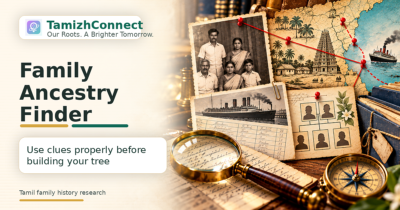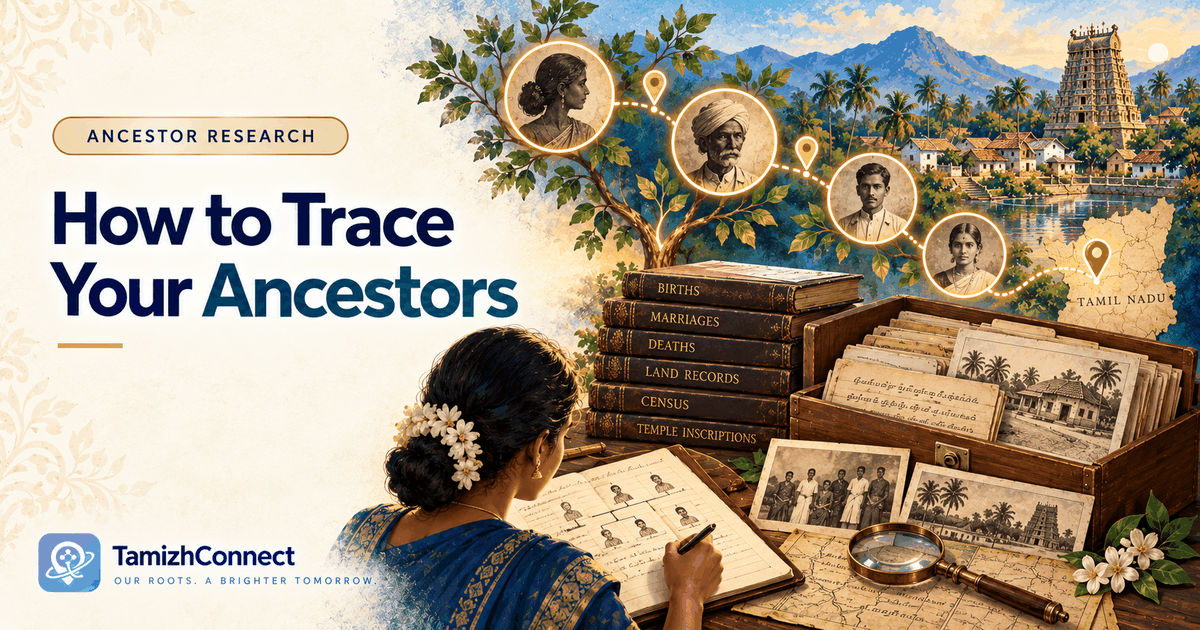
How to Trace Your Ancestry Using Records, Villages and Family Memory is not one search. It is a sequence of small, careful steps. The strongest ancestry research moves from known family facts to older records, not the other way around.
For Tamil families, the best starting clues are usually names, father’s names, native village, Kula Deivam, temple links, marriage records and oral history.
Step 1: Write what your family already knows
Begin with living relatives. Ask about:
- grandparents and great-grandparents
- old village names
- marriage connections
- family movements
- temple or church links
- relatives who migrated overseas
- old documents kept at home
Step 2: Preserve spelling variations
Do not correct spellings too early. Keep every version as written in documents. Tamil names can change when written in English, especially in colonial, migration or school records.
Step 3: Search with anchors
Use combinations rather than one keyword:
- name + father name
- name + village
- village + district
- ship or migration place + name
- spouse name + village
Step 4: Verify before claiming
A match is not proof. A good ancestry claim should connect multiple clues: records, dates, family memory, village identity and relationship structure.
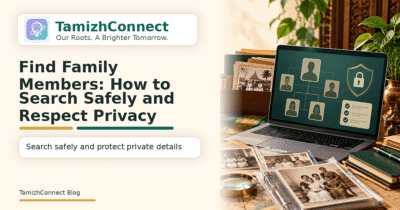
Step 5: Protect privacy
Public family history should focus on deceased ancestors and historical records. Living-person details should be private unless there is clear consent.
TamizhConnect angle
TamizhConnect supports Tamil-first ancestry research by combining private trees, village clues, relationship terms and Tamil-specific archive searches.
Where to go next
- Tamil Ancestry: A Complete Guide — the master research method for Tamil family history.
- Tamil Nadu voter search — 50 million+ current voters indexed by village and district.
- Indenture registers — for South African, Fijian, Mauritian and Malayan diaspora branches.