Verifying an ancestor is genuinely different from finding one. Finding is what most amateur genealogy does: you search the arrival register, get a hit for “Muthusamy son of Ramasamy, from Chetput, arrived 1876 on the Truro,” and add him to the tree. Verifying is what you do next — before you extend that tree by another generation on the strength of that one record.
The professional-genealogy standard for verification is the three-source rule. A claim of descent — that X is your great-great-grandfather, that Y is his father, that Z is the village they came from — should rest on at least three independent documentary sources before you treat it as confirmed. Two sources isn’t enough because both might be wrong in the same way (two records that share a colonial-era clerk’s transcription error tell you nothing about the underlying truth). One source is a lead, not a conclusion.
This guide walks the three-source rule as it applies to Tamil diaspora and Tamil Nadu family history — the specific sources that count as independent, the specific traps that make two sources look independent when they aren’t, and the specific verification workflow that separates amateur trees full of errors from research-grade trees that hold up.
What counts as an independent source
Two documents are independent if they were created by different processes at different times and did not draw on each other. This sounds simple but is where most amateur verification collapses.
Two Kew record classes (say CO 179 for Natal indentures and CO 291 for the Natal Blue Books) are NOT independent — they were both created by British colonial administration and often drew on the same underlying depot records. A match between the two proves consistency in the British record-keeping system, not consistency of the ancestor’s actual biography.
An arrival register at Durban (GLDC) and a duplicate arrival register at Kew (CO 179) are also NOT independent — the Kew copy was made from the Durban original. A match tells you the transcription was faithful, nothing else.
An arrival register at Durban and a temple record at the ancestor’s origin village ARE independent — they were created by different institutions in different jurisdictions with no shared paper trail. A match on both is a strong verification signal.
An arrival register and family oral history ARE independent — assuming the oral history genuinely comes from family memory and not from someone reading the arrival register aloud. Test this before treating oral history as an independent source: ask what the family knows that the archive record does NOT know. If the answer is “everything we know matches the record we already showed you,” that’s not an independent source, it’s the same source with an extra retelling.
The verification workflow
Here’s the sequence that actually produces verified trees:
Step 1: State the specific claim you’re verifying. Not “my great-grandfather,” but “Muthusamy Naidoo, who arrived Durban 1875 aboard the Belvedere from Chingleput district, is the father of my grandfather Rajah Naidoo who was born in Durban in 1908.” Precise claims are verifiable; vague claims are not.
Step 2: List the sources supporting the claim. Include every document, every family testimony, every inference. For each, note whether it’s a primary source (created at the time by someone with direct knowledge) or a secondary source (compiled later from primary sources or from memory).
Step 3: Check for source independence. Group sources that share a paper trail. If sources 1 and 2 are the same record in different archives, count them as one. If sources 3 and 4 are both family memory from the same generation, count them as one — they descend from a shared retelling.
Step 4: Count independent sources. A claim with three or more genuinely independent sources is confirmed. A claim with two is provisional and should be marked as such in the tree. A claim with one is a lead, not a fact.
Step 5: Document the reasoning. Write down which sources support which claim, and how you determined independence. This is the step amateur genealogy skips and professional genealogy insists on. It’s also the step that lets a future descendant re-examine your work and improve it.
The Tamil-specific verification landscape
Tamil ancestry has a specific set of source types that are worth naming in this framework:
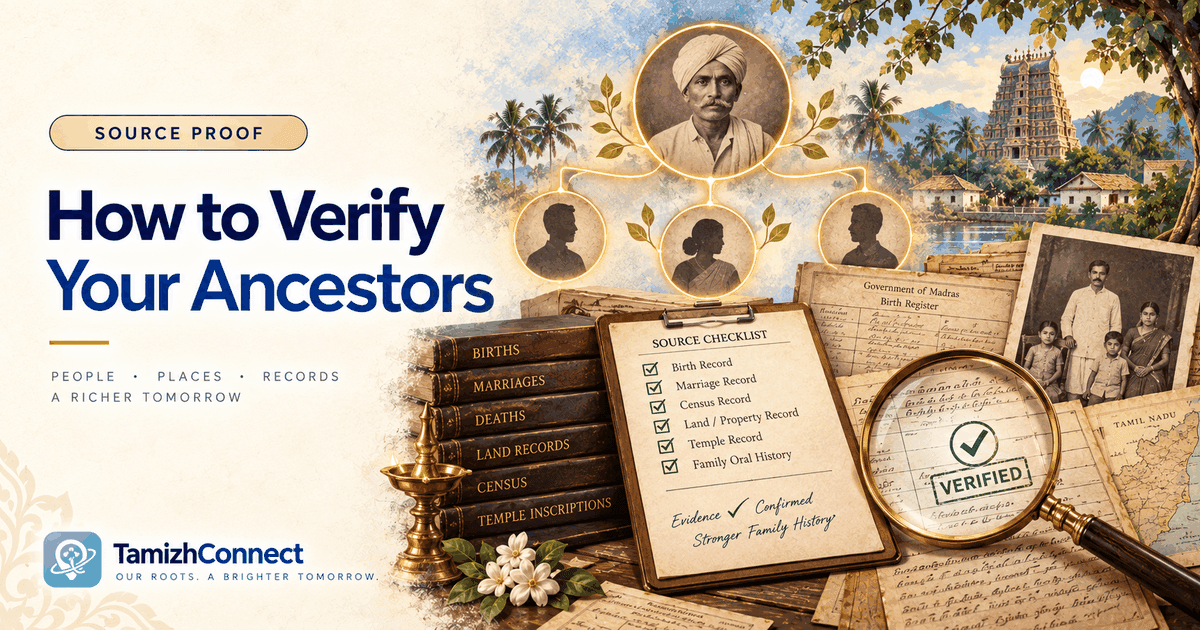
Colonial arrival registers — GLDC (Natal), MGI (Mauritius), National Archives of Fiji, various Caribbean archives. Primary sources for the arrival event; independent of each other across destinations but not across duplicate holdings at Kew.
Voter rolls — the Tamil Nadu Electoral Commission publishes annual voter rolls at village-level detail. A family with the same surname living at the same village today is a corroborating source for the origin-village claim. Independent of colonial records.
Temple registers — village temples often keep kula deivam (family deity) registers naming founding families. Independent of colonial records; independent of voter rolls (temple records are religious, voter rolls are administrative).
Land / patta records — the Tamil Nadu land-records portal at patta.tn.gov.in shows ownership lineages sometimes running back to the 1880s. Independent of every other source type.
Family memory — oral history from elders. Independent of colonial records ONLY IF the family memory predates or does not draw on the colonial record. A grandmother who remembers her grandfather’s stories from before she saw any archive record is an independent source; a grandmother who read the archive record last year and repeats it back is not.
Family photographs and letters — physical artifacts pre-dating your research. Photographs with dated captions, letters with postmarks, greeting cards with return addresses. Independent of all other sources.
The common two-source trap
The most common way amateur trees get into trouble: two colonial records that appear to independently confirm a claim but actually share the same underlying transcription error.
Concrete example. A researcher finds their ancestor Ramasamy in a Natal arrival register listed as “Ramasamy son of Perumal, from Wandiwash.” They then find a second record — Natal indenture medical register — that also lists “Ramasamy s/o Perumal, Wandiwash.” Two records, both British colonial, both showing the same name and village. Verification confirmed?
Not necessarily. The medical register was compiled from the arrival register a few weeks after arrival. It’s a downstream copy. If the arrival register got the name wrong (say the labourer’s actual name was Ramaswamy son of Palani, not Ramasamy son of Perumal), the medical register would have inherited that error. Both records show the same “confirmed” information but the confirmation is illusory.
The fix is to seek a genuinely independent third source — a temple record, a voter roll match, family memory that predates archive access. If those three agree, the claim is confirmed. If the third source disagrees, you know the two colonial records shared an error and you need to investigate which reading is correct.
The specific case of transliterated names
Tamil name transliteration into English creates a specific verification problem: colonial records typically spell names phonetically, family memory typically uses the modern Tamil spelling, and these two “spellings” can look very different even when they refer to the same name.
Colonial “Naidoo” and family-memory “Naidu” are the same name — the doubled-o is a colonial transcription of the long-u vowel. Verification should treat them as consistent, not as conflicting evidence. Similarly, “Perumal” and “Peroumall” are the same underlying name from different transcription traditions.
The verification rule for names: compare phonetic patterns, not exact spellings. If two records could plausibly be phonetic renderings of the same underlying Tamil name, treat them as consistent. If they cannot (say “Naidoo” and “Chetty”), treat them as different names.
What to do when sources conflict
Two verified sources sometimes contradict each other. The verification framework doesn’t tell you which is right — it tells you the claim is not yet confirmed and needs more work.
Conflicts fall into three types. Age conflicts (the arrival register says age 22, the marriage certificate two years later says age 30) usually resolve by trusting the marriage certificate more because the labourer would know their age better by then. Village conflicts (the arrival register says Wandiwash, family memory says Vellore) usually need a third source to break the tie. Father’s name conflicts (arrival register says Perumal, later record says Palani) are among the hardest and often reflect legitimate difference — some labourers gave their father’s name at arrival and their patrilineal-family name (which was different) at later registrations.
The rule for conflicts: never silently pick one. Record both, note the conflict, and mark the tree as provisional at that node until a third source resolves it.
Verification is why family trees are worth doing
A verified family tree is qualitatively different from an unverified one. The unverified tree looks impressive — sometimes dozens of generations, hundreds of names — but any given ancestor might not actually be an ancestor. The verified tree is smaller, more cautious, and much more valuable: each ancestor on it is genuinely confirmed to belong there, and future descendants can build on the tree with confidence.
The three-source rule is the discipline that makes the difference. It’s slow, it’s frustrating when a promising lead turns out to be single-source, and it’s often the reason a researcher’s tree stops at a specific generation rather than sprawling backwards forever. That stop is honest genealogy. The alternative — extending the tree on unverified claims — creates errors that compound down every descendant line.
For Tamil families with paper trails in both India and the diaspora, the three-source rule is especially achievable because the source types (colonial archive, voter roll, temple record, family memory) are naturally independent. A well-verified Tamil family tree is one of the most reliable ancestry documents any diaspora researcher can build.