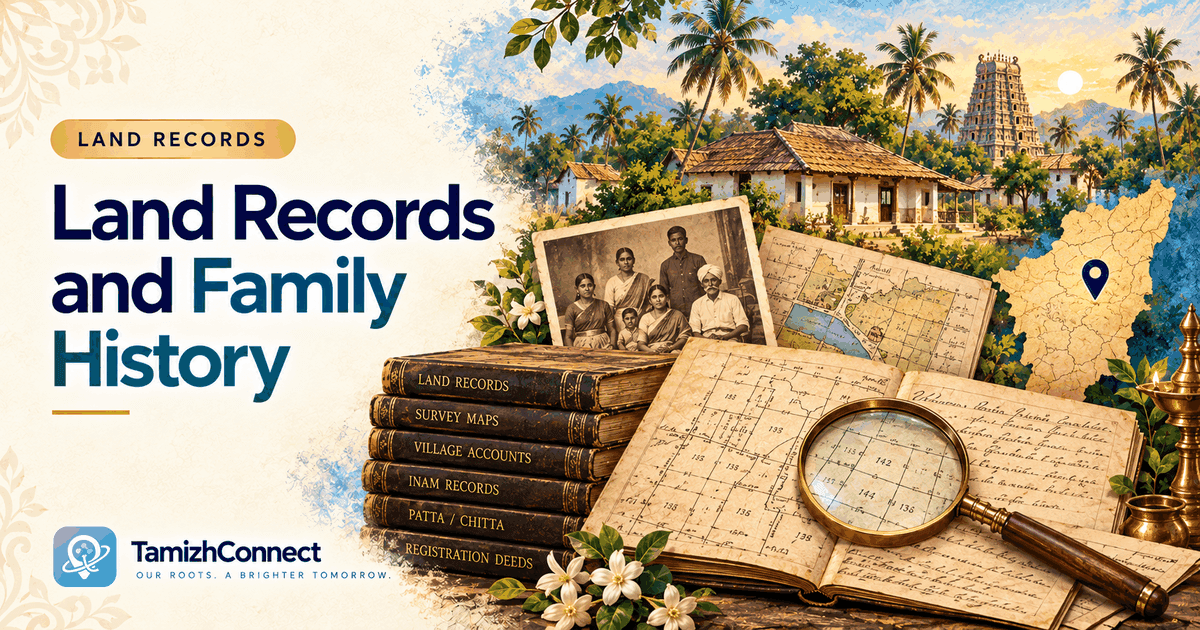
Land records are the most under-searched Tamil genealogy source. Descendants know to search arrival registers, voter rolls, and estate files. Very few know that Tamil Nadu keeps chain-of-title land records — pattas, chittas, and settlement records — that reach back to the 1880s in many villages, name generations of the family that owned each plot, and remain publicly accessible today through the state’s land-records portal.
For a descendant with a village of origin identified, patta records can add three to five generations of ancestors, confirm land-holding patterns, and identify collateral relatives (uncles, aunts, cousins) that no other record class captures. This guide walks the Tamil Nadu land-records system, the specific record types worth searching, and the techniques for extracting family information from what looks at first like administrative real-estate paperwork.
The Tamil Nadu land records system
Tamil Nadu’s land records system is one of the deepest in South Asia. The core records:
Patta. The ownership document for a specific land plot, naming the current owner. Updated when ownership changes. A patta today is the definitive proof of ownership.
Chitta. The village accountant’s summary showing all land held by a specific person in a specific village. If Muthusamy Pillai owns three plots in Wandiwash village, his chitta lists all three with survey numbers and areas.
Adangal (village-level land register). A register kept at the village level listing every plot in the village with its owner, area, and land type (dry, wet, irrigated). Updated annually. The village adangal is a snapshot of the whole village’s land ownership at a specific date.
Settlement Register. The original village land survey compiled during the settlement operations of the 1880s-1900s. These registers document the founding baseline of land ownership from which all subsequent records descend. They contain the specific ancestors who were the recorded owners at the settlement date.
Faisal Patti (revenue collection register). The village-level record of land revenue paid by each landholder each year. Historically the most detailed year-by-year record of village-level economic activity.
What patta records reveal about family
Patta records contain three types of genealogical information:
Owner’s name and lineage. The patta names the owner in traditional Tamil form: given name, father’s name, caste title. This directly documents one generation of ancestry per patta. If the owner is Muthusamy son of Perumal Pillai, the patta identifies Muthusamy AND documents that his father was Perumal.
Chain of title. When a plot changes hands, the new patta records the previous owner. Following a plot’s chain of title back through the settlement register documents the full succession of owners — often a father-to-son sequence spanning three, four, or five generations. This is the most direct multi-generation Tamil-ancestor documentation available.
Adjacent plot owners. Patta records typically list the owners of the four adjacent plots (north, south, east, west) as boundary references. Adjacent plot owners were often kinsmen — the traditional Tamil village land inheritance pattern subdivided ancestral plots among sons, so brothers ended up owning adjacent plots. A patta whose neighbours are two Pillai cousins is capturing the extended-family land-holding structure of the village.
Where surviving records live
Modern digital pattas. The Tamil Nadu land records portal at patta.tn.gov.in holds current pattas for most Tamil Nadu villages, accessible free by the public. Enter the village and survey number to view the current owner. Historical pattas (prior owners) are sometimes accessible through the same portal for major villages.
Village-level chittas and adangals. Held physically at the Village Administrative Officer’s (VAO) office in the specific village. VAO offices retain adangal registers going back decades. Access is by physical visit and typically requires either a small fee or a right-to-information (RTI) request.
Historical settlement registers. Held at the district Collector’s office (revenue records section) and at the Tamil Nadu State Archives in Chennai. The 1880s-1900s settlement registers are the founding baseline and are the deepest publicly-accessible ancestor documentation.
British-era faisal patti and taluk records. Some are held at the Tamil Nadu State Archives; others at district-level collectorate archives; a subset at the India Office Records (British Library) as duplicates sent to London.
Kula deivam and temple land records. Some temple lands (devadana) have separate temple-controlled land records, held by the specific temple or by the Hindu Religious and Charitable Endowments (HR&CE) department. Temple-controlled land records sometimes reach earlier than village-level records and can identify founding families.
The specific search workflow
The workflow for a descendant with a village of origin:
Step 1: Confirm the village name. Modern Tamil village names sometimes differ from colonial spellings. Cross-check the family’s oral tradition against the Tamil Nadu Revenue Department’s official village registry (available online) to identify the modern name and the specific district and taluk it belongs to.
Step 2: Search current pattas via patta.tn.gov.in. If any family with the ancestor’s surname/caste title still owns land in the village, their current patta is a starting point. The patta names the modern owner and often lists the father — connecting current descent to historical descent.
Step 3: Visit the VAO office. The village adangal register kept at the VAO office lists every plot in the village. Search for the ancestor’s family surname/caste title across all plots. Multiple plots owned by the same family surname often indicate the extended family’s historical land holdings.
Step 4: Request the settlement register at the district Collector’s office. This requires a formal request but produces the deepest documentation — the 1880s-1900s baseline owners of the ancestor’s plots. If your ancestor’s specific plot number appears in the settlement register with the ancestor’s grandfather’s name, you have direct 1880s-era ancestor documentation.
Step 5: Cross-reference with temple records. If the family has a kula deivam temple connection in the village, request the temple’s own land records (through HR&CE if a state-managed temple, or directly if a private temple).
What land records add that no other source does
Land records add three types of information no other Tamil-genealogy source provides:
Pre-emigration multi-generation documentation. Colonial-era arrival records document the emigrant ancestor and (partially) their father. Land records extend this back — an 1885 settlement register naming your emigrant ancestor’s grandfather adds a generation that no other source captures.
Collateral relatives. Arrival records document only the emigrant. Land records document everyone in the village who owned land — including brothers who didn’t emigrate, cousins, uncles, and nephews. This builds out the ancestor’s siblings and cousins in a way the emigration path alone can’t.
Economic and social context. Land records show whether the ancestor’s family was landholding or landless, small-holding or substantial, dry-farming or wet-irrigated. This context explains why the ancestor emigrated: landless families were more likely to sign indenture contracts than substantial landholders. Understanding the family’s economic position pre-emigration illuminates the migration decision.
The Zamindari and Ryotwari distinction
Colonial Tamil Nadu had two land-tenure systems: Zamindari (where a hereditary landlord held the land and cultivator families were tenants) and Ryotwari (where individual cultivator families held the land directly from the government). Different districts used different systems, and the record types survive differently.
Ryotwari districts (most of Chingleput, South Arcot, Salem, Coimbatore, and Tirunelveli) have detailed cultivator-family-level records because the government dealt directly with each family. These records are the richest for family research.
Zamindari districts (parts of Ramanathapuram, Sivagangai, some of North Arcot) have thinner cultivator records because the government dealt with the zamindar, not the cultivator. Family research in Zamindari areas usually requires the zamindar’s own private records, which sometimes survive in family archives or at the Tamil Nadu Archives if the zamindari was later dissolved.
Knowing which system your ancestor’s village was under determines what records to expect.
The RTI-request approach
For historical records not available online, a Right to Information (RTI) request is the systematic tool. The Tamil Nadu RTI system requires:
Filing a written request with the specific department (typically the district Collector’s revenue office or the state archives). Paying a small fee (typically ₹10). Waiting 30 days for response.
Effective RTI requests specify the exact record you want (“Faisal Patti register for [village name], [year]”) rather than a broad information request. Specific requests get specific responses; broad requests often get denied for excessive scope.
A descendant living outside India can file RTI requests through an Indian proxy (a family member or a paid researcher). Some specialised Tamil-genealogy researchers offer RTI-filing as a service.
The reward for the search effort
Land records are slower to work with than digitised colonial-arrival records. They require identifying the village first, then negotiating access through village or district-level offices, then reading records that were compiled in Tamil script for local use rather than English for colonial administration.
But the payoff is qualitatively different. Land records document the ancestor in their pre-emigration life — as a member of a specific village, part of a specific extended family, with specific economic circumstances that shaped why emigration happened. They add generations that no arrival-record research can add, and they connect the family to a physical place that descendants can, if they choose, visit and see.
For serious Tamil family research aiming beyond just “found the emigrant ancestor” and toward “understand the pre-emigration family and its village,” land records are the workhorse. The TamizhConnect village directory and roots-tracing tools pair well with land-records research — village identification via TC, land records via patta.tn.gov.in and district collectors’ offices.