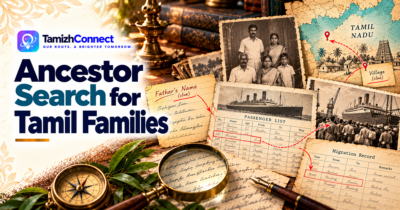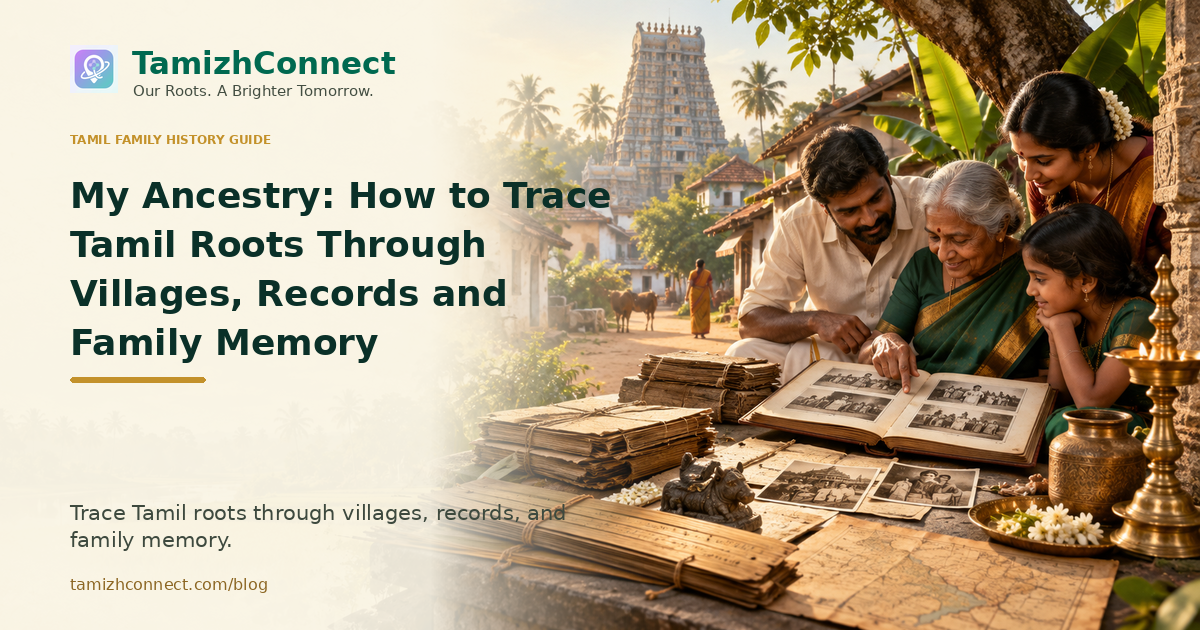
If you are asking “what is my ancestry?”, the answer may be closer than you think. For Tamil families, ancestry often lives in village names, father’s initials, Kula Deivam memories, wedding invitations, migration stories, and elders’ words.
Ancestry is not only a percentage on a DNA report. It is also the chain of names, places, relationships, and stories that connects one generation to another.
For Tamil families, that chain needs a Tamil-first method.
What Does “My Ancestry” Mean for Tamil Families?
Tamil ancestry may include:
- your family tree
- your native village
- your district or region
- your Kula Deivam tradition
- your kinship network
- your migration history
- your family’s old documents
- your elders’ memories
Some families know their village clearly. Others only remember a district. Diaspora families may remember “Madras,” “India,” or a plantation/estate name, but not the exact village.
All of these can be starting points.
Start With Identity Anchors
Write down what you know under these headings:
Names
Record names exactly as remembered and exactly as written in documents.
Include:
- personal names
- father names
- initials
- alternative spellings
- nicknames
- titles or local names
Places
Record every place connected to the family:
- native village
- current town
- district
- temple village
- migration destination
- estate or plantation name
- old address
Relationships
Use Tamil relationship terms where possible. They can show which branch a person belongs to.
Examples:
- Periyappa
- Chithappa
- Athai
- Mama
- Chithi
- Periyamma
Evidence
Attach or note evidence:
- documents
- certificates
- invitations
- photos
- elder testimony
- record matches
Do Not Skip Oral History
Oral history is not final proof by itself, but it can guide the search.
Ask elders:
- Who was the oldest ancestor they remember?
- Which village did the family come from?
- Was there a migration story?
- Which temple or Kula Deivam was connected?
- Were there relatives abroad?
- Did the family name change?
Write the answers down. Even uncertain memories can become useful when compared with records.
Records That May Help
Depending on your family’s history, useful records may include:
- voter rolls
- school records
- land documents
- temple records
- migration records
- indenture records
- ship lists
- family-tree records
- wedding invitations
- local community records
If your ancestor migrated from South India, migration records may preserve the village or father’s name that later generations forgot.
Why Village Matters
Many Tamil families cannot be traced reliably by name alone. A village can separate one person from many others with the same name.
A strong ancestry clue may look like this:
Name + father name + village + district + approximate year
For diaspora families, add:
Destination + ship or migration record + family oral history
How TamizhConnect Helps
TamizhConnect gives Tamil families a place to preserve and search their ancestry in a culturally accurate way.
It supports:
- private family trees
- Tamil relationship patterns
- native village clues
- Kula Deivam notes
- migration and archival record searches
- family collaboration
Explore here: TamizhConnect
Final Thought
Your ancestry is not just where your DNA points. It is where your names, villages, documents, and stories lead.
Start with what your family remembers. Then build carefully, one clue at a time.
Where to go next
- Tamil Ancestry: A Complete Guide — the master research method for Tamil family history.
- Tamil Nadu voter search — 50 million+ current voters indexed by village and district.
- Indenture registers — for South African, Fijian, Mauritian and Malayan diaspora branches.