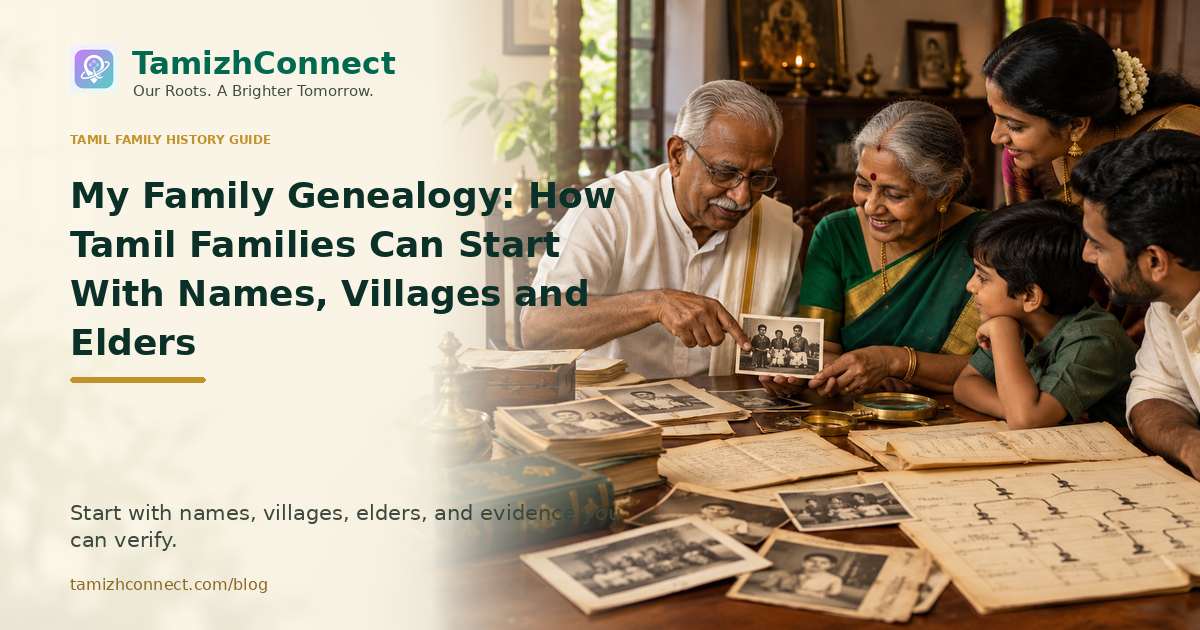
If you are asking “how do I start my family genealogy?”, begin with the people still alive, the villages still remembered, and the documents already inside your family. For Tamil families, genealogy works best when you build from living memory toward archival records — not the other way around.
Many people feel overwhelmed when they start family-history research. They think they need to find records from the 1800s immediately. That is usually the wrong starting point.
For Tamil families, the first stage is simpler and more powerful: collect the names, relationships, villages, and stories your family already knows.
Start With Three Generations
Begin with yourself and move backwards.
Add:
- yourself
- parents
- grandparents
- great-grandparents if known
- siblings of parents
- siblings of grandparents
- marriage connections
- native villages
- notes from elders
Even if the information is incomplete, record it. A partial tree is still useful.
Do not worry if you do not know exact dates. Estimated years, places, and family notes are better than losing the memory completely.
Use Tamil Relationship Terms Correctly
Tamil genealogy can become confusing if every relationship is reduced to “uncle,” “aunt,” or “cousin.” Tamil terms carry important information about which side of the family a person belongs to.
Examples include:
- Periyappa
- Chithappa
- Athai
- Mama
- Periyamma
- Chithi
- Thatha
- Paati
These relationship terms can help identify whether a person belongs to the father’s side, mother’s side, elder branch, younger branch, or marriage-linked branch.
When interviewing elders, ask for the Tamil relationship term, not only the English translation.
Record Native Villages Early
A native village is one of the most important anchors in Tamil family genealogy.
For every person in your tree, try to record:
- birth village
- native village
- marriage village
- current town
- district
- old district name if remembered
- temple village
Some families moved from village to town, or from one district to another. Do not assume the current town is the ancestral village.
Ask elders questions like:
- Where was our original house?
- Which village did marriage alliances come from?
- Which temple did the family visit?
- Did anyone move for work or land?
- Did the family come from a different district before settling here?
Preserve Spelling Variations
Tamil names often change when written in English. One clerk may spell a name one way, another clerk another way. Migration records can create even more variations.
For each ancestor, save all known versions:
- Tamil pronunciation
- English spelling
- initials
- expanded father’s name
- nicknames
- spelling from certificates
- spelling from migration records
Do not “clean up” names too early. The unusual spelling may be exactly what helps you find an old record.
Collect Home Documents
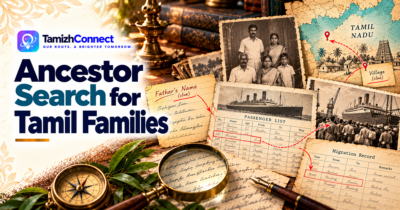
Family genealogy often begins in cupboards, boxes, photo albums, and old files.
Look for:
- wedding invitations
- death notices
- school certificates
- land documents
- ration cards
- old passports
- migration papers
- temple receipts
- letters
- old address books
- photographs with names written behind them
Take photos or scans. Write down who provided each document and what they remember about it.
Interview Elders Properly
Do not ask only “What was our family history?” That question is too broad.
Ask specific questions:
- What was your father’s full name?
- What was his father’s name?
- Which village did he come from?
- Did the family have another village before that?
- Which Kula Deivam did the family worship?
- Who migrated first?
- Were there relatives in another country?
- Which families were connected by marriage?
- Are there old documents or photographs?
Record the conversation if they agree. Otherwise, take notes immediately.
Search Records After You Build the Base
Once you have names, father names, villages, and approximate dates, you can begin searching records.
Useful search targets include:
- voter rolls
- migration records
- indenture records
- ship lists
- temple or community records
- local documents
- land records
- family trees created by relatives
A search for “Ramasamy” alone may be too broad. A search for “Ramasamy, father Muthusamy, village near Chingleput” is much stronger.
How TamizhConnect Fits In
TamizhConnect helps Tamil families build private trees and connect family memory with Tamil-specific records and village clues.
You can use it to:
- preserve your known family tree
- record Tamil kinship correctly
- add native village information
- record Kula Deivam clues
- search Tamil ancestry records where available
- link migration clues to family branches
Start your tree here: TamizhConnect
Final Thought
Your family genealogy does not begin in an archive. It begins with the people who still remember.
Ask now. Record now. Save the names before they disappear.
A family tree built today can become the evidence your children and grandchildren need tomorrow.
Where to go next
- Tamil Ancestry: A Complete Guide — the master research method for Tamil family history.
- Tamil Nadu voter search — 50 million+ current voters indexed by village and district.
- Indenture registers — for South African, Fijian, Mauritian and Malayan diaspora branches.