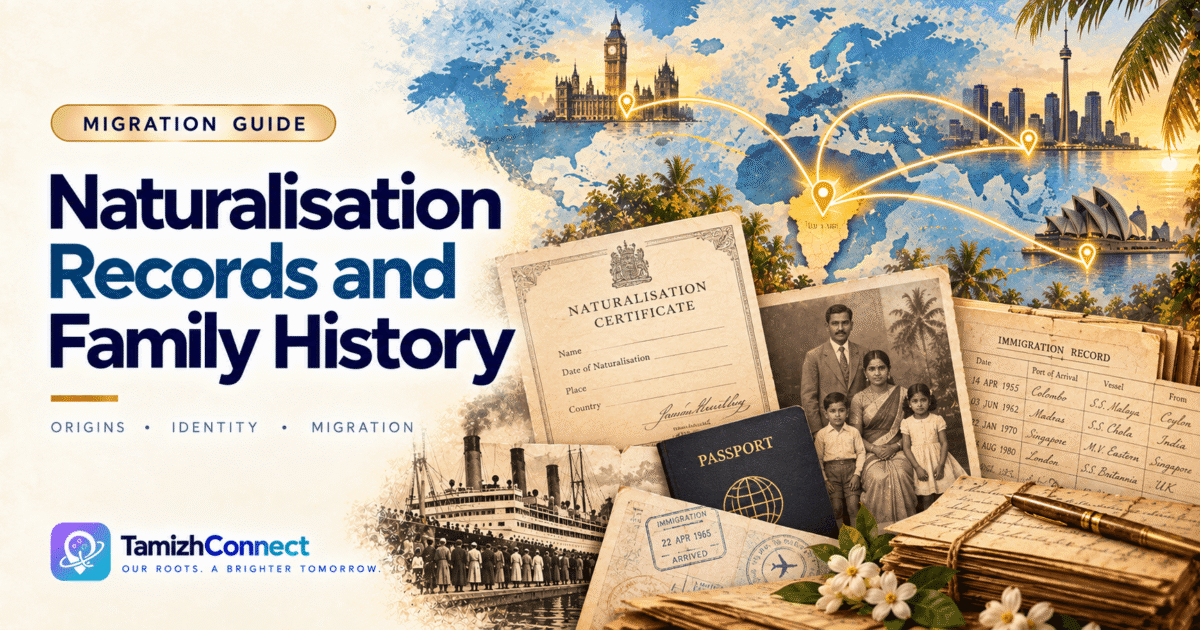
A naturalisation record is a piece of paper that packs more genealogical information per page than almost any other document class. When an Indian-born ancestor applied for British subjecthood in the late nineteenth or early twentieth century, they had to prove their identity to a colonial administrator who required — at minimum — full birth name, birthplace, parents’ names, current residence, occupation, wife’s name, and the names and ages of all children. That’s five generations of information, sometimes across two continents, on a single form.
This guide walks the British naturalisation record class (which covers ancestors who naturalised anywhere in the British Empire, including India, the UK, South Africa, Australia, and the West Indies) and the equivalents in the other jurisdictions Tamil ancestors reached in numbers — Dutch Suriname, French Réunion, and later the United States. It names the specific archives that hold each set, what the record fields look like in practice, and the two things that trip most people up: the distinction between naturalisation and “registration as a British subject” (they’re different) and the fact that many colonial-era records were destroyed or restricted after independence.
What a naturalisation record is
Naturalisation was the legal process by which a foreign-born person acquired British subject status. For an Indian-born ancestor, this typically became relevant either (a) if they wanted to travel outside India on a British passport rather than a colonial travel document, or (b) if they settled permanently in a Dominion (South Africa, Australia, Canada, New Zealand) and needed the legal recognition to own property, vote, or hold certain jobs.
Two important clarifications up front. First, most Indian-born people who moved within the British Empire in the 1860-1947 period did NOT need to naturalise, because they were already British subjects by virtue of India being under British administration. The naturalisation paperwork appears mainly for ancestors who moved to territories where the legal framework specifically required Indian British subjects to re-register (parts of colonial South Africa, some Australian jurisdictions from the 1900s onward) or for post-1947 emigrants who moved to former Dominions after India became independent.
Second, “naturalisation” was legally distinct from “registration as a British subject” (a lighter-weight process that mostly applied to Empire-born people moving to the UK). Both processes generated paperwork; both are useful for family history; but they’re indexed and stored in different record classes. If your ancestor’s story doesn’t fit the naturalisation record you find first, check the registration-as-British-subject index too.
The National Archives at Kew: the master naturalisation file
The National Archives at Kew (UK) holds the master set of British naturalisation certificates and their associated case files under record class HO 1 (early period), HO 45 and HO 144 (Home Office files) and BT 26/27 (Board of Trade passenger lists that name naturalisation dates). The case files include the applicant’s petition, supporting affidavits from referees (usually people who could vouch for the applicant’s character and identity), the applicant’s own biographical statement, and the final certificate issued.
The applicant’s biographical statement is where the genealogical gold lives. It typically names the applicant’s full birth name (with any variants used since), date and place of birth, father’s name, mother’s name (sometimes; less consistently), current residence, occupation, employer or business name, marriage date and place, spouse’s full name, and the names and ages of all children living at the time of application. For an applicant who arrived in the UK as a young man and applied for naturalisation in middle age, this single document can compress twenty years of family history into three pages.
The referee affidavits are the second-most-useful part. Two or three referees had to swear they knew the applicant, knew of no reason to doubt his identity, and had personally known him for at least five years. Names, addresses, and occupations of the referees are recorded — those are typically people from the applicant’s immediate social or business circle, which is often where extended family connections show up. If a referee for a Naidu applicant is another Naidu at the same address, that’s a strong lineage clue.
TamizhConnect indexes the Kew-side records that mention Indian-born applicants under the TNA provider. Search at tamizhconnectblog.kinsta.cloud/indenture-search for the ancestor’s name; if the record surfaces, click through for the full transcribed content.
Post-1947: naturalisation shifts to national jurisdictions
After Indian independence in 1947, naturalisation records for Indian-born people who emigrated to newly-independent countries shifted from British-Empire administration to the national government of the destination country. This split has practical consequences for research:
South Africa. The National Archives and Records Service of South Africa (NARSSA) in Pretoria holds naturalisation records from the pre-Union period (1860s-1910) through the twentieth century. Records for South African Indian applicants specifically are held under NARSSA reference codes; access is by written application and takes 4-8 weeks. Some records are still restricted under South Africa’s Promotion of Access to Information Act — files less than fifty years old typically require the applicant’s consent (or proof of death) to access.
United Kingdom (post-1948). Naturalisations from 1948 onward are held by the Home Office and are indexed at the General Register Office in Southport. Records less than 100 years old are subject to restrictions; the practical rule is that the file is fully accessible once the applicant has been deceased for at least fifteen years.
Australia. The National Archives of Australia (NAA) holds naturalisation records for Australia from the colonial period through the twentieth century. The Immigration Restriction Act 1901 and its successors created a distinct administrative track for Indian-born applicants; those files are often more thorough than general naturalisation applications because they had to overcome the discriminatory policy framework of the White Australia era. NAA files for Indian applicants are heavily digitised and searchable at naa.gov.au.
Canada. Library and Archives Canada (LAC) holds naturalisation records back to the 1850s. Records are indexed by year and by applicant; digitised subsets are searchable online. Pre-1917 naturalisations of British subjects in Canada often did not require paperwork (Indian-born applicants were already British subjects and didn’t need to naturalise until Canada instituted its own citizenship in 1947).
Non-British destinations: the trickier files
Tamil ancestors who emigrated to non-British colonial territories generated naturalisation paperwork under those destinations’ legal frameworks, which are structured very differently.
Suriname (Dutch). The Nationaal Archief in The Hague holds Dutch naturalisation records back to the 1860s. Records are in Dutch and follow a different structure — most Indian-born Surinamese labourers were classified as “Nederlands Onderdaan” (Dutch subject) rather than requiring formal naturalisation. The paperwork that does exist for named individuals is in the “koninklijke besluiten” (royal decrees) series. TamizhConnect’s SURINAME_BS provider covers the intersection with civil-registration records.
Réunion (French). French naturalisation records for Indian-origin ancestors are held at the Archives nationales d’outre-mer (ANOM) in Aix-en-Provence and at the local Réunion departmental archives. French law required formal naturalisation for Indian subjects who wanted to remain permanently — the process included a French-language competency test and often took several years. Files include Indian birth details (with French spellings — a Ramasamy might appear as Ramassamy) and family circumstances.
Mauritius. Mauritius is the special case: from 1834 to 1968 it was British-administered, so Mauritius naturalisation records for Indian ancestors are held partly at the UK National Archives at Kew (older records) and partly at the Mauritius Archives (later records). After 1968 independence, records shifted entirely to Mauritius. The MGI archive in Moka is the primary destination for research.
Reading a naturalisation file: what to prioritise
Given a filled-in naturalisation file, weight the fields in roughly this order:
Applicant’s full biographical statement. The three-to-ten-page personal narrative is the single densest source of family information you’re likely to find in the archive. Extract every name, date, and place systematically.
Referee names and addresses. These are the applicant’s immediate community. Cross-reference against other family names you know — a shared surname or a shared address strongly suggests a family connection.
Employer and occupation. If the applicant worked for a specific company or business, that company’s own records (if surviving) may name the applicant and other family members. Occupational directories from the period cross-reference employer to employee.
Marriage date and place. This anchors a second-generation lineage question. If the marriage was in Tamil Nadu, the marriage certificate should exist in Indian civil registration records. If the marriage was in the diaspora, it links to the destination country’s marriage index.
Children’s names and ages. This is your one-shot at getting the full sibling set for the applicant’s generation. Ages let you compute birth years within a plausible window.
The privacy overlay
Naturalisation records less than 75-100 years old are typically restricted in most jurisdictions. That means files for post-1925 applicants often can’t be accessed by researchers today without proof-of-death or applicant consent. Two practical implications:
If you’re researching a grandparent or great-grandparent who applied for naturalisation post-1930, expect either a wait for the record to open under statutory disclosure rules OR a proof-of-death application to unlock access. The proof-of-death route is usually faster if you have a death certificate.
If the file is fully restricted (some post-1970 files in Australia and Canada), you may still be able to access a redacted summary showing just the naturalisation date and place. That’s less useful than the full file but confirms the fact of naturalisation and gives you the reference number to request the full file later.
Common failure modes
Three things stop most naturalisation searches. First, the surname spelling drift: the ancestor may have naturalised under a spelling different from what the family uses today, and index searches don’t find it. Second, the record class confusion — searchers look in the naturalisation index when the correct record is in the registration-as-British-subject index (or vice versa). Third, the assumption that every Indian emigrant naturalised — most did not, so a null result on a naturalisation search doesn’t mean the ancestor didn’t emigrate; it just means they didn’t need to naturalise.
If the naturalisation record surfaces, treat it as one of the most valuable single documents in the whole family archive. It bridges the pre-emigration and post-emigration halves of the tree in a way most other records cannot.