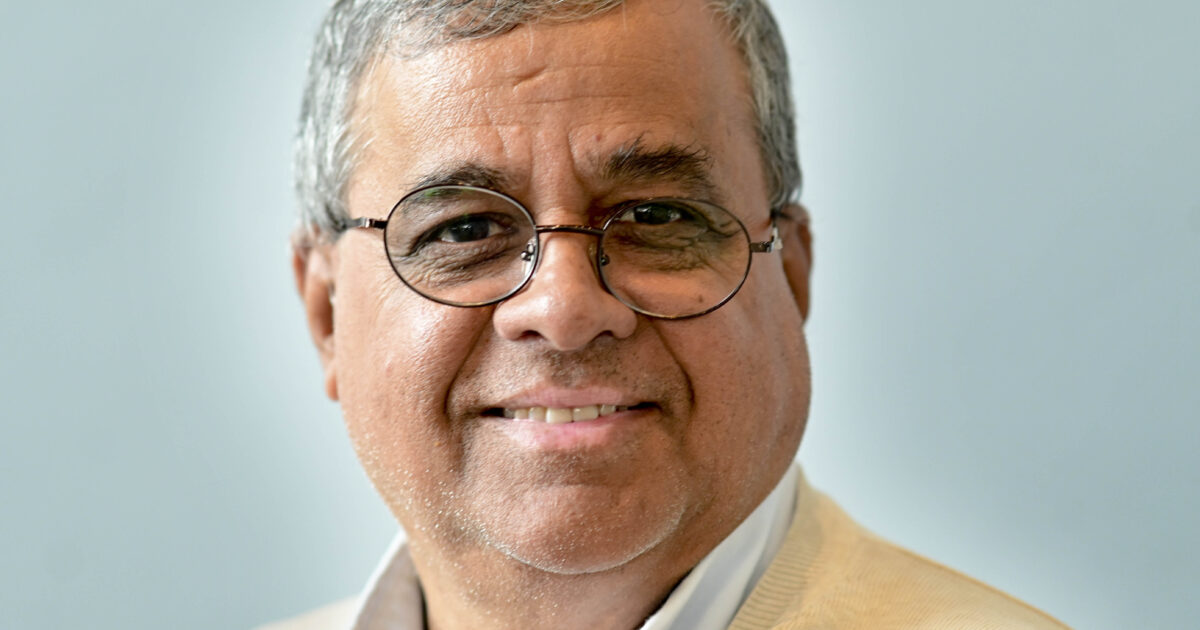
On the request of Sathesh Pandian Manickavasakam, Sandew Hira prepared this overview of his work on the history of indentured labour in Suriname.
Background
I was born in 1955 in Suriname, a former colony of the Dutch in Latin America, and moved with my family in 1970 to the Netherlands. I studied economics at the Erasmus University Rotterdam and worked as a consultant in the private company that my wife Sitla Bonoo and I had founded, Amrit Consultancy, until our retirement. Our company established a publishing house in 1993, Amrit Publishers, to support anti-colonial books that would not make it to the mainstream.
I always had an interest in history. During my study I took two years off to write a 360-page book on the history of the struggle against colonialism in Suriname, 1630-1940. One chapter was on the struggle of indentured labourers against colonialism. It was published in 1982.
For about fifteen years I was involved in other activities. See www.sandewhira.com for my CV and my work.
Digitising Suriname’s indenture records
Around 1995 I began a large project of digitising the archival records of Asian indentured labourers in Suriname: the immigration records of Chinese, Indian and Javanese indentured labour. Students of the Anton de Kom University in Suriname input the data manually in a database I had developed under the supervision of Maurits Hassankhan, who became a partner in the project.
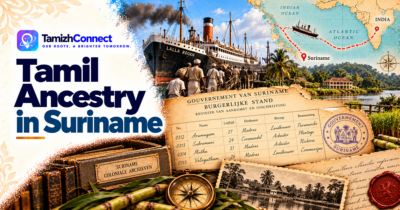
The database on the Indians was published in printed form, five volumes of 1,000 pages, in 1998 and was put online on the website of the National Archives of the Netherlands. Around 34,000 Indians came to Suriname during the period of indenture ship between 1873 and 1916. One third of their records did not survive. We were able to digitise only 27,000 records. There were around 2,000 immigration records from free Indians who did not come from India but from other Caribbean countries, where they were subjected to indenture ship. In 1998 I co-edited a reader with Maurits Hassankhan about the history of the Indian community between 1873 and 1998.
The database of the Javanese was published in printed form, five volumes of 1,000 pages. Around 33,000 Javanese came to Suriname during the period of indenture ship between 1898 and 1939. Most of the records did survive. Additionally, we digitised photographs of the individual Javanese. These photographs were not available for the Indians. The database was put online on the website of the National Archives of the Netherlands.
Around 2,600 Chinese came to Suriname during the period of indenture ship between 1853 and 1874. We were able to digitise around 2,500 records. They have not been published in printed form. The database was put online on the website of the National Archives of the Netherlands.
Documentaries, family journeys, and oral history
When the Indian database was published, a family from Amsterdam contacted me to share a story of their grandfather, Ramsahai, who came with his family from India in the last ship in 1916. The grandfather was still alive. He told me how his family was wandering between villages and how a recruiter enticed them to sign up for Suriname. I found the story fascinating and asked Ivette Forster, a friend who had made documentaries for Dutch public television, if we could make a documentary about Ramsahai.
We made a journey in 2000 with Ramsahai and some of his children back to his village Vaina in the Kanpur district, beginning in Kolkata and travelling via Varanasi, where he took a bath in the Ganges, to Vaina. It was a physical journey in search of relatives in India and a spiritual one in which he recounted the story of his life.
The 56-minute documentary was aired on public television in 2001.
In 2003 I worked with Ivette Forster on a second documentary on indentured labour, which included the uprising in 1902 at Mariënburg, the largest plantation in Suriname, where 24 Indians were executed after the bloody repression by the colonial government. The 56-minute documentary also included the story of Munshi Rahman Khan.
In 2013 I produced a third documentary on indenture ship, now with director Vincent Soekra. It is on the uprising at plantation Zorg en Hoop in 1884 led by a young woman, Janey Tetary. The documentary enacted the scene of the uprising. It was a series of two parts, each of 28 minutes.
Based on my experience during the making of the documentary on Ramsahai, I worked on a book on the search of families in the Surinamese community for their relatives in India. I interviewed 25 families who did make the journey to India, some with success and some without results. The book was published in 2000.
Munshi Rahman Khan and the Calcutta letters
In 2002 I started working on a peculiar story of Munshi Rahman Khan, an indentured labourer who wrote an autobiography. I got the manuscripts from the family. I cannot read Devanagari, so I hired a consultant in India to transcribe the Devanagari version in MS Word and translate it into English. I hired a consultant to go to the village and meet the family of Rahman Khan. He made a video of an interview he did and images of the village. I made a Dutch translation of the English version and published it in 2003. It contained letters he received from his family in India.
A long wish on my list was the digitisation of the Calcutta letters. This is the correspondence between the colonial government in Suriname and the colonial government in India about the life of Indian indentured labourers in Suriname. They also contain correspondence between families in Suriname and India. I asked Tanya Sitaram, a young historian from Suriname, to collaborate with me on this project.
The Calcutta letters were published in 2022 in print, 10 volumes of in total 5,000 pages. I brought together all the historical databases on Indian indenture ship, cleaned them up, because the manual entry of data had many errors, and published them on the website of the Sarnámihuis, a community organisation of the Indian community in the Netherlands: www.chdh.sarnamihuis.nl. I have a long working relationship with Sarnámihuis.
Museums and community institutions
In Suriname I have an even longer working relationship with the Lalla Rookh Foundation. They have supported the digitisation of the immigration registers, the production of the documentaries on the uprisings of 1884 and 1902, and the Calcutta letters. In 2016 Lalla Rookh opened the Lalla Rookh Museum in Paramaribo, Suriname. I was the first curator of the museum.
In 2025 the Suriname Museum was opened in Amsterdam. I was asked to develop the storyline for the Indian section of the museum.
Part of my mission is to encourage others to document the history of indenture ship in Suriname and the Indian community.
Encouraging family histories
In 2009 I came in contact with Padmini Kanhai, the great granddaughter of Chandrashekhar Sharma. He left India in 1893 to work as an indentured labourer in Guyana, a neighbouring colony of Suriname. After indenture ship he established a printing house and later moved to Suriname. His children, grandchildren and great grandchildren left Suriname and dispersed in several countries of the world. He returned in 1936 to India.
Padmini Kanhai Mishre lives with her sister in the city of Nieuwegein in the Netherlands. During several years she collected documents in the family that described the life history of Chandrashekhar Sharma. She travelled to India to meet her relatives and up to this day communicates with the family tree all over the world: India, Holland, England, Germany, Austria, Greece, Canada, U.S.A., Trinidad, Guyana, Barbados and Suriname. I encouraged her to write a book about the family. We published the book in 2010.
Sebieren Hassanmahomed collected life histories of Indian women and published a book in 2016 with these stories with Amrit Publishers. In 2022 Safikan Goelamhaider published her story about arranged marriage and migration from Suriname to Holland with Amrit.
An important historian of Indian indenture ship in Suriname is Dr. Radjinder Bhagwanbali. We published four of his books on the history of Surinamese indentured labour based in archival research, in 2010, 2011, 2021 and 2025.
Contact and websites
Contact: info@sandewhira.com, WhatsApp: +31 6412 83785
Websites: www.sandewhira.com, www.iisr.nl, www.din.today, www.amritpublishers.com.