Anyone who has ever tried to explain a Tamil family relationship in English has hit the same wall. The English cousin system has three words — cousin, second cousin, once-removed — and hand-waves everything else. Tamil has a separate word for almost every relationship in the second and third degrees, and those words carry information English doesn’t. Whether your mother’s brother’s daughter is your macchinichi or your anni tells you whether you could traditionally have married her.
This guide does two things. It maps the Tamil kinship system to the “first cousin / second cousin / once-removed” grid English-speaking family-tree software uses. And it names the Tamil word for each relationship, so if an elder tells you your grandmother had a “periyappa’s daughter,” you can work out on the tree where that person sits and what the English label would be.
The two sides that Tamil separates and English doesn’t
Tamil kinship, like most Dravidian languages, splits your relatives into two categories that English collapses into one. Your mother’s brother is a maama — a different word from your father’s brother, who is a chithappa or periyappa. Your mother’s sister is a chithi or periyamma. Your father’s sister is an athai. Four separate words where English says “aunt” or “uncle.”
This isn’t decorative. The distinction is about lineage and traditionally about marriage. In classical Tamil kinship, marriage between cross-cousins (children of a brother and sister) was preferred, and marriage between parallel cousins (children of two brothers, or two sisters) was forbidden. So the words don’t just describe who someone is — they describe which side of that traditional rule the person sits on.
You don’t need to accept the rule to use the vocabulary. Modern Tamil families use these words to describe who someone is on the tree, whether or not anyone is looking to arrange a marriage.
The cousin generation
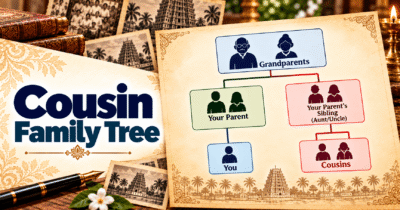
Your chithi‘s or periyamma‘s children — your mother’s sister’s kids — are your parallel cousins on the mother’s side. In Tamil they are called by sibling terms: anna (older brother), thambi (younger brother), akka (older sister), thangachi (younger sister). Tamil does not linguistically distinguish them from your actual siblings. In English family-tree software, they are your first cousins.
Your chithappa‘s or periyappa‘s children — your father’s brother’s kids — are the same shape: parallel cousins, called by sibling terms in Tamil, first cousins in English.
Your athai‘s children — your father’s sister’s kids — are your cross cousins. Tamil calls them by marriage-eligible terms: macchan (male cross cousin, roughly the male version of “sister-in-law’s brother”), macchinichi / manni (female cross cousin). These are the ones a traditional Tamil marriage rule considered eligible. In English they are still first cousins — the software doesn’t distinguish.
Your maama‘s children — your mother’s brother’s kids — are also cross cousins. Same Tamil terms (macchan, macchinichi), same English label (first cousin).
Second cousins — the generation everyone gets stuck on
Second cousins share a great-grandparent, not a grandparent. If your grandfather’s brother had a son, and that son had a daughter, that daughter is your second cousin.
Tamil handles this by extending the parent generation’s terms one step out. Your grandfather’s brother is a periya thatha or thatha‘s anna — literally “big grandfather” or “grandfather’s older brother.” His son (in your parent’s generation) is a periyappa or periyanna extended out — Tamil tends to use the same terms rather than invent second-degree ones. His daughter (in your generation) is often just called a sister or cousin (akka, thangachi, anna, thambi) in casual usage — Tamil families don’t usually distinguish first from second cousin in daily speech.
This is where the English system starts being genuinely useful for family-tree software. If you are building a documented tree and need a label for “my grandfather’s brother’s granddaughter,” English “second cousin” is more precise than the Tamil catch-all “cousin sister.”
The “once removed” trick
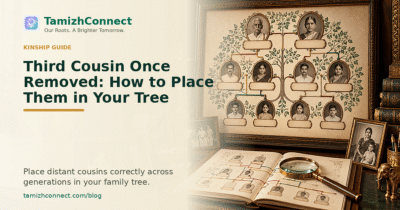
“Once removed” is not a distance in the tree — it’s a difference in generation. Your first cousin’s child is your first cousin once removed. Your parent’s first cousin is also your first cousin once removed. Both are one generation away from you.
Tamil has specific words for these. Your first cousin’s child (your generation’s child, essentially your niece or nephew by cousin) is a marumagan or marumagal in the strict traditional sense, though it is often expanded to include cross-cousins’ children too. Your parent’s first cousin — your parent’s cross cousin’s generation — is again a periyappa, chithappa, athai, maama, or chithi / periyamma depending on which side. Tamil expects one generation up, one generation over, and reuses the parent-generation words.
For English family-tree software, “once removed” is a cleaner label. For talking to an elder in Tamil, use the parent-generation term with the qualifier “of my anna” or “of my thambi” to disambiguate.
A worked example
Here is a real conversation shape that comes up all the time. An aunt calls you and says “your periyappa‘s son’s daughter is getting married in Chennai.” You want to know how you’re related to the girl.
Periyappa = your father’s older brother. His son = your first cousin (parallel cousin, on the father’s side, called by sibling terms in Tamil). That son’s daughter = your first cousin’s daughter = your first cousin once removed in English.
If the same aunt had said “your athai‘s son’s daughter is getting married” — athai is father’s sister, so her son is your cross cousin (still a first cousin in English), and his daughter is again your first cousin once removed.
Same English label, different Tamil relationship types under the hood. The Tamil word tells you which side of the family (father’s or mother’s, sibling’s line or spouse-of-sibling’s line), which the English label discards.
Building the tree
Documented family trees usually record the relationship in structural terms — “daughter of X, granddaughter of Y” — rather than kinship labels. That means the Tamil vocabulary doesn’t have to go into your tree directly. But it does help enormously when you’re on a WhatsApp call with an elder and they’re describing three generations of relatives by kinship term. Writing the Tamil word down against each person as they mention it lets you reconstruct who’s who later, cleanly.
Two practical tips. First, ask elders to describe someone using the two-generation approach: “who is her mother, and who is her mother’s father.” That grounds the person in the tree structure rather than the kinship word. Second, when the same person could reasonably be called by two words (a cousin who is close enough to be called anna in casual speech but is technically macchan in strict kinship), record both. Later, when you’re trying to reconcile your notes with a marriage certificate that names them by full given name and father’s name, both labels help you match.
Related reading
The vocabulary in this guide is drawn from the classical Tamil kinship system used across Tamil Nadu and northern Sri Lanka. There are small regional differences — Jaffna Tamil uses some terms differently, Chettinad families use expanded merchant-caste terminology, and Sri Lankan estate Tamil borrowed some Sinhala terms in the twentieth century. If a specific elder’s usage doesn’t match this guide, their usage is right for their family; treat this as the baseline.
For the naming conventions that go alongside the kinship terms — how a Tamil child gets their name, why the initial usually stands for the father, what changes for women at marriage — see Tamil Naming Conventions Beyond Last Names.
For the broader picture of how Tamil families track lineage over centuries — kula deivam temple records, palm-leaf lineage bundles, and the way a village family knows who’s related to whom without ever writing it down — see Temple records.
Corrections and family-specific usage notes welcome — contact us.