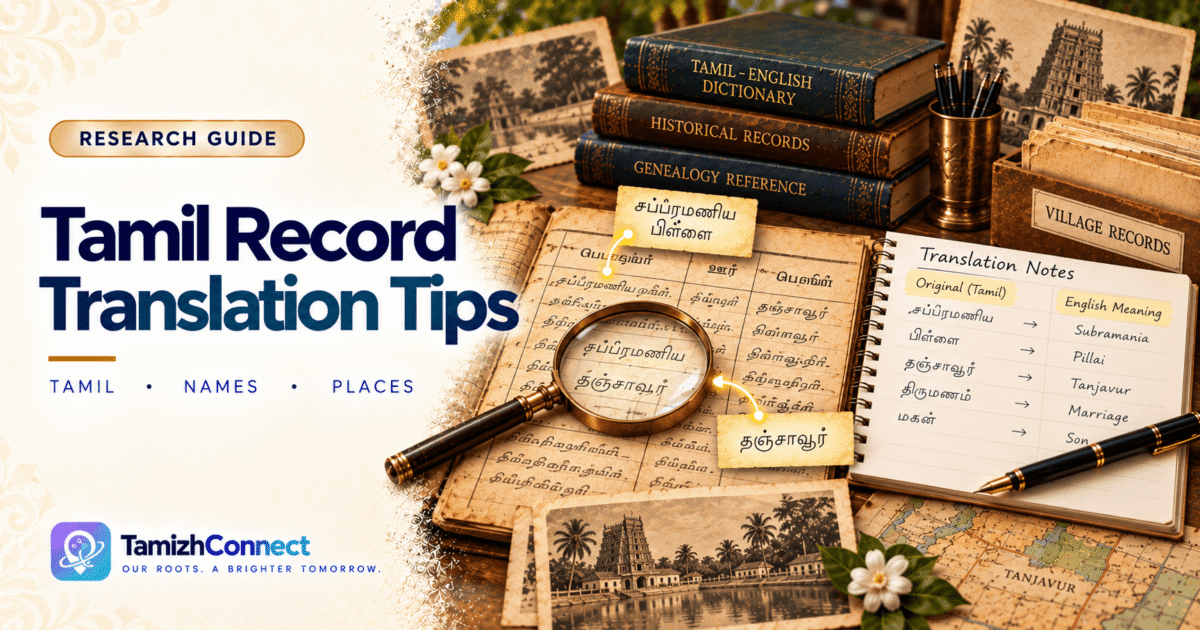
Every diaspora family with roots in Tamil Nadu eventually inherits a stack of paper in a script they can no longer read. The Tamil-language documents that come across as a research project — a great-grandmother’s letters, a village land patta from the 1930s, a temple registration paper, an old family Bible with Tamil endpapers — are often the richest source of pre-emigration information the family has, and often the least accessible.
This guide walks the practical translation process for Tamil-language genealogy documents. It covers what a translation actually requires, which parts of a document to prioritise translating first, how to work with a translator (professional or family member) efficiently, and how to handle the specific complications that Tamil script and colonial-era Tamil orthography add on top of the general genealogy-translation problem.
The document types you’ll encounter
Tamil-language documents in a diaspora family archive fall into a few predictable types:
Personal letters. Nineteenth and early twentieth century letters between the emigrant ancestor and family who stayed in India. Usually handwritten in Tamil script (sometimes with English words interspersed for post-office addressing). Content ranges from mundane (crop prices, weddings, deaths in the village) to genealogically dense (naming multiple generations in a single paragraph).
Land papers (pattas and settlement records). Village land ownership documents, sometimes running back to the 1880s. Contain the ancestor’s grandfather’s or great-grandfather’s name in Tamil script, the plot survey number, the village name, and often adjacent-plot owner names (which are cousins-at-various-removes).
Temple correspondence. Letters from village temples to descendants asking for donations, festival contributions, or ritual services. Usually name the family lineage back multiple generations to establish the descent claim.
Birth, marriage, and death certificates (Tamil-language originals). Pre-1960s Indian civil registration documents were often issued in Tamil script for the local record set (English for the register set that went to the district collector). If a family still holds a Tamil-language original, it’s typically more detailed than the corresponding English record.
Newspaper clippings. Obituaries, marriage announcements, matrimonial-column posts. Tamil newspapers from the 1930s-1970s are a rich source of specific family details rarely captured elsewhere.
School and religious certificates. Report cards, matriculation certificates, baptism records from Tamil Christian communities, community-organisation memberships. Often name parents and place of origin.
What “translating” actually requires
Genealogy translation is different from general translation because you don’t need beautiful prose — you need accurate transfer of specific pieces of information. The three levels of translation quality worth naming:
Structural translation. Identifying which parts of the document contain which types of information (names, dates, places, relationships) without necessarily translating the surrounding narrative. This is often enough for genealogy purposes — you know that the second paragraph names the ancestor’s four brothers even if you don’t know what the surrounding prose is about.
Content translation. Translating the names, dates, places, and factual statements into English while paraphrasing or skipping the narrative. Produces a usable English-language digest of the document.
Full translation. Line-by-line translation of the entire document, preserving tone and nuance. Necessary for family memoirs and letters where the emotional content matters; usually overkill for administrative documents.
For most genealogy purposes, structural translation followed by content translation of the identified sections is the efficient workflow. Full translation is reserved for the few documents (typically letters and family memoirs) where the surrounding narrative carries family-history value beyond the specific facts.
Prioritising what to translate first
If you have a stack of Tamil-language documents, translate them in this order:
1. Land papers. Highest genealogical density per page. Names are usually recorded in a standard patriarchal format (father’s name, individual name) that identifies multiple generations. Plot numbers can be cross-referenced against modern land records.
2. Death certificates. Name the deceased, parents’ names, and often the village of origin. In pre-1960s Tamil death certificates, the parents’ names are the single most valuable field.
3. Marriage certificates. Name both spouses, both sets of parents, both villages of origin. If you can access one, you’re getting two generations of two families in one document.
4. Personal letters. Highest information density but hardest to prioritise which letters matter. If time is limited, translate letters from before 1930 first (older letters more likely to name earlier generations) and letters explicitly mentioning genealogical events (births, weddings, deaths) before general correspondence.
5. Temple correspondence. Useful but often formulaic. The genealogical content is usually a lineage statement at the top (“descendants of X son of Y son of Z”) that can be extracted quickly.
6. Newspaper clippings. Case by case. An obituary of a family member is genealogically valuable; a general news clipping usually isn’t.
Do NOT try to translate everything at once. Prioritise, extract the genealogical information from the top-priority documents, and come back to lower-priority documents only if the top ones leave gaps.
Working with a Tamil-reading family member
If you have access to a Tamil-reading elder in the family, they are often the best translator for family documents — they know the family context, can spot inconsistencies against what they already know, and can interpret regional or archaic vocabulary that a general translator would miss.
Prepare the session. Bring the specific documents you want translated (not everything). Bring specific questions (“does this paragraph name any of great-grandfather’s siblings?”). Bring a notebook to write down the answers verbatim. Do not attempt to translate more than 3-4 documents in a single session — the elder will tire and translation quality will drop.
Record the session with permission. Audio recording lets you go back and re-check specific claims later. Video lets you associate the elder’s oral commentary (“I remember mother mentioning this cousin”) with the specific paragraphs of the document being translated. Both are family-history records in their own right, independent of the underlying document.
Working with a professional translator
When family translation isn’t available, a professional Tamil-English translator is the fallback. Two categories:
Standard commercial translators. Fine for administrative documents (certificates, land papers, formal correspondence). Less good for personal letters where regional idiom matters. Costs range widely; expect £50-150 per page for professional-grade work.
Genealogy specialist translators. A smaller pool but often better fit for family-history documents. They know to preserve name spellings verbatim (rather than modernising), to note archaic vocabulary rather than smooth it over, and to flag regionalisms that carry origin-clue information. Genealogy specialists are often available through professional-genealogist associations.
When commissioning a translation, be explicit about what you need. “Please translate this letter from my great-grandmother in 1926 to her son in Natal, preserving all names verbatim and noting any place-name references that appear archaic to you.” That instruction gets a better output than “please translate this letter.”
Specific complications of Tamil script and orthography
Tamil script has evolved over the past 150 years in ways that make older documents harder to read even for native Tamil speakers today. The main issues:
Grantha letters. Some pre-1970s Tamil texts used Grantha letters (a specialised script for Sanskrit-borrowed sounds like ja, sha, ksha). Modern Tamil-only readers may not know them. Land papers and religious documents from the 1930s often contain them.
Old spellings. Tamil spelling was standardised in the mid-twentieth century. Documents from before then use older spellings that look wrong to modern readers. “இருக்கிறார்” (he is) is modern; older forms might use “இருக்கின்றார்” or archaic variants a modern reader won’t immediately recognise.
Regional dialects. Tamil written in the 1930s in Tirunelveli district looked different from Tamil written in Chennai the same year. Regional vocabulary and idiom in a family letter carries origin-clue information — a translator who knows the dialects can identify the district your ancestor’s family was from just from the way they wrote.
Handwritten cursive. Handwritten Tamil cursive is harder for modern readers than printed Tamil, especially if the writer had their own idiosyncratic letter shapes. Bad handwriting compounds the archaic-spelling problem.
Cross-checking translations
Whenever possible, get a translation cross-checked by a second reader. Not for stylistic reasons, but because a single reader may misread a name, miss a genealogically relevant paragraph, or accidentally modernise an archaic spelling that would have been useful for further research.
The cross-check doesn’t need to be a full re-translation. Ask the second reader to verify the specific extracted facts: “did the first translator get the ancestor’s father’s name right? Is ‘Chetput’ the right modern spelling for the village mentioned? Did the letter really say the wedding was in 1928 or was that a guess?” A twenty-minute cross-check often catches errors that would otherwise propagate through the whole family tree.
Preserving the originals
Whatever you translate, keep the Tamil original. Not just for future research (better tools may emerge that let you re-translate more accurately) but because the original is itself a genealogical artifact — a physical object your ancestor held, wrote, or signed. Scan every document at high resolution before any manipulation. Store the scans redundantly (cloud + local + printed copy for the most important). Note the physical provenance (where the document was found, when, by whom).
The original always outlasts any specific translation. The translation is your working document; the original is the source of truth every future generation can return to.