People search for what does first cousin twice removed mean because cousin terms quickly become confusing once a family tree goes beyond grandparents. In Tamil families, the confusion can be stronger because everyday kinship terms are more precise than generic English labels. This guide explains the relationship in a simple way and shows how to record it without losing cultural meaning.
What "first cousin twice removed" actually means
A cousin relationship has two parts:
- Degree ("first," "second," "third") — how far back you must go to find the shared ancestor. First cousins share grandparents.
- Removed ("once removed," "twice removed") — the number of generations separating the two people. "Twice removed" = two generations apart.
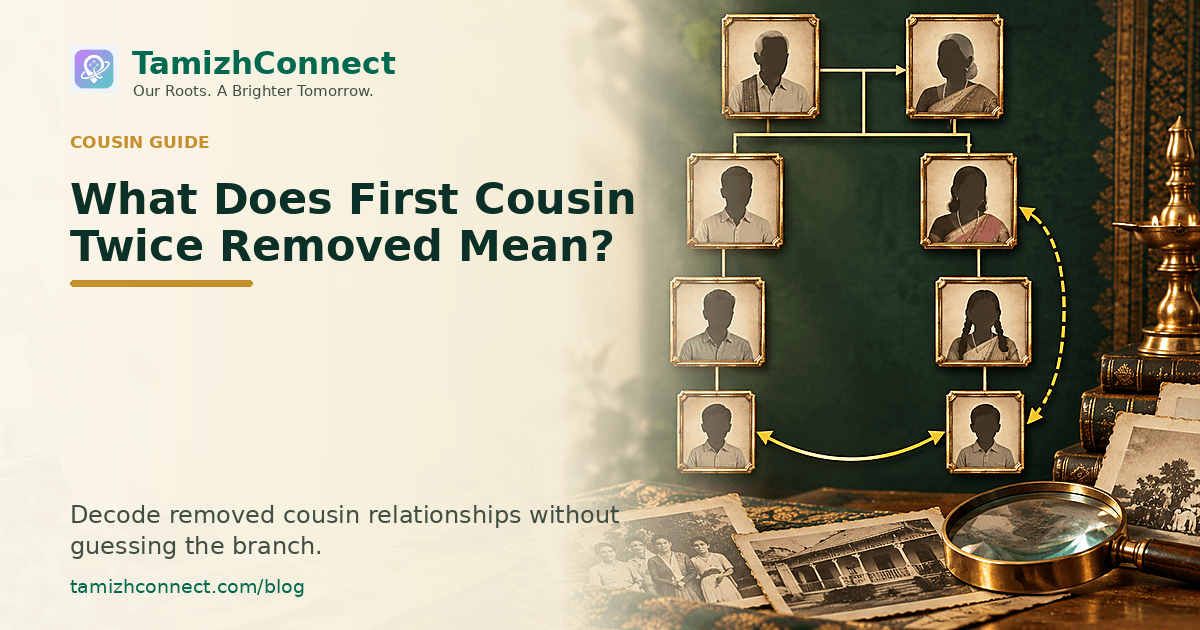
First cousin twice removed therefore means: someone who is a first cousin, but sits two generations away from you in the family tree.
The two shapes this relationship takes
Because "twice removed" can go up or down the tree, there are two common patterns:
- Your grandparent’s first cousin is your first cousin twice removed. Your grandparent and their first cousin share the great-great-grandparents on your side. Two generations separate you from your grandparent’s cousin — hence "twice removed."
- Your first cousin’s grandchild is your first cousin twice removed. You and your first cousin share grandparents. Their grandchild is two generations below you — again, "twice removed."
Both patterns are the same relationship, viewed from either end.
Concrete example
Imagine your grandmother had a first cousin. That first cousin is your first cousin twice removed:
- Your grandmother and her first cousin share their grandparents (your great-great-grandparents).
- The cousin sits two generations below the shared great-great-grandparents, and so does your grandmother — that makes them first cousins to each other.
- You sit two generations below your grandmother (grandmother → parent → you).
- Because the cousin relationship is first-cousin and you are two generations further down the line than one of the first cousins, they are your first cousin twice removed.
The same relationship read from the other end: your own first cousin’s grandchild is also your first cousin twice removed — you and their grandparent (your first cousin) share your grandparents, and they sit two generations below your first cousin.
Why this matters for Tamil families
Tamil families often use relationship words that describe the branch more accurately than English. A person may be called mama, athai, periyappa, chithappa, annan, akka, machan or another term depending on side and generation. English cousin labels are useful for tree software, but they should not replace the family’s own language.
How to record it in your tree
Start by identifying the shared ancestor (for a first cousin twice removed, that is a great-grandparent from one side and great-great-great-grandparent from the other). Count down from that ancestor to each person. If the generation counts differ by two, the relationship is "twice removed." Record the Tamil family term (mama, periyappa, chithappa, machan) alongside the English label so both stay visible.
Common mistake
Do not rely only on age. A much older person is not automatically an uncle or aunt in the genealogical sense. Use the tree path.
TamizhConnect tip
In TamizhConnect, build the line from known relatives first, then add notes for Tamil kinship terms. This protects both the evidence structure and the cultural language of the family.
Where to go next
- Tamil Naming System Explained — the initials + patronymic convention that changes how Tamil cousin relationships get recorded.
- Build your Tamil family tree — preserve Tamil relationship terms (periyappa, chithappa, athai, mama) alongside genealogy labels.
- Tamil Ancestry: A Complete Guide — the master research method.