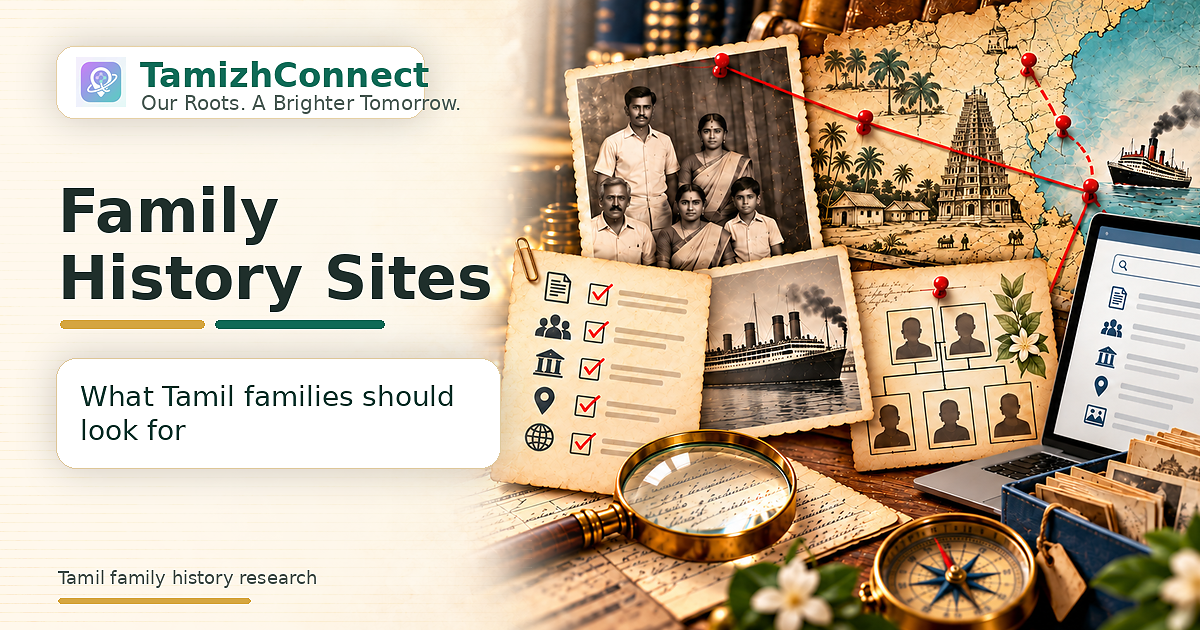
Generic family history sites — Ancestry, MyHeritage, FindMyPast, FamilySearch — are designed for Western family history workflows: hereditary surnames, civil registration from 1837 onward, standardised name matching. Tamil families using these sites often hit the same wall repeatedly: the platform’s assumptions don’t match Tamil naming, Tamil archives, or Tamil migration patterns.
This guide walks the specific features that make a family history site actually usable for Tamil research — the checklist of Tamil-specific requirements that generic reviews never mention. Use it as a comparison rubric when evaluating any platform for your research.
The Tamil-family feature checklist
1. Tamil script support
Many Tamil family records are in Tamil script — historical patta documents, temple registers, old civil registration documents, family Bibles with Tamil inscriptions. A family history site that only handles Latin-alphabet input forces you to transliterate everything, losing information and creating search dead ends.
Check:
- Can you enter Tamil-script names into the tree without transliteration?
- Does search accept Tamil-script queries?
- Are Tamil PDFs / images displayable in the platform without OCR errors?
Most Western platforms fail this. Tamil-specialist tools handle it natively.
2. Indenture-era record integration
The indenture era (1834-1917) is central to Tamil diaspora family history. A useful platform indexes:
- Departure records from Madras Emigration Depot (Royapuram)
- Departure records from Karaikal Depot (French emigration)
- Arrival records at each destination country’s port
- Estate / plantation assignment records
- Voyage information (ship name, arrival date, cohort size)
Generic platforms index maybe 5-10% of these globally. TamizhConnect’s indenture search indexes 400,000+ arrival records across South Africa, Mauritius, Fiji, Trinidad, Guyana, Suriname, and Réunion.
3. Community-specific data
Tamil communities (caste + sub-caste + religious tradition) are meaningful genealogical categories. A useful family history platform:
- Lets you record community affiliation for each ancestor
- Recognises community-title conventions (Pillai, Chettiar, Naidu, etc.) as distinct from hereditary surnames
- Handles Christian-Tamil naming (Christian + Tamil name variants for same person)
- Supports village-of-origin as a first-class field (not just a text note)
4. Kula deivam / family deity tracking
For Hindu Tamil families, the kula deivam (family deity) and the specific temple associated with it are important genealogical anchors. Kula deivam identity persists across many generations and can identify a specific ancestral line even when other records fail.
A useful platform lets you:
- Record kula deivam per family branch
- Note the specific temple / village where the deity is worshipped
- Link family members to their kula deivam identification
TamizhConnect’s kula deivam directory catalogs Tamil family deities specifically for this purpose.
5. Voter roll integration
Tamil Nadu voter rolls (published by the Electoral Commission) are one of the highest-density modern-era records for Tamil family research. Post-1951 voter rolls document millions of Tamil families at village-level detail. A useful family history platform:
- Indexes Tamil Nadu voter roll data
- Supports village-and-surname search combinations
- Handles the Tamil transliteration issues in voter roll data (many names appear in both Tamil and English forms)
6. Village record integration
Historical patta, chitta, and adangal records from Tamil Nadu villages contain multi-generational family information. A useful platform:
- References patta.tn.gov.in for current land records
- Indexes historical patta records where accessible
- Supports adjacent-plot-owner cluster analysis (identifying likely-related families via shared land boundaries)
7. Multi-language documentation
Tamil family papers span English, Tamil, Sanskrit, and sometimes French (Karaikal-emigrated families), Dutch (Suriname branch), Portuguese (older Chennai records). A useful platform supports uploading documents in any language with searchable metadata.
8. Diaspora community records
Tamil communities in each diaspora destination maintained their own records: temple committees in Natal, community associations in Trinidad, sabha organisations in Malaysia. A useful platform:
- Indexes destination-country Tamil community records where available
- Supports records from multiple diaspora locations for one family
- Handles the naming drift that occurs across generations in each destination
9. Phonetic name matching for Tamil
Tamil name transliteration is inconsistent across records. A useful platform’s search:
- Expands “Muthusamy” to include “Muddoosami,” “Muttuswamy,” “Muthusami,” “Muddusami”
- Handles French-orthography variants for Karaikal / Mauritius / Réunion records (“Ramassamy” for “Ramasamy”)
- Recognises common contractions (“M. Perumal” as potentially the same as “Muthusamy Perumal”)
10. Kinship-term support
Tamil kinship vocabulary (athai, mama, chithappa, periyappa, etc.) carries information Western “cousin/uncle/aunt” doesn’t. A useful platform lets you record traditional kinship labels alongside the standard English tree relationships. See our cousin explanation guide.
Evaluating specific platforms against the checklist
How the major generic platforms score against the Tamil-family checklist (rough summary):
- Ancestry.com: Tamil script support (partial); indenture records (thin); community-specific data (no); kula deivam (no); voter rolls (no); village records (no); phonetic Tamil matching (limited). Better for destination-country civil registration than for Tamil-origin records.
- MyHeritage: similar to Ancestry — good for civil registration, weak on Tamil-specific archives.
- FindMyPast: strong on UK / Commonwealth records including some India Office collections; weak on Tamil vernacular sources.
- FamilySearch: strong for FREE India-collections access; less polished UI; kula deivam / voter rolls not indexed.
- WikiTree: collaborative free tree; content depends on community contributions; Tamil coverage minimal.
- TamizhConnect: designed for Tamil family history — indexes indenture records, voter rolls, village directory, kula deivam, phonetic matching; less strong on destination-country civil registration.
The productive approach is combination: use TamizhConnect for Tamil-specific records, Ancestry / MyHeritage for destination-country civil registration, FamilySearch for free supplement, all pushing to a master tree.
What Tamil family history sites should look for from users
Reversing the question — what should you ask family history sites to provide?
- Clear indexing scope statements (what records exactly does the platform cover, from what dates, for what countries?)
- Trial access before committing to subscriptions
- GEDCOM export of your data
- Responsive customer support
- Privacy protections for living-relative data
- Transparent pricing (avoid platforms that hide subscription costs)
Cost-effectiveness for Tamil family research
Annual budget guidance for Tamil family history research:
- Free-only research: FamilySearch + patta.tn.gov.in + Tamil Nadu Electoral Commission + TamizhConnect free tier. Can produce substantial results for the pre-1900 India-side ancestry AND indenture arrivals.
- ~£100/year: adds a TamizhConnect paid tier for indenture / voter-roll access AND access to one destination-country archive on the appropriate specialist platform.
- ~£300/year: adds an Ancestry or MyHeritage subscription for destination-country civil registration + DNA testing / matching capabilities.
- £500+/year: adds proxy research services for physical archives (Chennai Archives, MGI Mauritius, National Archives of Fiji) that require in-person visits.
Prioritize free options first. Add paid subscriptions when you hit specific research walls the free tools can’t clear.
The checklist as an ongoing filter
New family history sites launch periodically. The checklist above is a filter for evaluating any of them against Tamil-specific requirements. A site that scores well on the checklist deserves a trial; a site that scores badly can be evaluated against generalist alternatives and often skipped.
What Tamil families should look for in family history sites is fundamentally different from what generic reviews recommend. Use the Tamil-specific checklist. Ignore the generic “top 10” articles. Your research will be genuinely more effective.