Tamil naming works fundamentally differently from Western naming, and the difference sits in the father’s name. Western records typically have Given Name + Surname, where the surname is a hereditary family identifier that stays constant across generations. Tamil records typically have Given Name + Father’s Given Name, where the “second name” changes every generation. Muthusamy son of Perumal has a son called Kannan son of Muthusamy, who has a son called Rajah son of Kannan. Three generations, three completely different “second names.”
This system is elegant, ancient, and captures generational information every record automatically. It also creates a specific set of research problems that trip up descendants who grew up in the Western naming framework. This guide walks the specific variations you’ll encounter, why they happen, and the search techniques that account for them.
The base Tamil naming system
Traditional Tamil naming, still widely used today, has two elements: the individual’s given name, and their father’s given name. Depending on the era and region, they were written either as [Father’s Name] [Individual’s Name] or [Individual’s Name] [Father’s Name], often with “S/O” (son of) or “D/O” (daughter of) between them. In Tamil, the father’s name is usually written first as a possessive prefix ending in “-in” or “-ar.” In English transliteration, either order appears.
Example: Perumal Muthusamy might mean “Muthusamy, son of Perumal.” Or, in some records, “Perumal, son of Muthusamy” (reversed order). The order depends on the recorder’s convention. This is the first source of confusion — the same name written two different ways can be the same person, or two different people, depending on which order the recorder used.
Caste titles (Pillai, Chettiar, Naidu, Gounder, Thevar, Mudaliar) sometimes appear as a third element. When they do, they usually sit at the end of the name: Muthusamy Perumal Pillai = “Muthusamy son of Perumal, of the Pillai caste.” Caste titles are hereditary and can look like Western surnames — but they’re not personal names, they’re community identifiers.
The variations that appear across records
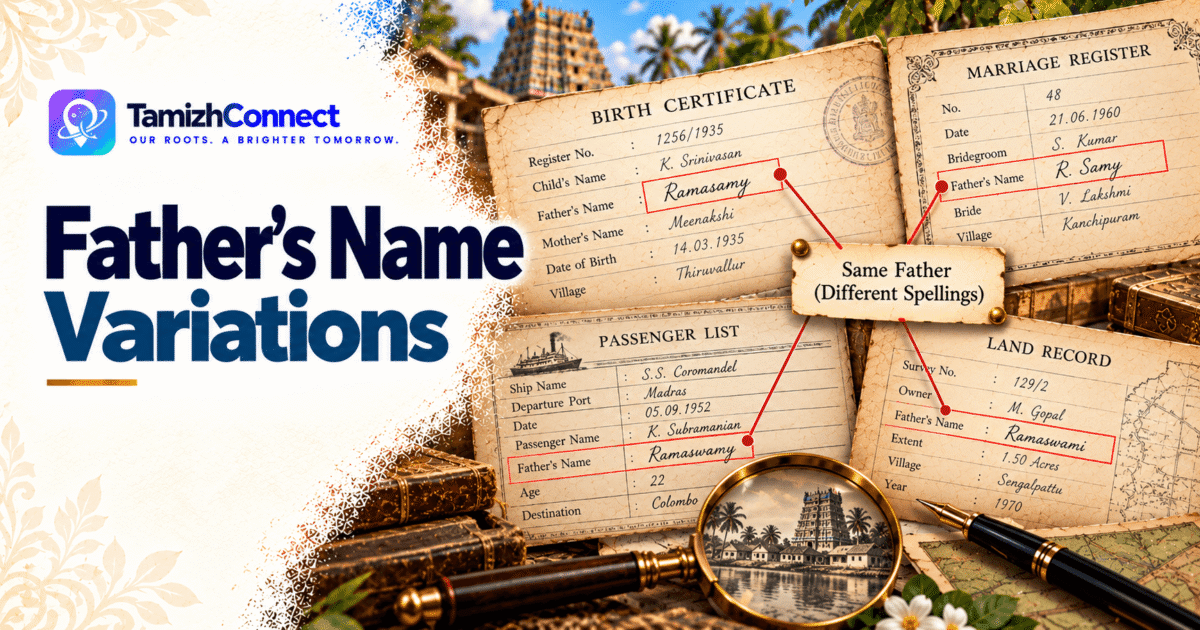
The same person named Muthusamy son of Perumal Pillai might appear in various records as any of:
Muthusamy Perumal Pillai — full form, father-name in middle, caste at end
Perumal Muthusamy Pillai — reversed order, same information
M. Perumal — colonial abbreviation (surname-column populated with father’s name)
Muthusamy s/o Perumal — explicit patronymic marker
P. Muthusamy Pillai — modern initial-plus-name (father’s initial + given + caste)
Muthusamy Pillai — short form dropping father’s name
Muthu Perumal — nickname form, both names shortened
Muthusamy alias Muddoo — colonial “alias” convention for phonetic variants
All of these can refer to the same person in different records. A researcher who searches only “Muthusamy Perumal Pillai” and finds nothing may be missing records that use one of the other forms.
The specific colonial-record complications
Colonial-era records added their own layer of variation on top of the Tamil naming system:
The surname-column problem. Colonial forms designed for European names had a Surname column and a Given Name column. Faced with Tamil names that had no surname per se, clerks made ad-hoc decisions about which name went where. Some put the caste title in the surname column (“Muthusamy” in given, “Pillai” in surname). Others put the father’s name (“Muthusamy” in given, “Perumal” in surname). Yet others put the full “father + caste” in the surname column. The result: the same person’s “surname” varies across colonial records depending on which clerk filled which form.
The initial-only rendering. Late colonial and post-independence records often abbreviated the father’s name to a single initial. “P. Muthusamy” = “Perumal’s son Muthusamy.” But without knowing this, a modern searcher might treat “P” as a middle-name initial in the Western sense, which loses the patronymic information.
The dropped-father-name form. Some records — especially informal ones like estate rolls or land tax registers — dropped the father’s name entirely, keeping only the given name and (sometimes) the caste. This makes the record shorter but loses the generational identifier.
The transliteration drift. The father’s name is transliterated independently of the given name, so both can drift. Muthusamy son of Perumal might appear as “Muthusami Peroumall” in one record and “Muddoosamy Permall” in another — same person, both names phonetically variant. See our spelling variants guide for the phonetic patterns.
The generational shift that trips up trees
The single most common family-tree error involving Tamil names: treating the father’s name as a surname and assuming it stays constant across generations. If a researcher sees Muthusamy Perumal in one record and then finds a next-generation Kannan Muthusamy, they may assume the two are unrelated because “the surnames are different.” In fact they’re father and son — Kannan son of Muthusamy is the son of Muthusamy son of Perumal.
The correct reading: the second name changes every generation, and matching a father’s name in generation N to the given name in generation N+1 is how you verify the descent. A researcher looking at a Tamil family tree should read across generations: the “father’s name” in one record should equal the “given name” in the father’s own record.
Concrete example. Grandfather is “Perumal Ramasamy Chettiar” (Perumal son of Ramasamy, of the Chettiar caste). Father is “Muthusamy Perumal Chettiar” (Muthusamy son of Perumal). The linkage: Perumal is the father’s name in the son’s record AND the given name in the father’s own record. That’s the confirmation the two records are of the same descent line. If those match, you have a verified father-son link. If they don’t match, either the descent is different or one record uses a different naming convention.
Search techniques that work
Given the variation, effective search techniques for Tamil-named ancestors:
Search the given name alone, then filter by village or age. A search for “Muthusamy” from Chettinad district, age 25-30, catches records that spelled his father’s name differently or omitted it entirely.
Search the father’s name too, as an alternate primary name. Records that reversed the order will show the father’s name as the “given” name. A search for both “Muthusamy” and “Perumal” catches both order conventions.
Cross-reference caste titles carefully. Caste titles are hereditary and constant across generations. If a family is Chettiar in one record and Pillai in another, either the family switched community identifier (unusual but happens) or the two records are of different families with similar personal names.
Use phonetic variant expansion for both names. The father’s name drifts phonetically the same way the given name does. Search “Perumal” as “Peroumall,” “Perumaul,” “Permall,” and “Perumaal” — one of these variants is likely to catch the record.
Verify father-son links generation-by-generation. Don’t build a tree assuming any one father-son link; verify each link by checking that the father’s name in the son’s record equals the given name in the father’s own record.
Modern descendants and the surname adoption question
Many Tamil families in the diaspora adopted a fixed surname during the twentieth century, often derived from the emigrant ancestor’s father’s name or from the caste title. A family whose emigrant ancestor was “Muthusamy son of Perumal Naidu” might have descendants today all surnamed “Naidu” — the caste title became the family surname in the destination country’s civil registration system.
This adoption is important for research because it means:
The modern descendant surname is often a fossil of an ancestor’s naming detail — either the caste title or a specific ancestor’s name. Working out which is the case can identify the specific ancestor whose name got frozen into the family surname.
Records from the transition period (roughly 1900-1940) may show mixed conventions in the same family — an elder brother named in the traditional Tamil pattern, a younger brother named with a fixed surname. Both patterns can appear side by side.
Two descendants with the same modern surname (both Naidu, both Pillai) are often unrelated — the surname reflects caste, not lineage. Descent research requires going back past the surname-adoption era to the pre-1900 Tamil-naming records.
The system’s genealogical strength
For all its research complications, the traditional Tamil patronymic system has a genuine genealogical advantage over the Western hereditary-surname system: every record automatically captures one generation of ancestry. A single Tamil-tradition record gives you both the individual and their father, whereas a single Western-tradition record gives you only the individual (the surname doesn’t identify a specific ancestor).
A Tamil-naming record chain across three generations directly documents three ancestors. A Western-naming record chain across three generations documents three individuals with the same surname but doesn’t verify that they’re related unless additional linkage records are found.
For descendants working back through Tamil records, this generational automaticity is worth learning to read. Once the system’s variations are understood, the Tamil naming pattern is a research asset, not a research obstacle.