Genealogy search is a spelling-variant problem before it is anything else. The record you want almost certainly exists. The problem is that a clerk sitting at a table in Durban in 1875 or Georgetown in 1892 spelled your ancestor’s name by ear, in a script and phonetic system that has nothing to do with how the family spells the name today. Get the spelling variant right and the record surfaces on the first search; get it wrong and you’ll spend years believing the record was lost.
This guide is a practical handbook for generating spelling variants systematically. It covers the phonetic patterns that produced most colonial-era name drift for Tamil, Bengali, and Bihari emigrants; the specific archive quirks that shifted spellings within a single record class; and the search techniques that expand a single name into a set of variants likely to catch the record you need.
Why spelling drifts happen
Understanding the mechanism helps predict the variants. Colonial-era name recording had four sources of drift:
The recorder’s native language. A British clerk in Natal heard Tamil names through English phonetics. A French clerk in Karaikal heard them through French phonetics. A Dutch clerk in Paramaribo heard them through Dutch. Each language’s phonetic system introduces different transformations. English clerks doubled vowels (“Naidoo” for Naidu); French clerks doubled consonants (“Ramassamy” for Ramasamy) and preserved terminal S (“Perumal” → “Peroumall” with a French-style terminal L).
The recorder’s speed. A depot clerk processing 400 arrivals in an afternoon had time to hear each name once and write it once. Fast writing produces distinctive shortcuts — dropped syllables, contracted double consonants, missed aspirations. The same clerk writing carefully in a private letter might spell the same name differently.
The speaker’s accent and dialect. A labourer from Chingleput district pronounced their name slightly differently from a labourer from South Arcot. Regional Tamil dialect variations came through as spelling variations in the colonial record. The suffix -samy in one district might sound like -sami or -swami depending on where the speaker was from.
Institutional standardisation. Once a name was written down in one document, it tended to be reproduced (with minor further drift) in every subsequent document that referenced the same person. This creates lineages of related spellings — a labourer named “Muddoosami” on arrival might appear in the estate register as “Muddoosami” and in the marriage certificate as “Muthusamy” if a different clerk who knew Tamil re-heard the name.
The core phonetic patterns
For Tamil names specifically, seven patterns generate most of the drift:
Vowel doubling. Long vowels transcribed as doubled English letters. u → oo, i → ee, a → aa (rarely). “Muthu” → “Muddoo”, “Kani” → “Canee”.
Aspiration drop or double. Aspirated stops (th, dh, kh, bh, gh, ph) written as unaspirated (t, d, k, b, g, p) or doubled to compensate. “Thangavelu” → “Tangavelu” or “Thangavellu” (with double L compensating).
Retroflex approximation. Tamil’s retroflex consonants (ழ, ன, ண, ல with dots) have no English equivalents. Clerks approximated with regular English consonants, sometimes doubled. “Perumal” → “Perumall” or “Perumaul” (approximating the retroflex L).
Terminal-consonant softening. Word-final n, r, m sometimes rendered as silent or as nn/rr/mm. “Kannan” → “Kanan” or “Kannann”.
C/K/Ch confusion. Tamil doesn’t distinguish k and c the way English does. “Kannan” and “Cannan” are both valid transliterations of the same Tamil name. “Chetty” appears as “Chetti”, “Chatty”, or “Setty”.
S/Sh alternation. Tamil has no distinct sh; clerks unfamiliar with Tamil sometimes added Sh where it wasn’t there, or dropped it where it was. “Siva” appears as “Shiva” (Sanskrit spelling influence); “Shanmugam” appears as “Sanmugam”.
French orthographic overlay. Karaikal and Pondicherry labourers passed through French administration before boarding, so their names carry French-style spellings even when they emigrated to British destinations. Terminal -s kept where English drops (Ramassamys instead of Ramasamys), double consonants for emphasis, “ou” where English would write “u” (Perumall → Peroumall).
Generating variants for a specific name
The systematic approach — given a family name in its modern spelling, generate the likely colonial variants:
Take the name. Break it into syllables. For each syllable, list the colonial-era variants that could produce that syllable. Combine them. Deduplicate. Expected output: 8-15 variants per name.
Worked example. “Ramasamy” — three syllables: Ra-ma-samy.
Ra → Ra, Rah (h added for long vowel)
ma → ma, mah, mma (doubled consonant)
samy → samy, sami, sammy, sawmy, saumy, ssamy (French double S)
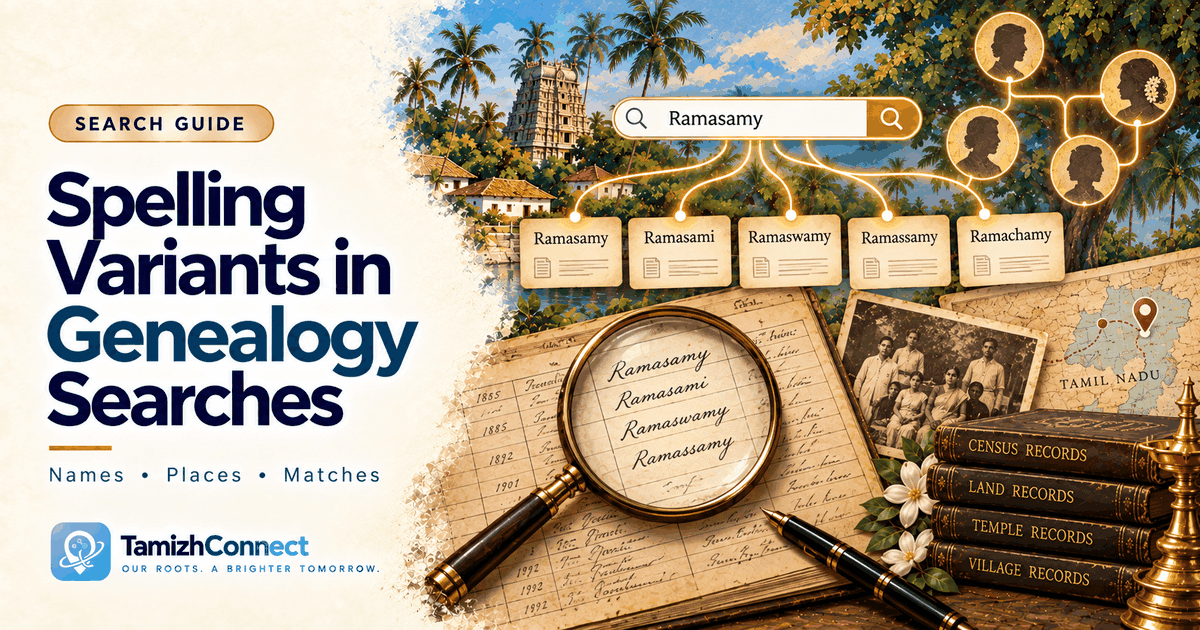
Combinations yield: Ramasamy, Ramasami, Ramassamy, Ramassami, Ramsammy, Rahmasamy, Ramasawmy, and more. The most productive spelling variants for Ramasamy — the ones you should try first in a search — are: Ramasamy, Ramasami, Ramassamy, Ramassami, Ramasawmy, Ramasammi.
TamizhConnect’s search automatically expands your query into these phonetic variants, so entering “Ramasamy” catches records spelled Ramasami, Ramassamy, and so on. If you’re searching an archive that doesn’t expand variants (most colonial archive websites do not), you have to run each variant as a separate search.
Destination-specific spelling conventions
Different destinations produced different dominant spelling patterns:
Natal (South African) records — English colonial transcription. Doubled vowels (“Naidoo”), dropped aspirations (“Tangavelu”), retroflex approximated with doubled L (“Perumall”).
Mauritius records — Mixed English (colonial administration) and French (large French-speaking Mauritian community). Even nineteenth-century Mauritius records show French-style spellings for Tamil names. “Ramasamy” → “Ramassamy” is standard.
Fiji girmit records — English colonial with strong Fijian-Hindi overlay by the 1920s. Second-generation records sometimes show Hindi-influenced spellings even for Tamil-origin names (Naidu → Naidua).
Trinidad, Guyana, Suriname records — English colonial with Creole influence in later records. Doubled vowels common; terminal -s often dropped. Suriname records use Dutch conventions (naidoe instead of Naidoo).
Post-independence records (all destinations) — increasingly standardised to modern-South-Indian-English spellings from the 1960s onward. If your ancestor emigrated pre-1917 but their descendants naturalised in the destination country in the 1970s, the pre-1917 arrival record and the 1970s naturalisation record may use spellings that look unrelated.
The search technique
Given a name and a target archive, the reliable search technique:
Try the modern family spelling first. If a hit, verify it’s the right person and move on. If no hit, generate the top 3-5 phonetic variants for the name and try each. If still no hit, try surname-only + village-only searches (without the given name) to see if the ancestor is in the archive under a spelling you haven’t guessed. If a candidate surfaces, check whether the given-name-variant on that candidate is plausibly the ancestor.
Do not conclude “the record doesn’t exist” until you’ve tried at least 5 phonetic variants AND the surname+village-only fallback. Most amateur searches that “fail” would succeed on variant number three.
When two records disagree on spelling
The same ancestor might appear in two archives under two different spellings. If a Natal arrival register shows “Muddoosami” and a South African civil marriage certificate ten years later shows “Muthusamy,” which is right?
Both are right — they’re both records of the same ancestor’s name, transcribed differently. The modern family spelling is a third variant, usually closer to the marriage-certificate spelling because civil registration by the 1890s was starting to standardise. Verification (see the verification guide) treats phonetic-variant name matches as consistent, not conflicting.
The practical takeaway
Spelling drift is not a research obstacle you overcome once and forget. It’s a permanent feature of colonial-era records that requires ongoing awareness. Every time you extend the tree by another record, check whether the new record’s spelling matches the existing tree’s spelling, and whether apparent inconsistencies are actually just phonetic variants.
A tree that gets the phonetic-variant expansion right will find records that a tree with rigid spelling matching will miss. That difference is often the difference between a stalled tree at generation four and a completed tree at generation six.