Conflicting records are not a research failure. They’re a research signal. Two records that disagree about your ancestor’s birth year, father’s name, or village of origin are telling you something specific — that at least one record was compiled with imperfect information, and that the true state of affairs sits somewhere between them. The research task is to figure out which record is closer to the truth, why the other one drifted, and what the reconciliation implies for the wider family tree.
This guide walks the decision framework professional genealogists use to compare conflicting records, adapted for the specific record types Tamil family research encounters. It covers the three principles that govern most reconciliations, the specific patterns of conflict that appear in Tamil records, and the procedure for documenting a reconciled record when the underlying sources continue to disagree.
The three reconciliation principles
Professional genealogy has settled on three principles that resolve most record conflicts:
Primary sources outrank secondary sources. A birth certificate compiled at the time of the birth (primary) outranks a death certificate compiled decades later that mentions the same birth (secondary). The primary source had less time for information decay and typically had a person with direct knowledge (the doctor, the parent) as the reporter.
Records closer to the event outrank records further from the event. A marriage certificate compiled the day of the marriage outranks a will compiled thirty years later that references the marriage. Time between event and recording is a proxy for information decay.
The person most likely to know the fact is the most reliable reporter. A father registering his own child’s birth is a more reliable reporter of the child’s parents than an adult sibling registering the same birth years later. When two records disagree, look at who supplied the information to each — that identifies which reporter is more likely to have known.
These three principles resolve most conflicts. They don’t resolve all conflicts, and they occasionally contradict each other, which is where the harder judgment work sits.
The specific conflict patterns in Tamil records
Tamil family research encounters six recurring conflict patterns:
Age conflicts on arrival vs. later records. An indenture arrival record from 1875 says the labourer was 22. A civil marriage certificate ten years later says he was 30 (should be 32 if the arrival record was right). This is the single most common Tamil-diaspora conflict. Almost always the marriage certificate is right and the arrival record was wrong — the depot recorded age from labourer self-report, and labourers under 18 or over 40 were rejected from indenture, so young labourers often lied upward to reach 18 and older labourers lied downward to stay under 40. See verification framework for how to record the reconciliation.
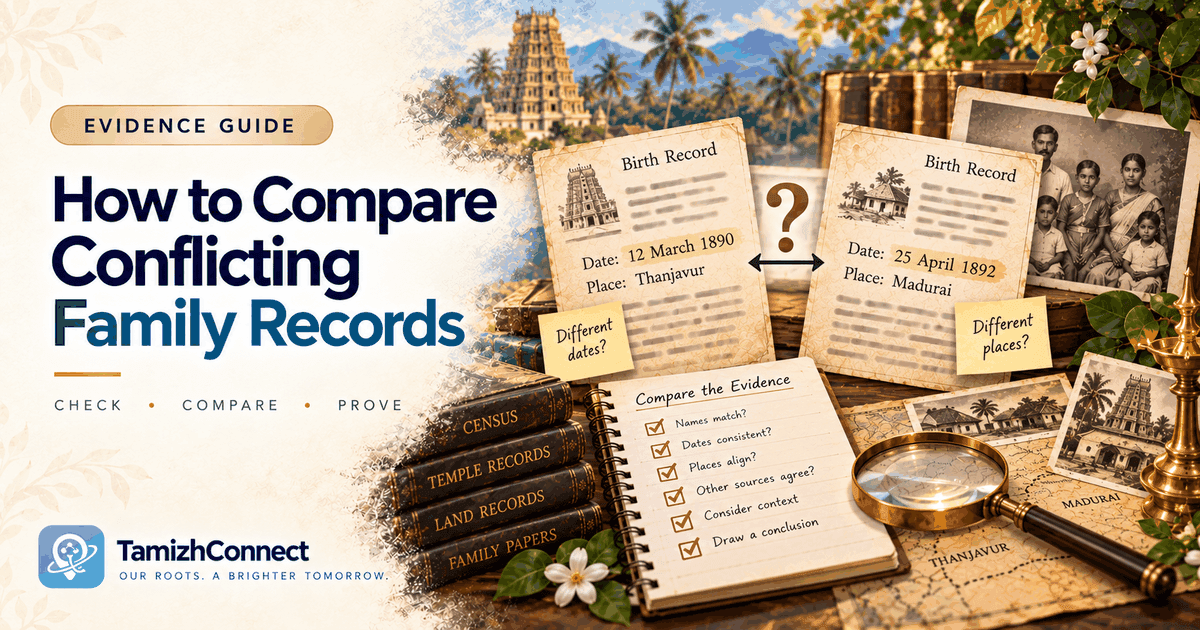
Village conflicts. One record says Wandiwash; another says Vellore. Options: (a) same village called by different names (Wandiwash is the British-colonial rendering of what may be called differently locally); (b) villages in the same district with names that got confused (both in North Arcot); (c) the labourer moved between villages before emigration and the two records reflect different points; (d) genuine error in one record. Reconciliation typically requires a third source — voter roll, temple record, or family memory — to break the tie.
Father’s name conflicts. One record says Perumal; another says Palani. This is often not error but a legitimate difference: some labourers gave their biological father’s name at arrival and their adoptive/patrilineal-family name at later registrations. Others switched names when converting religion (Hindu Perumal becoming Christian Peter, both being the “same” father in the labourer’s mind). Reconciliation requires understanding the specific family context — Christian conversion pattern, adoption pattern, or paternal-lineage-vs-biological pattern.
Sub-caste and community conflicts. Colonial records rendered Tamil sub-castes inconsistently. Vanniyar might appear as Vannian, Vannikula, Palli, Kshatriya, or Rajakulam — all referring to overlapping community identifiers. Reconciliation usually requires knowing the family’s oral tradition of community identity.
Marriage date conflicts. The estate marriage register says 3 March 1885; the civil marriage certificate says 15 March 1885. Options: (a) the estate registered the community/religious ceremony while the civil registration was performed weeks later; (b) date transcription error in one register; (c) two ceremonies (uncommon but happens). The reconciliation depends on distinguishing “date of the ceremony” from “date of civil registration.”
Death date conflicts. One record says the labourer died in 1889; another says he was still alive in 1892. Options: (a) death was reported prematurely (rumour spread, then corrected); (b) two people with the same name died and got confused; (c) the labourer transferred estates and one estate marked him dead when he was actually elsewhere. Reconciliation requires checking downstream records — if the labourer appears in 1892 land records, he clearly wasn’t dead in 1889.
The reconciliation procedure
The step-by-step procedure for reconciling a conflict:
Step 1: Name the specific fact in conflict. Not “the records disagree” but “the arrival register says birth year 1853; the marriage certificate says birth year 1855.” Precision matters — sometimes what looks like disagreement is actually the two records recording different but related facts.
Step 2: Identify each source’s type. Primary or secondary? Contemporaneous or retrospective? Self-reported or reported by another party? These attributes determine which reconciliation principle applies.
Step 3: Apply the reconciliation principles. Does one source clearly outrank the other by primary/secondary status, distance from event, or reporter reliability? If yes, that source wins.
Step 4: If the principles don’t clearly resolve it, seek a third source. A third independent source (see the three-source rule) can break the tie. If it agrees with one of the two conflicting sources, that’s the more reliable version. If it disagrees with both, the situation is genuinely unclear and needs a fourth source or provisional documentation.
Step 5: Document both sources and the reasoning. Never silently pick one and discard the other. Record both, note the conflict, note which one you’re treating as primary, and note the reasoning. Future descendants may find sources that revise your reconciliation, and they need to know what you decided and why.
When to leave a conflict unresolved
Sometimes the correct call is not to reconcile. Some conflicts genuinely reflect two facts that were both true at different points, and forcing a single “correct” answer distorts the underlying reality.
Concrete example. A Tamil labourer’s father is named Perumal on the arrival register and Peter on a Christian baptism record for the labourer’s son twenty years later. These aren’t in conflict — they’re documenting the same person before and after his religious conversion. The reconciliation is not “which is his real name” but “his name changed from Perumal to Peter following his baptism circa 1878.”
Another example. A village name that changed with post-independence administrative reorganisation. The colonial arrival register says “Chetput”; a modern voter roll says “Chetpet.” These aren’t a conflict — they’re the pre-1947 and post-1947 renderings of the same village. Both are correct for their respective time periods.
Recognising when a “conflict” is actually two-true-facts-at-different-times prevents over-reconciliation and preserves the temporal texture the records genuinely capture.
The specific difficulty of undated conflicts
Some records don’t clearly state when they were compiled. A family Bible with genealogical annotations might have entries added over decades in the same handwriting. A land record might have been copied from an earlier record with no notation of the copying date. When the recording date is unclear, the distance-from-event principle can’t be applied cleanly.
For undated records, the reconciliation approach is:
Use handwriting, paper age, and language convention to estimate when the record was compiled. A record using pre-1970s Tamil spelling was likely compiled before the 1970s. A record on paper stock that dates from a specific decade was compiled during or after that decade.
Note the uncertainty explicitly. “Family Bible entry, compiled between 1920 and 1950 based on handwriting and paper age” is more useful than pretending you know the exact date.
Weight the undated record cautiously in reconciliation. If two dated records conflict and an undated third record agrees with one, the agreement is a weak (not strong) tiebreaker because the undated record’s reliability can’t be assessed.
The reconciled record: what to write
When you’ve reconciled a conflict, the record you carry forward in the family tree should look like this:
“Muthusamy son of Perumal. Born circa 1853 (marriage certificate reports age 30 in March 1885; arrival register 1875 reports age 22, inconsistent — see conflict note). Village of origin: Wandiwash, North Arcot (arrival register and voter roll agree; temple record disagrees at Vellore, likely a different person of similar name).”
That reconciled entry preserves everything future descendants need: the reconciled fact (birth circa 1853), the sources (marriage certificate primary, arrival register secondary), the reasoning (marriage certificate closer to event, arrival register self-reported at depot), and the unresolved uncertainty (village conflict noted for future work).
A reconciled record is not a certain record. It’s an honestly-uncertain record with the reasoning made visible. That’s the difference between a family tree that misleads its descendants and one that helps them.