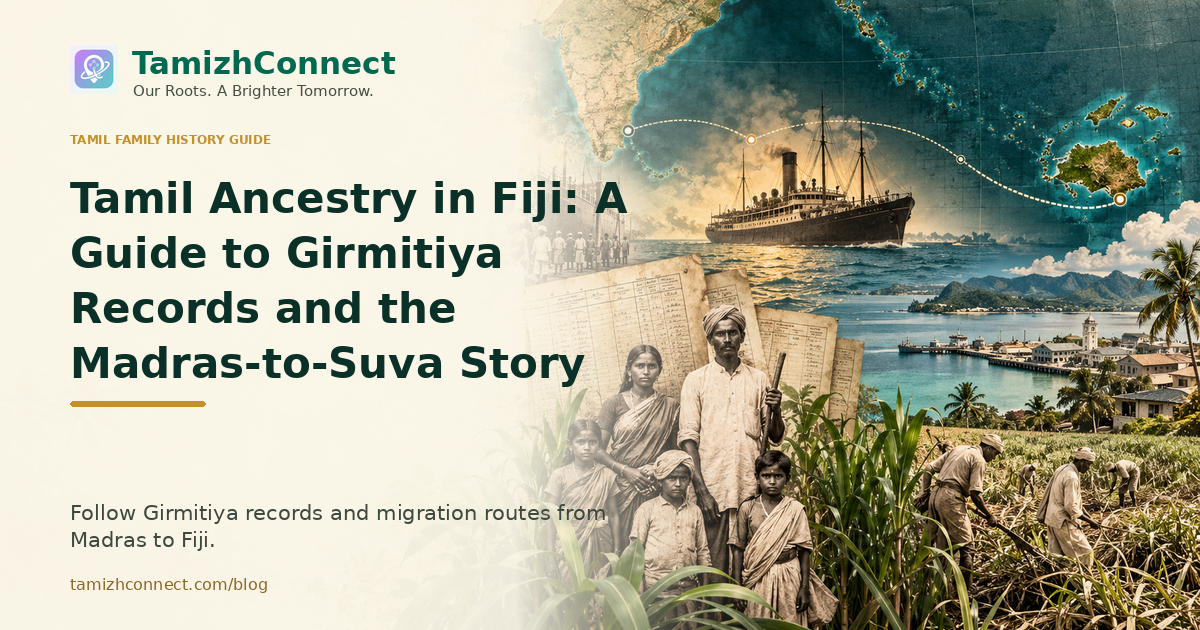
Fiji’s Tamil families are a smaller share of the Indo-Fijian population than the Bhojpuri majority, but the paper trail for both runs through the same set of colonial archives. If your family came from the Madras Presidency between 1879 and 1916 — the girmit period — a specific record almost certainly exists somewhere, and the practical question is which archive to check first and what to bring with you.
This guide walks the two record layers that reach the deepest for Indo-Fijian Tamil families: the arrival registers held in Suva and Auckland, and the smaller Madras-side departure records the girmitiya-focused databases have indexed. It also names the specific dead ends that trip people up (the Leonidas was not a Tamil ship), the shipwrecked-record gaps (the 1884 Syria), and the surname patterns that survived the Fiji Hindi drift.
Who came, and from where
Between 1879 and 1916, roughly 60,000 indentured Indians arrived in Fiji under the girmit contract. The great majority — around 45,000 — were recruited through the Calcutta depot from the Hindi-speaking belt of North India. A smaller stream, roughly 15,000, came through the Madras depot from the districts of what was then Madras Presidency. That Madras stream is where most Indo-Fijian Tamil families originate.
Within the Madras Presidency, recruitment concentrated in three areas. Chingleput (now Chengalpattu and Kanchipuram) and North Arcot (now Vellore, Ranipet, Tirupathur, and Tiruvannamalai) supplied a large share, following the same recruitment patterns that fed Natal. Salem and its neighbouring taluks made up a second cluster. A third stream came from the Telugu-speaking districts bordering Madras — Nellore especially — which is why some Indo-Fijian families with Telugu surnames like Naidu or Reddy appear in what we shorthand as “Tamil” Fiji records.
Not every ship carried Tamil labourers. The Leonidas, which reached Levuka on 14 May 1879 as the first girmit ship, was recruited from Calcutta and its passengers were almost entirely North Indian. If a family story anchors on that vessel and the surname pattern is Tamil, the ancestor arrived on a later ship — the Ganges in 1882, the Bayard, the Rhone, or one of the Madras-departure runs from the 1890s onward.
The National Archives of Fiji, and the papers that survived
The main colonial holding is the National Archives of Fiji in Suva. It holds the arrival registers for the girmit period, the plantation employer records, and post-indenture papers up to the 1920s. Records were catalogued but not fully digitised; a search in person is still the deepest option for anything before 1900. The archives take email enquiries and answer within a few weeks for specific-ancestor lookups.
Two Fiji-specific gaps are worth knowing about before you start. The Colonial Sugar Refining Company (CSR), which employed most Indo-Fijian labourers, kept its own plantation registers separately from the government arrival records. Some CSR papers were destroyed when the mills closed in the 1970s; others survived and are held between Sydney (Noel Butlin Archives Centre at ANU) and Fiji. The second gap is the Syria, which wrecked on Nasilai Reef in 1884 with the loss of 59 lives — the passenger list survived, but many personal effects and depot papers travelling with the voyage did not.
For lineages that reach into the 1890s or later, the archive holdings are more complete. The girmit contract itself (a paper strip with the labourer’s name, father’s name, home village and depot number) was kept as a duplicate and many survive. If you can find one for your ancestor, it is the single most useful document for pushing the tree back into Tamil Nadu.
What TamizhConnect indexes
TamizhConnect ingests the Madras-recruited slice of the Fiji girmit records under the provider code GIRMITIYA_MADRAS — roughly 12,000 arrivals. Search on tamizhconnect.com/indenture-search and filter by country to see them. Each record carries the ancestor’s name (as the colonial clerk transliterated it), age at departure, father’s name, native district and often the village, ship, arrival year, and the pass number that was their contract identifier.
What we do not carry is the North Indian majority of the Fiji arrivals — those are indexed by girmit.org and by the National Archives of India. If your family surname pattern is North Indian (Chaudhary, Prasad, Singh with a Bhojpuri anchor rather than a Punjabi one) the Fiji girmit database at girmit.org is a better first stop than ours.
Searching, in the order that usually works
Start with the surname if you have one and it is not extremely common. Naidu, Muthusamy, Perumal, Pillai and Reddy are the most-frequent Tamil surnames on the Fiji manifests; if yours is one of these, filter by district or arrival year immediately to keep the result set navigable. Add the father’s name early — it is the single field that most reliably distinguishes two Muthusamys who arrived on different ships.
If the surname is uncommon (Vanniyar, Kandasamy, Ramamurthy, Iyer), search bare and see what returns. On the Fiji-Madras dataset, a rare surname usually returns fewer than fifty rows even without filters.
Spelling drift is heavy on Fiji records. Bhojpuri-speaking clerks recorded Tamil names in Devanagari-derived phonetic spellings that don’t match the modern Roman spellings families use today. “Muthusamy” appears as Mutu Sami, Muthusamy, Mudduswamy, or (in a Fiji-Hindi drift) Muddoosami. “Padayachi” often lost the trailing letter and became Padayachi, Padayat, Paray. Try three or four variants before concluding the record isn’t there.
The ancestral village question
Fiji records name the ancestor’s district (zillah) reliably; the village is captured on some records and missing from others. When present, the village name was transliterated once at the depot and then travelled through the depot pass to the arrival register — so a spelling that survives on the Fiji record is usually recognisably close to the modern Tamil Nadu name. Chingleput arrivals almost always name a taluk or village; Salem arrivals less often.
Once you have a suspected village, the reverse-lookup that closes the loop is on Tamil Nadu voter records. Search the village for the surname you started with. If a household with the same surname still lives there, you have a candidate for a living cousin — the primary line may have left in 1885, but a great-uncle who stayed usually shows up.
For a fuller walkthrough of the reverse-lookup mechanic, see Find Tamil ancestors by village name.
The Tamil-in-Fiji story after 1916
Indenture officially ended in 1916 and the last labourers arrived in 1920. Most families did not return to India — around 60% of Indo-Fijians in the girmit generation chose to stay after their contract, taking up small farming or shopkeeping on freehold land or the fringes of the CSR estates. Later generations concentrated in the sugar belts of Vanua Levu and Viti Levu, and later in Nadi, Ba, Lautoka and Suva.
Post-indenture records are held at the National Archives of Fiji for the colonial period and at the Fiji Bureau of Statistics for civil registration from 1970 onward. Tamil temples and community associations — the Sri Sivasubramaniya Swami temple at Nadi, the various Kaliamman temples across the sugar belt — hold membership and life-event records that pre-date the national civil registration and often go back to community founding. If you have a Tamil-speaking uncle or aunt still active in one of these temples, ask what the koil manram (temple trust) has on file. It is often more than the government archives held for the same window.
Where to start
Search the Fiji Madras arrivals for your surname. If a family story anchors on a specific ship or year, add that filter first — it will usually narrow to a workable shortlist. Cross-reference the village on the Fiji record against the Tamil Nadu voter search for present-day households with the same surname. If both sides line up, save the arrival record to your tree; if only one does, keep looking — Fiji had enough Tamil arrivals with common surnames that a lucky match on name alone is rarely proof.
For context around the broader story — why 12,000 Tamil families left Madras for Fiji when Trinidad and Natal and Mauritius were all competing for the same labour pool — see Tamil Ancestry: Tracing Tamil Roots. For the North Indian side of the same manifests, the girmit.org database is the standard reference.
This guide is maintained by TamizhConnect, drawing on the National Archives of Fiji, the Noel Butlin Archives Centre at ANU (CSR papers), and the Madras Presidency depot records. Corrections and additions welcome — contact us.