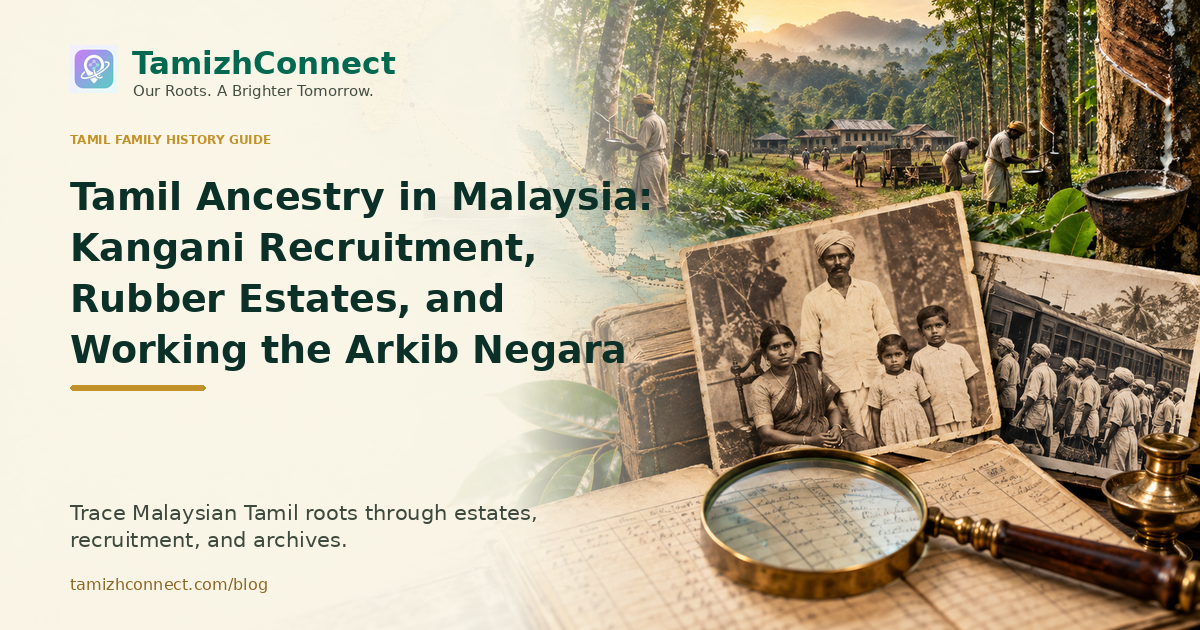
Malaysian Tamil ancestry sits on a different paper trail from the classic indenture destinations. Most Malaysian Tamil families didn’t arrive under the girmit or engagisme contract at all — they came through the kangani system, in which an experienced Tamil recruiter (the kangani) went back to his home district and brought over ten, twenty, or fifty people from villages he already knew. The kangani was paid per head recruited and often per year the recruits stayed on the estate. The record trail this produced is fragmented across estate-level papers, government migration registers, and the ledgers of the temples the community built almost as soon as they arrived.
This guide walks the layers as they exist today: the Arkib Negara Malaysia in Kuala Lumpur, the successor rubber-company records that hold estate-employee registers, the temple societies that pre-date the government archives, and the earlier Chettinad merchant migration that is a separate story with its own records. It also names the two things most family historians get wrong on their first pass — that kangani recruitment wasn’t indenture, and that the Chettinad and estate-labour streams don’t share the same archive.
The two streams that fed Malaysian Tamil communities
Two distinct migrations produced modern Malaysian Tamils. The older is the Chettinad merchant migration — Nattukottai Chettiar bankers, moneylenders and traders who established a presence in the Straits Settlements from the mid-nineteenth century, and across the Malay states through the late nineteenth and early twentieth. Chettiar records survive in different places from labour-migration records, and the family history workflow is entirely different — Chettiar family trees are usually kept by the family firm and by the community temples in Chettinad villages back in Tamil Nadu, and reach cleanly back through the eighteenth century for founding families.
The larger stream, and the one most Malaysian Tamil families descend from, is the estate-labour migration. Between roughly 1870 and 1938, Tamil labourers were recruited through the kangani system for the rubber estates that reshaped the Malayan interior — the Klang valley, the Kajang belt, Perak’s Kinta valley, Kedah and Johor. The peak decades were 1900–1930, when British planters expanded rubber acreage rapidly and the kangani recruitment network drew on established Tamil districts (Salem, Madurai, Ramnad, Trichinopoly) and their taluks.
A third smaller stream is the post-1948 professional migration — teachers, clerks, technicians and later medical professionals from Tamil Nadu and Jaffna into an urbanising Malaysian economy. That stream is documented through immigration records and employer files that survive in more familiar shape.
The Arkib Negara Malaysia
The Arkib Negara Malaysia in Kuala Lumpur is the primary government archive for the colonial period. It holds British Malaya administrative records for the Federated Malay States, the Straits Settlements and the unfederated states, including the Indian Immigration Department papers from roughly 1907 onward. Estate-recruitment registers, kangani licence records, and repatriation papers are all held here. The archive has a Malaysian Genealogy Centre that assists with family research; email enquiries answer within a few weeks for specific-ancestor lookups.
The pre-1907 kangani-era records are patchier. The Indian Immigration Department was formalised in 1907; before that, kangani recruitment happened with less government oversight and less documentation. If a family lore anchors on an ancestor who arrived before 1900, the estate-employer register at the specific estate is often the only surviving record — and many of those didn’t survive the interwar period.
The rubber-estate record layer
British planter companies employed most of the kangani recruits directly. Employer registers, wage books, and life-event records (marriages, deaths, births on the estate) were kept at the estate level rather than centralised. As estates changed hands over the twentieth century, these records dispersed — some went to successor companies (Sime Darby, Guthries and later Guthrie Berhad, Highlands & Lowlands, Kumpulan Guthrie), some went to the Rubber Research Institute of Malaysia archive, some to the Arkib Negara, and some were lost when estates were subdivided for the FELDA smallholder schemes from the 1950s onward.
For a specific family with a known estate anchor — “my grandfather worked at Batang Berjuntai” or “our family was at Kajang Ulu Semenyih” — a research request to the successor company and to the Arkib Negara for that district’s estate files is often the deepest source. The estate name itself is worth chasing down carefully: many estates changed names when they changed hands, and the modern name may not match what appears in colonial-era records.
Temple societies as an archive layer
Tamil communities on the rubber estates built temples almost as soon as they arrived. The Sri Mahamariamman temple network across the Klang valley, the Muneeswarar temples at estate boundaries, the Murugan temples on hilltops that anchored community identity — all of these hold membership rolls, marriage certificates, donation ledgers, and death registers that often reach further back than the formal government civil registration does. A Tamil family whose grandparents were on a specific estate through the 1920s and 1930s may find that the estate temple has records the Arkib Negara doesn’t.
The practical route is to identify the temple your family has historically been associated with and contact the temple committee (the koil manram). Membership records are often held by the current committee’s secretary. The larger temples — Batu Caves Sri Subramaniar Swamy, the Sri Mahamariamman on Jalan Bandar in KL, the various historic temples in Ipoh and Klang — have consolidated their archives; smaller estate temples may still hold the records on-site.
Searching the Tamil Nadu side
Malaysian kangani records typically name the village of origin (often as the taluk plus village) more consistently than the classic indenture records did — because the kangani knew the village, he named it precisely. Common recruitment districts were Salem (especially Attur, Namakkal, Rasipuram), Madurai (Melur, Usilampatti), Ramnad (Sivagangai, Karaikudi), Trichinopoly (Musiri, Manapparai), and to a lesser extent Chingleput and Tanjore.
Once you have a suspected village, reverse-lookup on Tamil Nadu voter records works the standard way. If a household with the same surname still lives in the village, a match is possible; multiple households means you need one more anchor (father’s name, deity, occupation) to narrow. The kangani migration pulled families in clusters — three brothers from the same village often arrived within a year of each other — so a Malaysian Tamil family often has multiple relatives from the same original village to cross-check against.
For the general reverse-lookup mechanic, see Find Tamil ancestors by village name.
Post-independence Malaysian Tamil identity
Malaysia’s Tamil community is around two million people today — the third-largest ethnic group in the country, and the largest Tamil-descent population outside India and Sri Lanka. Post-independence policy (the New Economic Policy from 1971, education-quota shifts, and the estate-fragmentation that came with FELDA and later privatisation) reshaped where Malaysian Tamil families lived. The Klang valley remains the largest urban concentration; Ipoh and the Kinta valley retain a historic community; smaller communities persist across Johor, Kedah, and the east coast.
Tamil-language schools (SJKT — Sekolah Jenis Kebangsaan Tamil) retain records of student enrolments going back to the founding of each school, often 60–80 years. For a family whose parents or grandparents attended a specific SJKT, the school’s enrolment records are a useful cross-reference against the wider family tree. The Malaysian Tamil press — Malaysia Nanban, Makkal Osai, Tamil Nesan — hold obituary archives going back decades that are the best source for post-1970 life-event records outside the civil registration.
Where to start
For estate-labour ancestry, the practical order is: identify the estate anchor if you have one, contact the Arkib Negara Malaysian Genealogy Centre with the ancestor’s name and estate, and in parallel contact the estate-associated temple committee for community records. For Chettinad merchant ancestry, the route is different — start with the family firm (if it still operates) and the Nattukottai Chettiar temple in the ancestral village in Chettinad, which usually holds the deepest lineage records.
For Tamil Nadu-side cross-referencing, search the Tamil Nadu voter records for the recruitment village once you have one. For context on the wider Tamil diaspora, see Tamil Ancestry: Tracing Tamil Roots.
This guide is maintained by TamizhConnect, drawing on the Arkib Negara Malaysia, successor plantation-company archives, and Malaysian Tamil temple societies. Corrections and additions welcome — contact us.