More Tamil labourers arrived in Mauritius under indenture than in any other single destination. The Mauritian archive holdings — the reason we can still trace individual arrivals more than 180 years after the first ship — are also the deepest and best-preserved of any indenture destination. If your family is Indo-Mauritian with Madras Presidency roots, the practical question is not whether the record exists but which of two archives holds the copy you need.
This guide walks the Mauritian arrival system in the order that works for a family historian starting from home: the Aapravasi Ghat as the entry point, the Immigration Archives at MGI Moka as the record layer, TamizhConnect’s III collection for the initial search, and the specific quirks (French transliteration, physical-mark descriptions, the immigration number as the anchor) that trip people up if you approach it like a British-only archive.
The scale and the timing
Mauritius received roughly 450,000 indentured labourers between 1834 and 1910 — the largest single-country total of the whole indenture era. Of that, around 240,000 arrivals were recruited from the Madras Presidency; the rest came from Calcutta and Bombay. The Madras stream is where Tamil, Telugu and Malayalam families in modern Mauritius originate. Tamil-descent Mauritians today are heavily concentrated in Port Louis, Rose Hill and Curepipe, with smaller established communities around Grand River North West and along the southern coast.
The 1834 Atlas arrival is where the whole “Great Experiment” of Indian indenture begins. The Atlas was primarily Calcutta-recruited, but Mauritian sugar planters shifted heavily to Madras through the 1840s and 1850s — the peak Tamil recruitment years — because the Madras Presidency’s famine cycles produced a larger pool of prospective recruits than Bengal did in the same window. If your ancestor arrived between 1843 and 1865, they came in the highest-volume phase of the Madras-to-Mauritius pipeline.
Aapravasi Ghat: where every one of the 450,000 landed
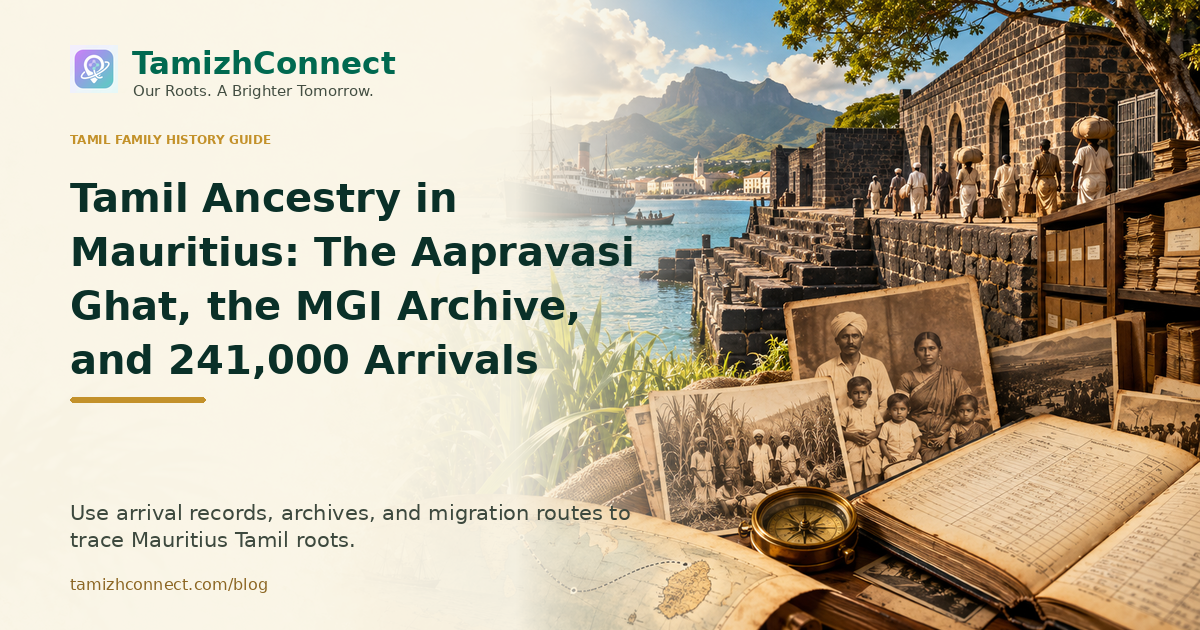
Every indentured labourer arriving in Mauritius passed through the Aapravasi Ghat depot in Port Louis before being assigned to an estate. The depot buildings still stand and are a UNESCO World Heritage Site since 2006. What matters for genealogy is that the depot generated the record: on arrival, each labourer’s name, age, physical description, native village, father’s name, ship, and indenture number were recorded on the depot register.
Aapravasi Ghat itself doesn’t hold the archive today — the Aapravasi Ghat Trust Fund maintains the site and runs interpretation, but the actual paper record is held at the Mahatma Gandhi Institute (MGI) in Moka. A visit to Aapravasi Ghat is worth making for context (the depot rooms, the entry stairs, the memorial to arriving families); the record search happens at the MGI.
The Mahatma Gandhi Institute Immigration Archive
The Immigration Archive at MGI Moka holds the master collection of Mauritian indenture records. The archive has digitised a substantial share of the ship-register images and made them searchable by name and immigration number. For most Tamil-descent Indo-Mauritian families, this is the primary source.
The MGI archive has two habits of record-keeping that most other indenture archives don’t share. First, physical-mark descriptions were captured in detail: scars, tattoos, missing digits, distinctive marks that colonial administrators used to identify labourers across contracts. These are macabre to read but genuinely useful for family historians — if two Muthusamys with the same father’s name arrive within a year of each other, the physical marks often disambiguate. Second, French transliterations were used alongside or instead of English on many records: “Muthu” became “Mootoo,” “Perumal” became “Peroumal,” “Nagappan” became “Nagapen.” The two spellings can coexist on the same person’s record depending on which clerk wrote it.
The immigration number — a unique per-person identifier assigned at the Aapravasi Ghat depot — is the anchor for the whole system. Once you have an immigration number for one ancestor, everything else radiates out: same-ship passengers with numbers in the same range, siblings assigned to the same estate, later children whose birth records reference the parent’s immigration number.
What TamizhConnect indexes
TamizhConnect ingests the III (theiii.in) collection under the provider code III, which holds roughly 241,000 Mauritian arrival records covering 1834–1910. Search at tamizhconnect.com/indenture-search with country filter set to Mauritius. Each record carries the immigration number, name (in both English and French spellings where the source captured both), ship, arrival date, father’s name, age, and often the native village and physical marks.
The III collection is deep but not complete — it covers the ship-register layer well and the estate-assignment layer less fully. For estate-assignment records (which estate a labourer was bound to, how long they stayed, what their post-indenture destination was), a follow-on lookup at the MGI Immigration Archive is often needed. Emails to the archive answer within a few weeks for specific-ancestor lookups; provide the immigration number if you have it, otherwise the ship and arrival year.
Searching, in the order that usually works
Start with the surname if you have one that’s not extremely common. Common Tamil surnames in Mauritius run in a specific pattern: Naidu (and its French drift Naidoo, Nayudou), Perumal, Pillai (Pillay in the French drift), Chettiar, Mudaliar, Padayachi, and Nadar. If your surname is one of these, filter by ship or arrival year immediately — Mauritian datasets are large enough that a bare surname search on Perumal returns thousands of rows.
Add the father’s name early. On Mauritian records the father’s name is captured with unusual consistency (more so than on Natal or Fiji records), which makes it the single most valuable disambiguator. If the father’s name is also common (Muthusamy is a father-name in every generation), fall back to the ship + year filter next.
French transliteration matters. If a Mauritian family lore anchors on a name that’s Franco-Tamil (“Ramalingam” as “Ramalingom”, “Subramaniam” as “Soubramanien”), search both spellings — the archive holds both versions of some records but only one for others. A phonetic variant is often the reason a first search returns nothing.
The village question
Mauritian records name the native village more often than Fiji or Natal records do — the depot clerks captured village-level detail as part of the identification pattern. When present, the village name was recorded in phonetic English (or French) transliteration and often survives close to the modern Tamil Nadu spelling. Chingleput, North Arcot, South Arcot and Trichinopoly are the recruitment districts that fed Mauritius most heavily; if a family lore names a village in one of these regions, the arrival record probably confirms it.
Reverse-lookup on the Tamil Nadu side works the same way as for other destinations. Take the village name from the Mauritian record and search the Tamil Nadu voter records for households in that village. Common surnames returning multiple households means you need one more anchor (father’s name, deity, occupation) to narrow; a rare surname returning one or two households is often a direct match to a living cousin.
For the broader village-to-family reverse-lookup mechanic, see Find Tamil ancestors by village name.
Post-indenture Mauritius
Most Mauritian indentured labourers did not return to India — the return rate ran around 20% across the whole 1834–1910 window, lower than for Fiji or Trinidad. Those who stayed took up small-scale sugar-cane cultivation, transitioned into shopkeeping and trades, or (from the 1870s onward) moved into administrative and clerical jobs as the colonial economy diversified. Modern Indo-Mauritians are around 68% of the country’s population, of whom the Tamil, Telugu and Malayalam-descent share is substantial.
Post-indenture records — civil registration for births, marriages and deaths — begin systematically from 1868 and are held at the Civil Status Division in Port Louis. Church records for Tamil Catholic families (a large community in Mauritius, following pre-indenture Portuguese and French missionary presence in the Madras coastal districts) are held by individual parishes; the Diocese of Port Louis archives hold consolidated copies from around 1850. Temple records for Hindu families are held by the individual temples — the Kaylasson temple at Sainte Croix, the Marie Reine de la Paix, and the various village-scale temples across the sugar belt.
Where to start
Search the Mauritian arrivals on indenture-search for your surname and the country filter. If the family name is common, add the father’s name or an approximate arrival decade before scrolling — Mauritius is the largest single dataset in the whole system and unfiltered searches on common names return unhelpfully broad results.
Once you have a candidate record, save it to your family tree and use the immigration number as the anchor for the next set of searches: same-ship passengers, siblings assigned to the same estate, later children in the civil registers. Cross-reference the village on the record against the Tamil Nadu voter search to identify potential living relatives who never left.
For context on the wider indenture picture — why Mauritius took the largest share of Tamil labour when Natal and Trinidad were competing for the same recruits — see Tamil Ancestry: Tracing Tamil Roots. For the ship-history angle, the Tamil diaspora research playbook covers the vessel-lookup pattern in more detail.
This guide is maintained by TamizhConnect, drawing on the Mahatma Gandhi Institute Immigration Archive at Moka, the Aapravasi Ghat Trust Fund, and the III (theiii.in) collection. Corrections and additions welcome — contact us.