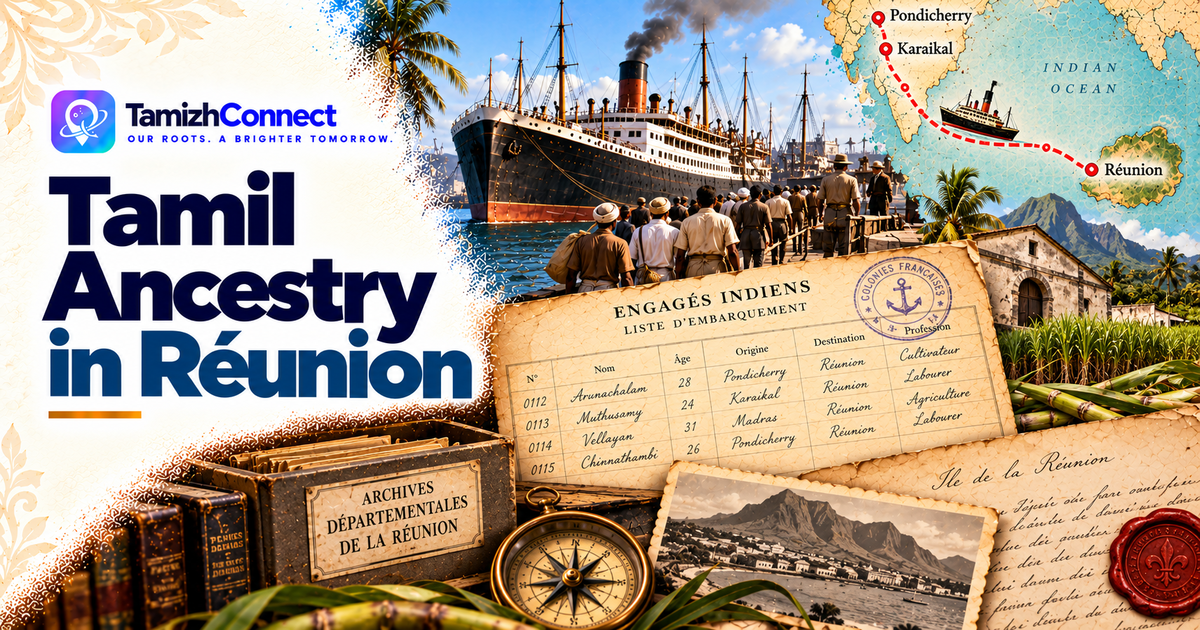
Réunion — the French overseas department in the Indian Ocean — has one of the deepest and most continuous Tamil communities in the diaspora, and one of the most French-inflected paper trails. Between 1848 and 1892, French planters recruited between 80,000 and 100,000 Tamil labourers under the engagisme system, the French counterpart to British indenture. The vast majority came from the French-administered enclaves of Pondicherry, Karikal, Mahé and Yanam, and from the greater Coromandel coast of Madras Presidency.
This guide walks the record layers for Réunionnais Tamil (Malbars) families: the Archives Départementales de La Réunion in Saint-Denis, the French-side departure records at the Archives Nationales d’Outre-Mer in Aix-en-Provence, the Pondicherry-side records at the Institut Français de Pondichéry, and the temple societies of the modern Malbars community that hold the deepest continuous community records.
The scale and the timing
Réunion’s engagisme era formally begins with the abolition of slavery in the French colonies in 1848. Sugar planters, facing the loss of the enslaved workforce, turned to indentured labour recruited from India, China, Madagascar and East Africa. The Indian recruitment quickly dominated, and by the mid-1850s the majority of arrivals were Tamil.
Recruitment ran heaviest through the French Indian enclaves — Pondicherry (Puducherry), Karikal (Karaikal), and to a lesser extent Mahé on the Malabar coast. This is significant because the French depots recorded arrivals differently from the British Madras depot: French administrative practice, French clerks, French transliteration. Names that appear as “Muthusamy” on British records appear as “Moutoussamy” on French; “Perumal” becomes “Peroumal”; “Ramanathan” becomes “Ramanaden.”
A smaller stream came from British Madras Presidency directly — recruits who travelled to Pondicherry or Karikal to sign on with a French planter. These arrivals appear on both the British departure record (if it survives) and the French arrival record.
Archives Départementales de La Réunion
The Archives Départementales de La Réunion (ADR) in Saint-Denis hold the arrival registers for engagisme-era Tamil labourers, the plantation-employer records, and the French civil registration that begins systematically in the 1850s. The archive has substantially digitised the arrival registers and made them searchable through its online portal. Coverage is deep from 1848 forward.
Each arrival record carries the labourer’s matricule — a unique numeric identifier assigned at the depot, functionally equivalent to the British “immigration number.” The matricule is the anchor for the whole engagisme record system: once you have a matricule for one ancestor, subsequent searches (same-ship arrivals, same-estate assignments, later civil-registration cross-references) all radiate from that number.
The French-side departure records
The Archives Nationales d’Outre-Mer (ANOM) in Aix-en-Provence hold the French colonial administration’s departure-side records for engagisme. The relevant series document recruitment through Pondicherry and Karikal, correspondence about specific labour contracts, and the ship manifests for engagisme voyages. ANOM has digitised substantial portions and is searchable online; for pre-1870 records the coverage is patchier.
For labourers recruited from the French Indian enclaves, the Institut Français de Pondichéry and the Bibliothèque Nationale de France hold additional documentation — Pondicherry-side administrative records, French East India Company papers that pre-date the French departmental period, and personal papers of nineteenth-century French colonial officials. These are more valuable for context and for tracing specific families than for bulk lookups.
The Malbars community and its temples
Modern Réunionnais Tamil identity — the Malbars community — has retained an unusually strong continuous cultural and religious presence for a colonial-era diaspora. Réunion has some of the oldest continuously-operating Tamil Hindu temples outside India, several dating to the 1850s and 1860s. The Temple Narassingua Peroumal at Saint-Louis, the Temple Kali at Saint-André, and the various Muniswaran and Amman temples across the island hold community records that pre-date most civil registration.
Fire-walking ceremonies (marche sur le feu) and the traditional festival cycle survived through the 150 years of French administration and are visibly practised today across the island — annual pilgrimages, temple festivals, and community events are attended by tens of thousands of Malbars families. This community continuity means that a Réunionnais Tamil family researching lineage often has both the archival records and the living community memory available.
Searching, in the order that usually works
Start with the ADR digitised arrival registers if the family has any known engagisme-era ancestor. Search on the French transliteration of the name first (Moutoussamy, Peroumal, Ramanaden), then try the English or Tamil spelling as a second pass. If a match returns, note the matricule immediately — it opens every subsequent search across the ADR collection.
For families whose lore anchors in the French Indian enclaves — “we came from Karikal” or “our family was from Pondicherry” — the second stop is ANOM in Aix-en-Provence for the departure-side records. These often name the specific village or quarter within the enclave from which the labourer was recruited, and cross-reference cleanly with modern Pondicherry and Karaikal civil registration.
For deeper lineage — pre-1848, into the enslaved-era and free-worker layers that preceded engagisme — the enslaved-people registers (indicateurs des affranchis) at the ADR are the primary source. A small share of Malbars families descend from labour who arrived before 1848; those records are indexed separately from the engagisme series.
The Tamil Nadu side
French-side records name the ancestor’s village more consistently than most British indenture destinations because the French depots at Pondicherry and Karikal were administratively closer to the labourer’s home taluks. When the village appears on an ADR record, it is usually recognisable in modern Pondicherry, Karaikal, Cuddalore, or Villupuram districts.
Reverse-lookup at Tamil Nadu voter records works the standard way for villages in Cuddalore and Villupuram districts. Pondicherry and Karaikal are Union Territory of Puducherry today, and their electoral rolls are held by the Puducherry Election Commission rather than Tamil Nadu’s — TamizhConnect’s voter dataset covers Tamil Nadu and Puducherry together, so a single search across the combined roll picks up either.
For the general reverse-lookup mechanic, see Find Tamil ancestors by village name.
Post-engagisme and the modern community
Engagisme ended in Réunion in 1892 and the last labourers arrived on the earliest 1890s ships. Return rates were low — around 15% across the whole 1848–1892 window — because Réunion never offered systematic return passages the way British colonies eventually did, and because the second-generation community had already put down roots by the time the option existed.
Modern Réunion has around 870,000 residents. The Malbars community is estimated at somewhere between 15% and 25% depending on the census definition used — a lower bound of roughly 130,000 and an upper bound closer to 200,000. The community is concentrated on the north and east of the island (Saint-Denis, Saint-André, Sainte-Marie) and in the sugar-belt villages. Post-1946 (when Réunion became an overseas department of France with full French citizenship for residents), migration to metropolitan France added around 70,000 Malbars to the diaspora in Paris and Marseille specifically.
Where to start
Search the ADR digitised arrival registers for your family’s ancestor names in French transliteration. Note the matricule when a match returns. For French-Indian-enclave recruitment, follow up at ANOM Aix-en-Provence. For temple-community records, contact the koil manram of the temple your family has historically been associated with.
Cross-reference the village or taluk on the arrival record against the Tamil Nadu voter search (or the Puducherry electoral rolls for Karaikal and Pondicherry). For wider context, see Tamil Ancestry: Tracing Tamil Roots.
This guide is maintained by TamizhConnect, drawing on the Archives Départementales de La Réunion, the Archives Nationales d’Outre-Mer in Aix-en-Provence, the Institut Français de Pondichéry, and the Réunionnais Malbars temple societies. Corrections and additions welcome — contact us.