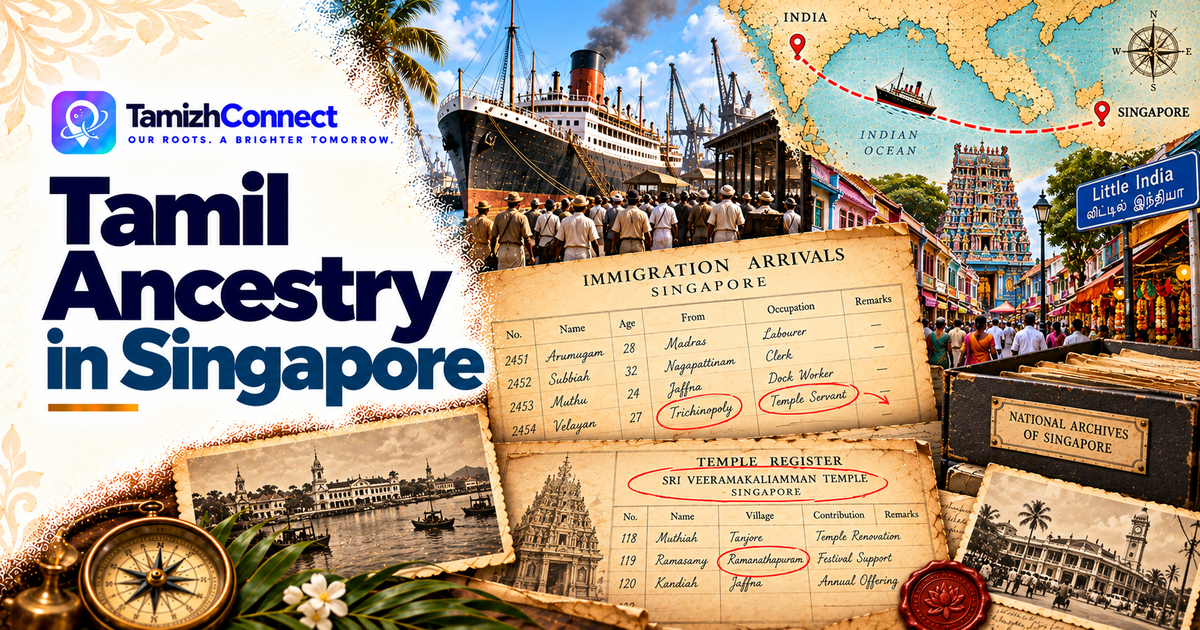
Singapore’s Tamil community is smaller than Malaysia’s but the record trail is denser — because Singapore has always been a compact urban space, and because the National Archives of Singapore has been unusually rigorous about preserving colonial-era administrative papers. If your family is Tamil Singaporean, the archives usually reach — the question is which layer to consult for which kind of record.
This guide walks the Singapore Tamil ancestry archive in the order that works for a family historian starting from home: the NAS, the historic temples of Little India that pre-date the systematic civil registration, the Chettiar Kittangi ledgers that reach into the nineteenth century for merchant families, and the post-independence civil-registration records that fill everything after 1965. It also names the specific dislocation window (1942–1945, Japanese occupation) that lost some records and the surname patterns that specific to Straits-Tamil creolisation.
The three streams that built Singapore Tamil identity
Modern Singaporean Tamils descend from three overlapping migrations. The earliest and smallest is the pre-1867 Straits Settlements period, when Tamil convict labour was brought from Madras Presidency to work on early infrastructure — the Padang, the government buildings, some of the roads — under a convict-labour system that pre-dated systematic indenture. Convict records survive at the National Archives of Singapore and at TNA Kew (CO 275 series).
The largest stream is the kangani-era estate and urban labour migration from roughly 1870 to 1940. The same kangani recruitment network that fed Malaya’s rubber estates supplied Singapore’s rubber processing plants, port labour, and the domestic and small-trade economy of Serangoon Road. Recruitment sources were similar — Salem, Madurai, Ramnad, Trichinopoly — with a slightly higher share from the Nagapattinam / Karaikal / Coromandel coast because Singapore’s shipping connection made those departure ports viable.
A third distinct stream is the Chettinad merchant migration, running in parallel with Malaya’s Chettiar establishment. The Chettiar community in Singapore concentrated at the Kittangi (compound) buildings along Market Street and later Chulia Street, running banking, moneylending and trade operations. Chettiar records are held by the community and are separate from the government archive layer.
The National Archives of Singapore
The NAS holds British colonial administrative papers, Indian Immigration Department records (from the 1907 formalisation onward), and post-independence civil registration. Its Oral History Centre also holds hundreds of recorded interviews with first-generation Tamil Singaporeans from the 1970s and 1980s — interview transcripts often name family villages, arrival years, and details that never made it into any written record.
The NAS has been unusually forward on digitisation. Substantial portions of the immigration register, community-association records, and colonial-era vital statistics are searchable online through the NAS Archives Online portal. For pre-1900 records the coverage is thinner (the Straits Settlements administrative papers of the mid-nineteenth century have some gaps), but from 1907 forward the paper trail is dense.
The Japanese occupation window (1942–1945)
Between the fall of Singapore in February 1942 and the return of British administration in September 1945, some record-keeping continued under Japanese occupation authorities and some did not. Colonial-era Indian Immigration Department papers were partially dispersed in the pre-invasion evacuation and partially destroyed. Post-war reconstruction of the registry took years, and the 1942–1945 window has genuine gaps for births, marriages, and deaths that occurred during the occupation.
The Indian National Army (INA) records from the same period are held partly at the NAS and partly at the National Archives of India. If your family had any INA involvement — Tamil Singaporeans were a significant share of the INA — those records are worth checking as a separate source that sometimes preserves personal details lost from the civil registers.
The Serangoon Road temples
Little India’s historic temples pre-date the systematic civil registration and hold community records that are the deepest source for pre-1900 Tamil Singaporean families. The Sri Veeramakaliamman temple (founded 1881), the Sri Srinivasa Perumal temple (Serangoon Road, 1855) and the Sri Vadapathira Kaliamman temple all hold founding-family registers, donation ledgers and life-event records going back to the founding decades.
The Sri Mariamman temple on South Bridge Road — the oldest Hindu temple in Singapore, founded 1827 by Naraina Pillai — has records reaching into the earliest phase of Tamil settlement. For a family with any Chettiar or early-Tamil-merchant background, this temple’s registers are often the earliest surviving mention of the family.
The Kittangi ledgers
Chettiar business families in Singapore maintained ledger books (kittangi account books, also called ola chuvadi when written on palm leaf) that recorded loans, business transactions, and family events. Many of these ledgers survive in family holdings across Singapore and Chettinad (in Tamil Nadu). They are the most detailed pre-1900 record layer for Chettiar Singaporean families, and often the only place where the founding-generation arrivals are named.
Access to Kittangi records is family-controlled — they are not held at the NAS or any public archive. Chettiar community organisations (the Nattukottai Chettiars’ Temple Society at Tank Road, the various Nagarathar Sangams) sometimes maintain consolidated records for members who have donated papers; a research request through the temple society is often the first productive contact.
Searching the Tamil Nadu side
Singapore’s Indian Immigration records name the ancestor’s district and often the taluk or village. Recruitment concentrated in Nagapattinam (which had the closest departure port to Singapore), Ramnad, Madurai, and Salem districts. Chettiar families almost always name the specific Chettinad village (Kanadukathan, Karaikudi, Devakottai, Pallathur are the most common).
Once you have a suspected village, reverse-lookup at Tamil Nadu voter records works the standard way. For Chettinad families, the reverse-lookup is often especially productive because Chettiar villages have small populations and the ancestral house often still stands and is still associated with the family name.
Post-independence Singapore
Modern Singaporean Tamils are around 5% of the population — roughly 350,000 people. The community concentrates in the historic Serangoon Road area (which is now Little India as a heritage precinct), and in the various HDB estates across the island. Post-independence Singapore’s civil registration is systematic from 1965 onward and is held at the Immigration & Checkpoints Authority and the Registry of Births and Deaths.
Later professional migration from India and Sri Lanka has added to the community since the 1990s. Second-generation and later Tamil Singaporeans often maintain family ties back to specific Tamil Nadu villages or Sri Lankan hometowns that are worth documenting in the tree as anchor points — Singaporean policy makes it relatively easy to visit and maintain these connections, which family historians can use to build village-side documentation.
Where to start
Search the NAS Archives Online portal for your family surname and known ancestor names. In parallel, identify the temple your family has historically been associated with and contact its koil manram for community records. For Chettinad families, the Nattukottai Chettiars’ Temple Society at Tank Road is often the most productive first contact.
Cross-reference Tamil Nadu villages on Tamil Nadu voter records to identify potential living cousins in the ancestral village. For wider context, see Tamil Ancestry: Tracing Tamil Roots.
This guide is maintained by TamizhConnect, drawing on the National Archives of Singapore, the Serangoon Road temples’ community records, and the Chettinad Kittangi archives. Corrections and additions welcome — contact us.