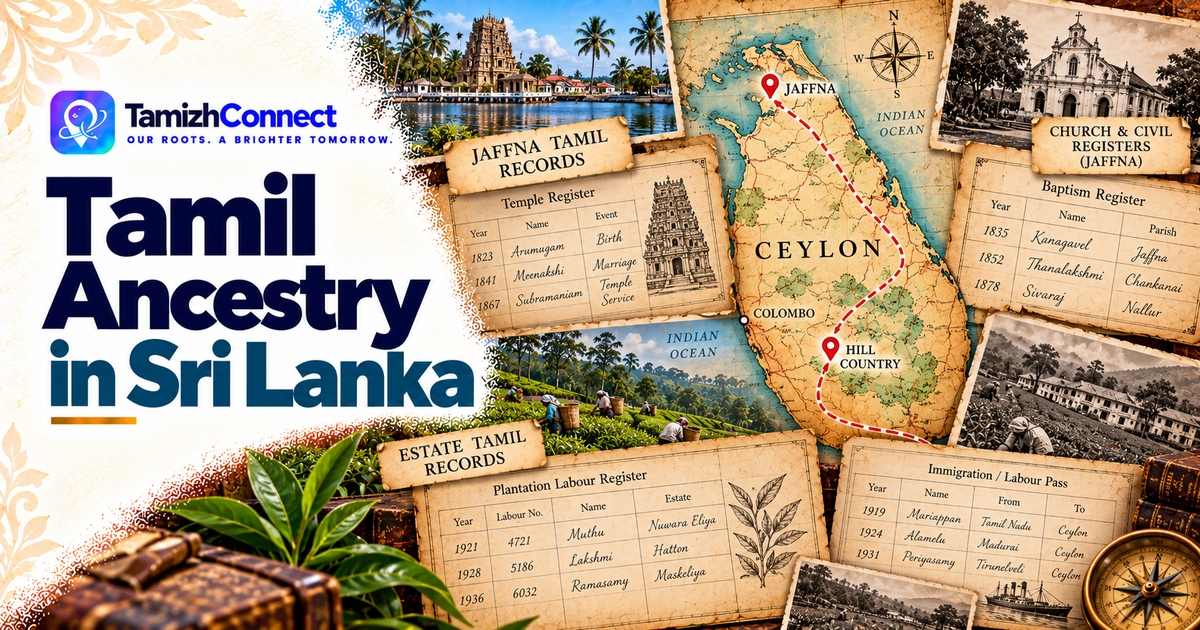
Sri Lankan Tamil ancestry splits sharply into two communities with different histories, different recruitment patterns, and different archives. The Jaffna Tamils have been present in the north and east of the island for centuries — some family lineages reach into pre-colonial records via temple palm-leaf ledgers. The Estate Tamils (also called Up-country Tamils or Malaiyaha Tamils) descend from labour migration to the Ceylon tea and coffee estates between roughly 1830 and 1930, recruited from the same Tamil Nadu districts that fed the classic indenture destinations.
This guide covers both threads. For Jaffna Tamil families, the record layer is the temple palm-leaf records, the Dutch-era church registers of the maritime districts, and the Jaffna District Kachcheri archives. For Estate Tamil families, the record layer is closer to the Malaysia kangani model — plantation employer records, the Ceylon Indian Immigration Department papers, and the post-1948 citizenship-registration records that document who did and didn’t get recognised as citizens after independence.
Jaffna Tamils: the ancient community
The Jaffna Peninsula and the eastern coast (Batticaloa, Trincomalee, Vanni) have hosted Tamil-speaking communities for at least two thousand years — the earliest inscriptions in Old Tamil script in the region date to before the Common Era. Documented family lineages in specific villages, held on palm-leaf temple ledgers, can reach eight to twelve generations for founding families. This is a different research problem from indenture-diaspora ancestry entirely.
The core record sources for Jaffna Tamil families:
Temple palm-leaf ledgers (ola chuvadi) survive at many of the historic temples across the Jaffna Peninsula. The Nallur Kandaswamy temple, the Maviddapuram Kandaswamy temple (also spelt Mavittapuram), and dozens of village temples hold donation ledgers and lineage records that pre-date all colonial documentation. Access is through the temple’s koil manram and often requires community introduction.
Dutch-era church registers, held partly at the Sri Lanka National Archives in Colombo and partly at the church-parish level, document Tamil Christian families from the seventeenth century onward. The Dutch Reformed Church converted a significant share of coastal Tamil families in the seventeenth and eighteenth centuries, and their baptism, marriage and death registers survive for many parishes.
The Jaffna District Kachcheri archives hold British colonial administrative papers from 1796 onward, including revenue records, land settlement documents, and post-1900 civil registration. These sit alongside the pre-British Dutch-period administrative records for the same district.
Modern civil registration in Sri Lanka is systematic from around 1867 and is held by the Registrar-General’s Department. For Jaffna Tamil families with unbroken village presence, the combination of civil registration plus temple records reaches deep enough to build documented trees back to the eighteenth century for many households.
Estate Tamils: the labour-migration community
Between roughly 1830 and 1930, Tamil labourers were recruited from Tamil Nadu districts to work on the coffee estates (later tea estates) of the Ceylon hill country. Recruitment used a kangani-style system similar to the Malaysian model — an experienced Tamil recruiter went home to his district and brought over families he knew. Peak recruitment was 1870–1930, when Ceylon’s tea industry expanded dramatically.
Recruitment sources concentrated in Trichinopoly (Tiruchirappalli), Ramnad, Madurai, and Tanjore districts, with smaller streams from Salem and North Arcot. Estate Tamil family lore often names a specific hometown at the taluk level; some name the village.
The Ceylon Indian Immigration Department was formalised in 1907 and its records are held at the Sri Lanka National Archives. Estate-employer records for the major planter companies (Whittall, Boustead, Lipton’s original tea estates) survive at varying completeness — some are consolidated at the National Archives, some at the Tea Research Institute of Sri Lanka in Talawakelle, and some at the successor plantation companies that operate today.
The 1948 Ceylon Citizenship Act and its aftermath are a critical documentary window for Estate Tamil families. The Act made it difficult for Indian-origin Tamils to establish citizenship, and hundreds of thousands were classified as stateless for decades. The Sirimavo-Shastri Pact of 1964 negotiated repatriation of a portion of the community to India; subsequent legislation gradually extended citizenship to those who remained. The documents generated by this process — citizenship applications, repatriation registers, ration cards, estate certificates — are held at the Department of Immigration and Emigration in Colombo and at the Indian High Commission’s historical files.
What TamizhConnect covers
TamizhConnect indexes the UK Colonial Office Ceylon papers under provider code TNA_CEYLON. Search at tamizhconnect.com/indenture-search with the country filter set to Ceylon (Sri Lanka). Coverage is the ship-manifest and Colonial Office correspondence layer, which is most useful for Estate Tamil families arriving in the pre-1900 window.
Jaffna Tamil records — pre-dating the indenture era and belonging to a different documentary tradition — are not indexed in the same collection. For Jaffna Tamil ancestry, the primary research path is through Sri Lankan sources directly: the National Archives in Colombo, the Jaffna District Kachcheri, and the temple societies. Chennai’s British Council library and the Roja Muthiah Research Library also hold some Sri Lankan Tamil community records from the twentieth century.
Searching, in the order that usually works
For Estate Tamil families, start with the estate anchor if you have one. “My grandmother worked at Nuwara Eliya” or “our family was at Bogawantalawa” narrows the recruiting-district and arrival-decade search substantially. The Ceylon Indian Immigration Department records, cross-referenced with the estate-employer registers, usually reach.
For Jaffna Tamil families, start with the ancestral village or the temple. Village-level community identity is stronger in Jaffna than in most Tamil diaspora contexts, and the temple koil manram usually knows the founding families of the village going back generations.
For families in the diaspora further out (Sri Lankan Tamil communities in Toronto, London, Melbourne, Kuala Lumpur), the family tree usually pauses at the Sri Lankan generation and needs Sri Lankan-side research to push further back. The London-based Tamil community associations and Toronto’s Sri Lankan Tamil archives often preserve records that survived the 1983 civil-war dislocation better than the equivalent records in Sri Lanka itself.
Where to start
For Estate Tamil families with a plantation anchor, search Ceylon indenture-search and cross-reference the recruitment village against the Tamil Nadu voter search. For Jaffna Tamil families, the primary path is Sri Lankan sources directly — the National Archives in Colombo, the Jaffna District Kachcheri, and the ancestral temple’s koil manram.
For context on the wider Tamil diaspora, see Tamil Ancestry: Tracing Tamil Roots.
This guide is maintained by TamizhConnect, drawing on the Sri Lanka National Archives, the Jaffna District Kachcheri, the Tea Research Institute of Sri Lanka, and the temple societies of both the Jaffna Peninsula and the hill country. Corrections and additions welcome — contact us.