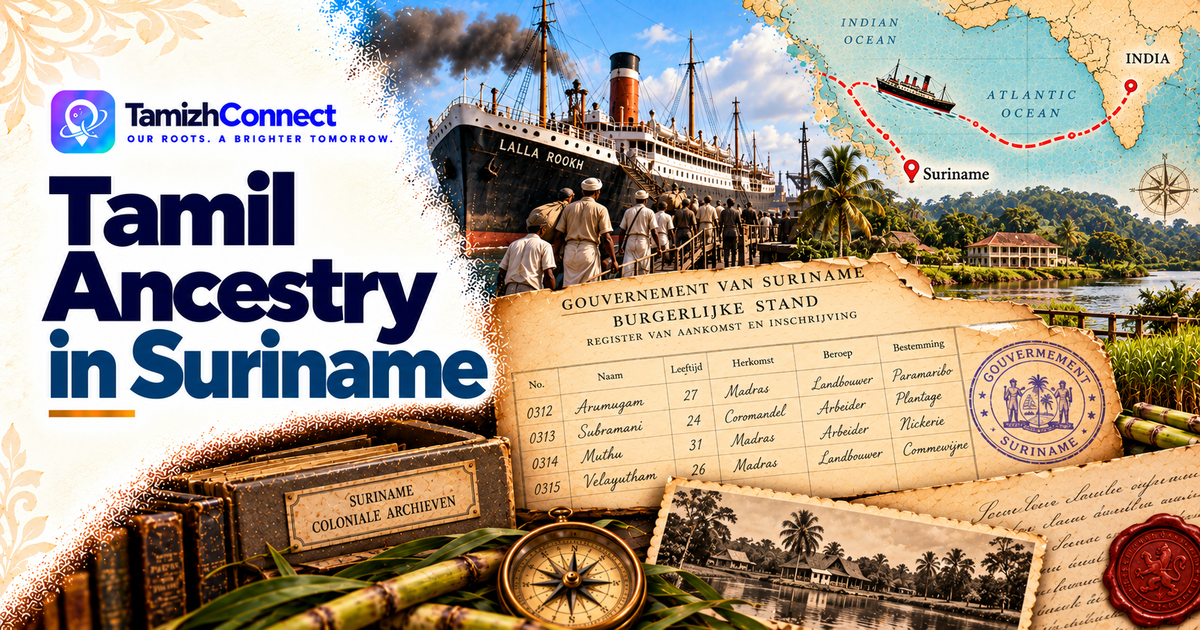
Suriname received around 34,000 indentured Indian labourers between 1873 and 1916, of whom the great majority were recruited through the Calcutta depot from the Bhojpuri-speaking belt. A small minority — probably in the range of 3,000 to 5,000 arrivals — came from the Madras Presidency. The record trail for both is unusually well-preserved for a South American colony because the Dutch administrative system prioritised civil registration and the Nationaal Archief in The Hague inherited the Dutch-East-India archive with unusual continuity.
This guide walks the Surinamese record layers as they exist today: the Nationaal Archief in The Hague, the Suriname National Archives in Paramaribo, and the Surinamese civil-registration series that TamizhConnect indexes. It also names the first-ship anchor point (the Lalla Rookh, June 1873, Calcutta-recruited so not Tamil), the Dutch-language layer that trips up first-time researchers, and the surname-drift pattern specific to Sranan Tongo phonetics.
How Tamil arrivals fit in
Surinamese indenture began in 1873 with the arrival of the Lalla Rookh in Paramaribo on 5 June, carrying 399 labourers recruited from Calcutta. The Lalla Rookh and the ships that followed through the 1870s were dominated by Bhojpuri-speaking recruits from Bihar, Uttar Pradesh, and adjacent areas. The Madras stream was smaller and arrived on later ships, with peak Tamil recruitment for Suriname running from the 1880s through the early 1900s.
Recruitment sources in Tamil Nadu concentrated in the same districts that fed Trinidad and Guyana — Chingleput, North Arcot, South Arcot, Trichinopoly, Salem — with a slightly different volume mix reflecting the small overall Madras share. Tamil-descent Surinamese families are a minority within the broader Hindustani community, which is itself around 27% of Suriname’s total population today.
The Nationaal Archief in The Hague
The main archive holding for Surinamese indenture is the Nationaal Archief in The Hague, which inherited the Dutch colonial administrative records after Suriname’s independence in 1975. The relevant series are the Immigratie Departement papers, the colonial-government correspondence about individual indenture contracts, and the ship-manifest series that documents each arrival ship in detail.
The Nationaal Archief has been substantially digitised and is searchable online through the archive’s portal. Coverage is deep from 1873 forward and includes the full run of arrival registers, most estate-employer records, and the post-indenture civil registration that begins from around 1902 for the Asian communities.
The Surinamese civil-registration system (Burgerlijke Stand)
The Dutch administration extended civil registration (Burgerlijke Stand, BS) to Suriname’s Asian communities systematically from around 1902. Births, marriages and deaths from that point forward are recorded in a continuous series that TamizhConnect indexes under the provider code SURINAME_BS. Search at tamizhconnect.com/indenture-search with the country filter set to Suriname to browse the collection.
The BS is the largest single collection we ingest — roughly 905,000 records, spanning births, marriages and deaths for the whole Surinamese population from 1902 onward. Most records concern Bhojpuri-descent Hindustani families or Afro-Surinamese families rather than Tamil-descent families, but the Tamil minority is present and the records are unusually detailed by the standards of colonial civil registration.
A parallel collection — the SURINAME_SLAVEN slave registers — documents the enslaved population of Suriname from 1830 to 1863 (emancipation in Suriname’s Dutch colonial context). This is a different community from the indenture-era Indian arrivals, but for Afro-Surinamese families with any pre-1863 ancestry these registers are the primary source. TamizhConnect indexes them under provider code SURINAME_SLAVEN.
Language: everything is in Dutch
The Surinamese archive layer is entirely in Dutch, and specific to the archival practice of pre-independence Dutch colonial administration. Family historians working from English or Tamil often need translation support for the older records. Modern Dutch-Surinamese archive staff are used to research requests and answer email enquiries in English; the archive portal has some English-language navigation but the record content itself is Dutch.
Names on the records use Dutch-language transliterations of Tamil names, which drift differently from the English or French transliterations used at other colonies. “Muthusamy” often appears as “Moetoesami” or “Moetoesamy” in Dutch orthography; “Nagappan” appears as “Nagapan” or “Nakappan.” Try three or four spellings before concluding the record isn’t there.
The Suriname National Archives (Paramaribo)
The Suriname National Archives (Nationaal Archief Suriname) in Paramaribo holds the post-independence records and duplicates of some pre-1975 papers. For post-1975 civil registration, marriage certificates, and modern life-event records, this is the primary source. For pre-1975 indenture-era records, The Hague is usually the deeper holding, but the Paramaribo archive holds some estate-level papers and community-association records that The Hague doesn’t.
Since 2010, a joint programme between the two archives has been progressively unifying access — the Nationaal Archief in The Hague is the reference source for the pre-1975 window, and the Paramaribo archive handles the post-1975 register.
Post-indenture Suriname and the emigration wave
Indenture in Suriname ended in 1916. Return rates were relatively high — around 34% across the whole 1873–1916 window — because the Dutch administration offered subsidised return passages for a longer window than most other colonies did. The families that stayed took up small-scale rice cultivation on the coastal polders, later moving into shopkeeping and trades.
A large secondary emigration wave from Suriname to the Netherlands began in the late 1960s, accelerated around independence in 1975. Modern Surinamese-descent Hindustani communities in Amsterdam, The Hague, Rotterdam and Utrecht are substantial — probably around 175,000 people — and Tamil-descent Surinamese families who moved to the Netherlands often maintain family ties both to Suriname and (increasingly) back to India through the reconnection work that TamizhConnect indexes.
Where to start
Search Suriname indenture-search for your surname. If nothing returns, try one or two Dutch-transliteration variants (Moetoesami for Muthusamy, Piellaij for Pillai). If a candidate returns, cross-reference the native village on the arrival record against the Tamil Nadu voter search for present-day households with the same surname in that village.
For the deeper archive dive, the Nationaal Archief in The Hague is the primary source for indenture-era records. Email enquiries answer within a few weeks. For post-1975 records or community-association records, the Suriname National Archives in Paramaribo is the second stop.
For wider context, see Tamil Ancestry: Tracing Tamil Roots.
This guide is maintained by TamizhConnect, drawing on the Nationaal Archief in The Hague, the Suriname National Archives in Paramaribo, and the Surinamese Burgerlijke Stand civil-registration series. Corrections and additions welcome — contact us.