The question “what are second cousins?” doesn’t have a satisfying one-line answer. It has a definition (people who share great-grandparents), a common misconception (they’re one step further than first cousins in some vague way), and a nest of related terms that get confused with each other. This guide walks the actual definition, the counting rule that produces second-cousin status, and the Tamil kinship vocabulary that describes the same relationships in less abstract terms.
The definition in plain English
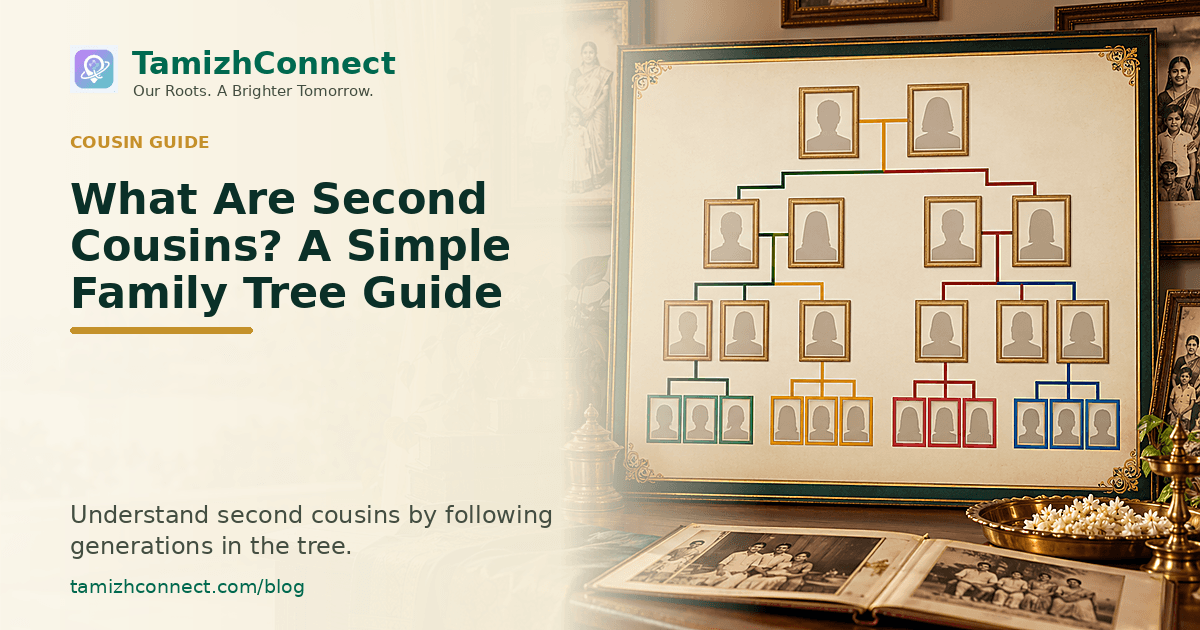
Two people are second cousins if they share great-grandparents but not grandparents. Their grandparents were siblings; their great-grandparents were the same couple.
Concrete example. Great-grandfather Muthusamy had two children: Perumal (grandfather A) and Rajammal (grandfather B, technically a great-aunt in this line). Perumal had a child, Kannan (parent A). Rajammal had a child, Selvi (parent B). Kannan and Selvi are first cousins because they share grandparents (Muthusamy and his wife). Kannan has a child, Ravi. Selvi has a child, Priya. Ravi and Priya are second cousins because they share great-grandparents (Muthusamy and his wife) but not grandparents.
Every additional generation of shared ancestry adds one to the “cousin number”:
- Same parents = siblings
- Same grandparents (but not parents) = first cousins
- Same great-grandparents (but not grandparents) = second cousins
- Same great-great-grandparents (but not great-grandparents) = third cousins
- …and so on for further generations
The counting rule
To determine the cousin number between two people, count the generations from each of them back to the closest shared ancestor. If both counts are equal AND they’re not siblings, use that count minus one as the cousin number.
Example:
- Ravi and Priya both go 3 generations back to reach Muthusamy (parent → grandparent → great-grandparent).
- 3 – 1 = 2, so they’re second cousins.
Another example:
- Ravi and his cousin Deepa both go 4 generations back to reach a shared great-great-grandfather.
- 4 – 1 = 3, so Ravi and Deepa are third cousins.
If the counts are different (one goes 3 generations back, the other goes 4), that’s where “removed” comes in — see our cousin once removed guide.
Why second cousins matter for family history
Second cousins are the boundary where “family we know” typically ends and “family we don’t know exists” typically begins. Most people know their first cousins by name; many don’t know their second cousins at all. Yet second cousins share ~3% DNA on average, are typically 1-3 years apart in age, and often live in the same region.
For Tamil family history research, second cousins are especially important because:
- The shared great-grandparents are the generation most Tamil families can still access via oral history (grandparents remember their own grandparents)
- Second cousins on the maternal and paternal sides often live in the same village, ancestral or migrated to same destination — clustering is common
- Extended-family gatherings for weddings, funerals, and festivals bring second cousins together, making outreach practical
- Second cousins are often the primary bridge to distant family branches you don’t yet know exist
Second cousins in Tamil kinship vocabulary
Tamil kinship terminology handles second cousins through descriptive constructions rather than a single term. The pattern:
- Athai magal / magan (first cousin — your father’s sister’s child)
- Athai magal-oda magal / magan (that first cousin’s daughter / son — your first cousin’s child)
- Then extending to second cousins: your grandfather’s sister’s grandchild would be “thatha’s athai’s peran / pethi”
The Tamil constructions are longer but more precise — they name the intermediate ancestors rather than using a numeric cousin label. In practice, most Tamil-speaking families call second cousins by given names (“Rajammal’s family”) rather than by kinship term, because everyone knows the family relationships already.
Cross-cousin vs. parallel cousin distinction still applies:
- Second cousins whose shared great-grandparents’ children were siblings of opposite sex = cross-lineage second cousins
- Second cousins whose shared great-grandparents’ children were siblings of same sex = parallel-lineage second cousins
Historically the cross- vs. parallel- distinction affected marriage eligibility (cross-cousin marriage was traditionally acceptable in Tamil communities; parallel-cousin marriage was not). Modern practice varies widely.
DNA and second cousins
DNA testing services (Ancestry, MyHeritage, 23andMe) can identify second cousins with reasonable confidence. Expected shared DNA:
- First cousins: ~12.5% (or ~880 centiMorgans)
- Second cousins: ~3.1% (or ~230 centiMorgans)
- Third cousins: ~0.8% (or ~55 centiMorgans)
The wide variance in second-cousin DNA (75-360 cM) makes DNA-only identification imprecise. A test result showing ~230 cM shared could indicate a second cousin, a first cousin twice removed, or a half first cousin. Cross-reference DNA matches with known family trees to confirm the specific relationship.
For Tamil family DNA research, second cousins are usually more informative than more distant matches because:
- The shared great-grandparents are often within oral-history reach, so DNA confirmation of the match usually connects to a known ancestor
- Second cousins in the same emigration cohort (both ancestors sailed from Madras in the same era) often reveal ship-cohort family connections
- Reconnecting with unknown second cousins via DNA often opens up whole family branches you didn’t know existed
Common second-cousin mistakes
Five patterns that confuse second-cousin identification:
- Confusing second cousin with first cousin once removed. Second cousins share great-grandparents (same generation as each other). First cousin once removed = your first cousin’s child, or your parent’s first cousin (different generations). Different relationships entirely.
- Assuming second cousins live far away. “Removed” implies distance to some ears, but second cousins are just as often local — same village, same suburb, same destination-country city.
- Missing the great-aunt/uncle link. Your second cousin’s parent is not your first cousin — they’re your parent’s first cousin, and by relationship to you, your first cousin once removed.
- Over-counting generations. The count is from each person back to the shared ancestor, not the total number of people in the family line. Ravi to Muthusamy is 3 generations (parent, grandparent, great-grandparent). Not 4, not 6.
- Assuming second cousin = second-degree relative. Genetics uses “second-degree relative” to mean grandparent / grandchild / aunt / uncle / half-sibling. Second COUSIN is a different concept — a fifth-degree relative in genetics terms. Different classification systems, different meanings.
Building the second-cousin branch on the family tree
To add second cousins to your family tree systematically:
- Identify each of your great-grandparents (all 8, ideally).
- For each great-grandparent, identify their children (your grandparent’s generation, including your grandparent’s siblings — your great-aunts and great-uncles).
- For each great-aunt/uncle, identify their children (your parent’s generation cousins — your first cousins once removed).
- For each of those, identify their children — those are your second cousins.
The count of potential second cousins can be large — one Tamil family with 4 great-grandparent couples, each with 3-5 children, could easily have 40-60 second cousins. Prioritize the branches your family maintains contact with; add the others as leads to investigate.
Answering “what are second cousins” is straightforward once the shared-great-grandparents rule clicks. From there, the rest of the cousin vocabulary — third cousins, fourth cousins, once/twice/thrice removed — follows the same counting logic. Get the second-cousin definition solid and the whole family-tree relationship map becomes tractable.