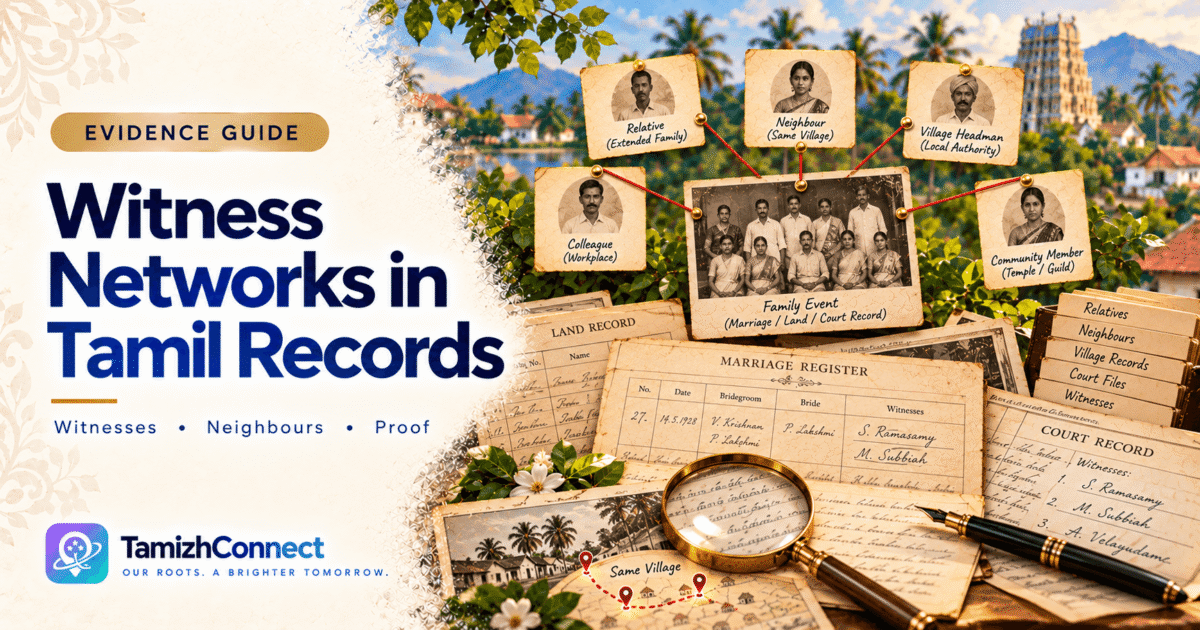
Amateur genealogy typically reads the fields of a record in order of obvious importance — the name of the person the record is about, the date, the place, the parents’ names — and stops there. The witness list at the bottom of most colonial-era records gets a quick glance and no further attention. This is a mistake. The witness list is often the second-most-valuable field on the whole document, and for Tamil records specifically, it opens up cluster relationships that no other source captures.
This guide walks the witness column across the Tamil-record classes where it appears most productively: Christian marriage certificates, Hindu temple donation deeds, colonial legal documents, land-registration papers, and naturalisation applications. It explains why witnesses were chosen the way they were, what their appearance tells you about the family relationships behind the paper, and how to use witness-network analysis to fill gaps that direct-ancestor search can’t reach.
Why witnesses were chosen the way they were
Understanding witness selection helps you read the witness list. Two rules underpinned most witness choices in colonial-era Tamil records:
Kinship precedence. When available, close kin (brothers, brothers-in-law, uncles, nephews) were preferred as witnesses. This wasn’t a rigid rule but a strong preference — a marriage certificate whose witnesses are two of the groom’s brothers is documenting both the marriage and the family structure. A marriage certificate whose witnesses are apparent strangers might be documenting a marriage where the close kin were absent, dead, or estranged.
Community precedence. Failing available close kin, witnesses were drawn from the same community — same-caste, same-village-of-origin, same-religion. A Tamil-Hindu labourer’s marriage in Natal witnessed by two other Tamil-Hindu labourers from the same estate is documenting community membership as much as the marriage itself.
These preferences mean the witness list is a directly-readable indicator of the family and community network around the person the record is about. Two brothers-in-law as witnesses tell you about the person’s spouse’s family. Three same-village co-emigrants tell you about the person’s origin cluster. A colonial administrator as sole witness tells you the family was under administrative supervision (a widow, an orphan, or a labour dispute).
Christian marriage certificates: the richest witness records
For Tamil Christian families (mostly in Chennai and Tirunelveli districts, and in colonial destinations with active missionary presence — Trinidad, Guyana, South Africa), marriage certificates from the 1870s onward almost always list four to six witnesses. The witnesses were chosen with genuine care because Christian marriage was legally binding under the Marriage Act and the witnesses vouched for the identity and consent of the couple.
What witness lists reveal on Christian marriage certificates:
The bride’s family. Convention put the bride’s father and brothers as first witnesses. If a bride’s father was deceased, her uncle or older brother took the role. A bride whose first witness is her paternal uncle is telling you her father was already dead by the marriage date.
The groom’s family. Convention put the groom’s father and brothers as second witnesses. Same rules apply for deceased or absent father — the pattern of witnesses reveals which male kin were available on the groom’s side.
Community endorsement. The last one or two witnesses were often community elders — church deacon, village head, senior labourer, or in the diaspora, the estate driver or bookkeeper. These indicate the couple’s standing in the wider community.
Cross-reference witness names across multiple marriage certificates in the same community and you can reconstruct a substantial network of extended families. If Muthusamy’s brother Ramasamy witnesses Muthusamy’s marriage, and then Ramasamy’s own marriage a few years later is witnessed by Kandasamy (another brother, previously unmentioned), you’ve now identified three siblings in Muthusamy’s generation.
Hindu temple donation deeds and the pattern of donor-witnesses
Tamil Hindu religious documents — temple donation deeds, kula deivam appointment papers, festival contribution registers — follow a different witness convention. Temples used witnesses to establish that donations were made freely, that donors had authority over the property being donated, and that community members endorsed the donation.
For genealogy, temple witness lists reveal community-of-worship connections that overlap significantly with family relationships. A donor whose witnesses at a Chennai-area temple in 1890 are three men with different surnames is telling you those three men were his community, likely his extended family or in-laws-through-daughters.
Village temple registers from Tamil Nadu often survive better than one might expect. The Tamil Nadu Archives holds many village-temple donation records dating back to the 1880s. A witness search across the temple records for a specific village produces a network that describes the village’s family structure with more depth than any secular record.
Colonial legal documents: property, inheritance, guardianship
Property transfers, inheritance disputes, and guardianship appointments generated colonial legal documents that required witnesses. Unlike marriage certificates (which had a fixed witness role), legal documents used witnesses more variably — sometimes as identity vouchers, sometimes as beneficiaries, sometimes as adversarial witnesses in disputes.
The most productive class for family research is guardianship documents. When a labourer died leaving minor children, the estate manager or the Protector of Immigrants appointed a guardian. The guardianship paper names the deceased, the children (with ages), the appointed guardian, and typically two or three witnesses vouching for the guardian’s fitness.
Witness selection on guardianship documents follows kinship precedence tightly — the guardian is almost always the deceased’s brother or brother-in-law, and the witnesses are typically the children’s uncles from the other side. A guardianship document from 1885 in Natal thus names four adult male relatives on both sides of the deceased’s family in one document.
Land-registration papers: witness as boundary marker
Tamil Nadu village land registration used witnesses in a specific way: witnesses were often the owners of adjacent land plots. This means the witness list on an 1890 patta document names your ancestor’s plot AND the names of his neighbours — who were often cousins, brothers-in-law, or same-community members.
For families that owned land in a Tamil Nadu village, the historical patta records held at the district land-records office (or, for some periods, at the Tamil Nadu Archives) contain witness networks that describe the local family structure in unusual detail. A patta from 1885 with four adjacent-plot-owner witnesses named X, Y, Z, and W is telling you the ancestor’s four immediate neighbours; a cross-check of X, Y, Z, and W across other village records will usually confirm their family relationships.
Naturalisation applications: the referee affidavit
Naturalisation applications (see our naturalisation guide) required two or three referees who swore to know the applicant. The referees were not called “witnesses” but functioned identically — vouching for identity and character.
Referee choice on naturalisation applications reveals the applicant’s professional and social network as of the application date. A South African Indian applicant in 1920 whose referees are his business partner and his brother-in-law is telling you two things: he was in business (naturalisation was often driven by business needs) and his brother-in-law was in the same locality. Both are family-history clues.
The systematic technique: witness network graphs
Sophisticated genealogy uses witness data to build network graphs. The workflow:
Collect the witness lists from every available record. Marriage certificates, temple deeds, legal papers, naturalisation applications. For each record, extract the subject’s name and the witness names.
Build a graph. Nodes are people; edges connect a person to everyone who witnessed a record for them. Draw the graph by hand for small families; use graph software (Gephi, Cytoscape, or spreadsheet-based network tools) for larger ones.
Look for clusters. Densely-connected sub-networks in the graph usually represent extended-family units. A cluster of eight people who witness each other’s records repeatedly is almost always an extended-family group across two or three generations.
Identify bridges. Some people appear in multiple otherwise-separate clusters. These are usually in-laws or community leaders who bridged multiple families. Identifying bridges tells you about marriage alliances across extended families.
The failure modes worth naming
Common names. A witness named “Ramasamy” without further identifiers could be any of hundreds of Ramasamys in the community. Witness-network analysis requires cross-referencing with age, address, occupation, and other identifying information to be sure you’ve matched the same person across records.
Colonial administrative witnesses. Some records list the recording officer as a witness — the notary, the magistrate, the priest. These are not family members and don’t carry genealogical weight; they’re the person whose signature made the record legal.
Missing witness lists. Some record classes (post-1960s civil records, informal community documents) don’t record witnesses systematically. The technique only works on records that took witnessing seriously — nineteenth and early twentieth century colonial documents mostly do.
The reward
A well-built witness network graph reveals the shape of your ancestor’s extended family in a way no single record could. It’s slow to build — extracting witness data from 20-30 records and cross-referencing them takes real time — but the resulting picture typically identifies three to five additional generations of family relationship beyond what direct-ancestor search alone reveals.
For Tamil families with paper trails in both India (temple + land records) and the diaspora (marriage + guardianship + naturalisation records), witness-network analysis is the technique that stitches the two halves of the family tree together. The witness lists at the bottom of the paper are, quite often, worth more than the fields at the top.