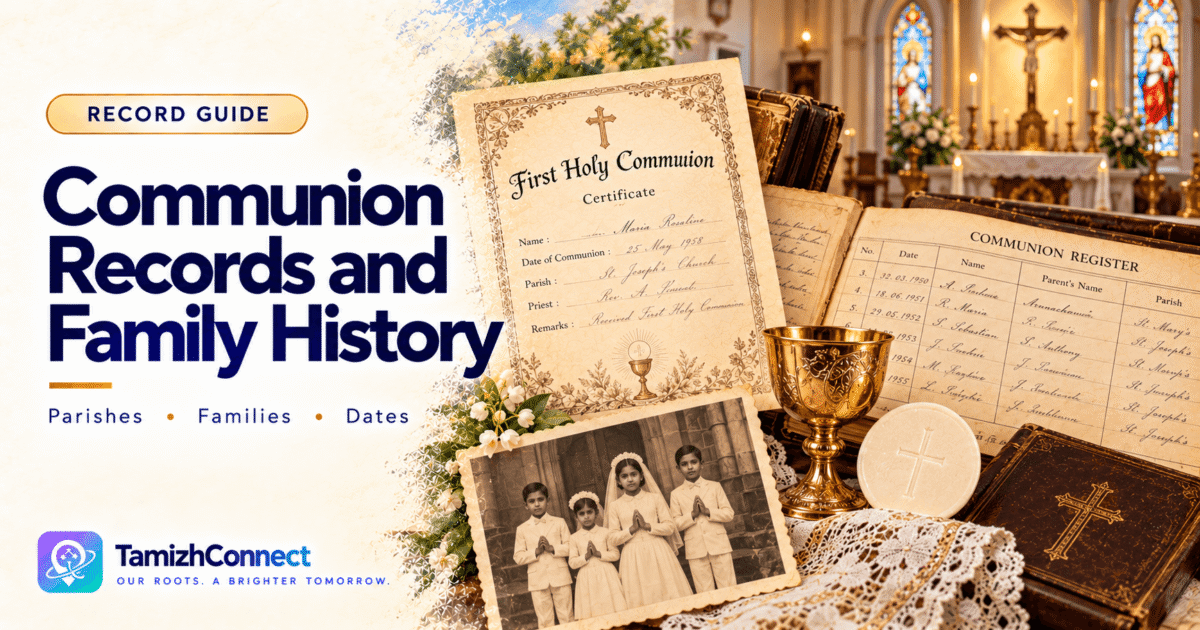
Communion registers are the strangest genealogy source in the Christian record tradition. Unlike baptism, confirmation, marriage, and burial — each of which happens once — communion is administered week after week, sometimes daily, for the ancestor’s entire Christian life. The register keeps a running record of who received the sacrament and when. For a Tamil Christian family with several generations at the same parish, the communion register contains hundreds of entries per person, spanning decades.
Amateur genealogy essentially never searches communion registers. Professional Tamil Christian research increasingly does, because the running weekly-or-monthly documentation captures family movement, marriage timing, illness, death, and community reintegration in ways single-event records cannot. This guide walks the structure of communion registers, the specific information they preserve, and the specific ways to extract genealogically useful patterns from them.
Why communion was recorded and by whom
Different Christian traditions recorded communion attendance for different reasons:
Roman Catholic parishes historically kept the “Status Animarum” — an annual (or more frequent) household-by-household record of who in the parish had confessed and received communion during the year. This was pastoral tracking, not just administrative. Non-communicants were noted (with reason, if known — illness, dispute, ex-communication).
Anglican / CSI parishes kept communion attendance lists tied to Christmas, Easter, and specific parish feast days. Regular attendance at these major communions was expected of active members; absence was noted and (in serious cases) followed up pastorally.
Lutheran (TELC) parishes kept confessional attendance records tied to the Lutheran tradition of confession-before-communion. These “Beichte” registers documented not just communion but the ongoing pastoral relationship.
Across all traditions, the shared thread: the parish tracked who was communing to identify who was in active pastoral care and who had drifted, moved, or died. This means communion registers are simultaneously spiritual records and community-attendance records — which is what makes them genealogically useful.
What a communion register contains
The typical Tamil Christian communion register from the 1870s onward has these features:
Date column. The communion date. Sunday services generate the bulk of entries; Christmas, Easter, and feast days generate high-attendance entries; weekday communions generate small entries.
Communicant name column. The full Christian name of each person receiving communion. Family members typically communed together and appear in the same visit.
Cluster patterns. Families communed as units. Muthusamy, his wife Mary, their three children, his elderly mother — all in the same entry cluster on the same Sunday. This clustering documents the family’s active household composition on a specific date.
Notes column (variable). Some parishes recorded exceptional notes — first communion after long illness, first communion by a returned migrant, first communion after re-admission following a discipline dispute. These annotations are genealogically valuable because they document specific life events.
Special-service notation. Confirmations, weddings, funerals with communion, and other services would generate distinctive entries clearly labelled. A wedding-communion entry from 1885 documents the couple’s first shared communion — often near the wedding date but not necessarily on it.
The specific genealogical uses
Communion registers add information no single-event record captures:
Ongoing family composition. The clustering of who communed together, week after week, documents the family’s household composition across decades. A pattern where a new child appears in family clusters starting in 1885 (child’s first communion probably) and disappears from clusters after 1892 (marriage into another family, or death) documents that child’s active parish membership.
Migration timing. A family whose communion records at Parish A run continuously 1860-1880 and then abruptly stop, with the same family appearing in Parish B’s register from 1881, documents the family’s move between the two parishes at a specific date. This is often the only record of intra-district family movement.
Return-from-diaspora documentation. A family with communion records at Palayamkottai 1855-1875, then a 20-year gap, then resumed records 1895-1920, tells you the family emigrated 1875 (probably to a colonial destination for indenture) and returned in 1895. The specific return-date is capturable only from the communion register.
Illness and mortality signals. A regular communicant suddenly missing for months, then returning with the “first communion after illness” annotation, documents a health event. Sudden permanent absence from communion records — with a following burial register entry a few weeks later — documents death timing precisely.
Community discipline events. Some parishes recorded when a communicant was suspended or re-admitted after a discipline case (marriage dispute, community disagreement, doctrinal disagreement). These annotations are rare but genealogically valuable when they exist.
Where surviving communion registers live
Communion registers are generally held at the specific parish archive, not consolidated at diocesan level (unlike baptism / marriage / burial registers which were more likely to be centralised):
Active parish archives. Most Tamil Christian parishes still holding regular services retain their historical communion registers. Access is typically through the parish priest / pastor.
Closed-parish records. When a parish closed, its records typically transferred to the local diocesan archive. CSI, RC, and TELC diocesan archives hold closed-parish records for the parishes in their district.
Mission society archives (UK / US). Some early-mission communion registers were sent as duplicates to the mission society home office. CMS archive at Birmingham and SPG archive at Oxford hold selected communion registers, particularly for high-profile early-mission parishes.
Diaspora parish archives. Destination-country parishes where Tamil Christian families relocated retain their own communion registers. Anglican Church of Southern Africa parishes for South Africa Tamil Christians; various Catholic and Anglican parishes in Trinidad, Fiji, and Guyana for those diasporas.
The under-searched status: why it matters
Communion registers are enormous — a parish with 100 active members over 50 years generates 250,000-500,000 individual entries. This scale is why they’re under-searched: no digital index exists for most, and manual reading requires a research visit and substantial patience.
But the payoff is unique. Every other Christian record type is a snapshot; communion is a running film. For Tamil Christian families where continuous parish membership is documented across generations, the communion register is often the only source that captures:
The specific date a family moved between parishes. The specific date an emigrant returned from the diaspora. The specific date a child began communing (first communion). The specific date an elderly family member stopped communing (illness or death). The specific weeks a family attended together (marriage timing, cohabitation patterns). The specific community-of-belonging that surrounded the family (who they communed alongside).
The systematic research technique
Given the register’s scale, the systematic approach:
Step 1: Identify the specific parish. Family oral history or baptism/confirmation records identify the parish. Multiple parishes in the family history require checking each register separately.
Step 2: Identify the specific years to search. Rather than reading the whole register, identify years of interest — around known events (birth, marriage, death) or specific decades where the family was active. A year at a time is manageable.
Step 3: Read the register looking for family cluster patterns. Extract the family clusters (Muthusamy + Mary + children) across the years. Note dates when the cluster changes composition — child appears, child disappears, elder appears, elder disappears.
Step 4: Cross-reference cluster changes with other records. When a new person appears in a family cluster, check baptism records for a first-communion event around that date. When someone disappears, check marriage records (moved to another family), burial records (died), or emigration records (left the country).
Step 5: Document what the pattern reveals. The cluster analysis reveals family composition over decades — often the ONLY source of month-by-month composition changes for pre-1900 Tamil Christian families.
The reward for the effort
Communion register research is slow and requires physical access. But for Tamil Christian families with continuous parish membership, it produces a level of documentation no other source approaches — a decade-by-decade family composition, community integration, movement, and life-event timeline that no arrival register, no civil registration, no oral history can match.
For serious research, consider communion register review after baptism, confirmation, and marriage records have been exhausted. It’s the “next-level” source for Tamil Christian family research — the source that turns a family tree into a family life.
Combine with our witness networks guide (marriage / baptism sponsors) and cluster research guide for the most complete Tamil Christian family reconstruction possible.