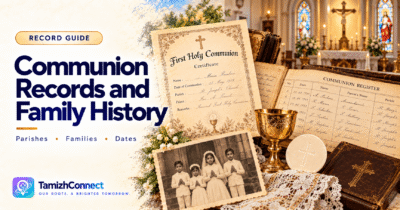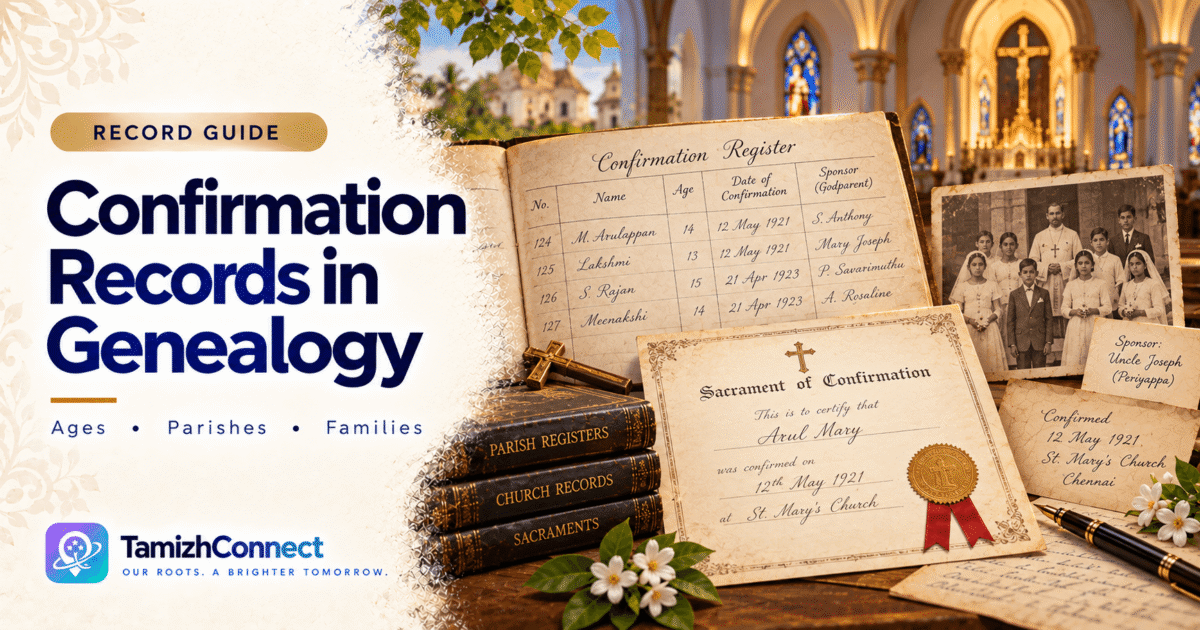
Confirmation records get less genealogy attention than baptism or marriage records because confirmation isn’t a “life event” in the Western civil-registration sense. It doesn’t create a new legal person. It doesn’t join two families. But for Tamil Christian family research, confirmation records occupy a specific and useful gap in the documentary record — they capture the ancestor at ages 12-16, name the confirming bishop and sponsors (typically different from baptismal sponsors), and often show the family’s parish at a specific point that no other record captures.
This guide walks the specific structure of Anglican, Catholic, and Lutheran confirmation records as kept in Tamil Christian traditions, the information they add beyond baptism, and the surviving deposits worth searching. Confirmation records are the underused workhorse of Tamil Christian genealogy — worth learning to read.
What confirmation is and when it happened
Confirmation is the Christian sacrament that “confirms” a person’s baptismal identity. Different traditions administer it at different ages:
Anglican / Church of South India. Traditionally administered by a bishop to candidates aged 12-16, following a period of catechism preparation. Modern practice is similar; the bishop’s rare visits to any given parish mean confirmations were batched — dozens of candidates confirmed in one visit.
Roman Catholic. Traditionally administered by a bishop to candidates aged 7-14 (before Vatican II) or 12-18 (modern practice). Again batched around episcopal visits.
Lutheran (TELC). Administered by parish pastors (not requiring a bishop in the Lutheran tradition) to candidates aged 14-16 following intensive catechism instruction. Less batched than Anglican/RC; more parish-level records.
Because confirmations were batched around bishop visits, a single confirmation record often lists 20-100 candidates confirmed on the same day at the same parish. This makes confirmation records genealogically distinctive: they capture an entire cohort of the parish’s teenagers on one date, revealing peer networks that no other record captures.
What a confirmation record contains
The typical Tamil-Christian confirmation entry, following the format most Anglican and CSI parishes use:
Date of confirmation. The date the bishop visited and administered the sacrament.
Officiating bishop. The bishop’s name and see. For pre-1947 Anglican confirmations, typically the Bishop of Madras or Bishop of Tirunelveli. Post-1947, the CSI moderator or diocesan bishop.
Names of candidates. Full Christian name (with pre-conversion Tamil name for adult confirmations), age, and often the parents’ names for each candidate. A single line per candidate, but with more per-candidate detail than a baptism entry.
Parish and residence. The candidate’s parish at confirmation and often their residence — useful for tracking families that moved between parishes.
Sponsors (Anglican / RC tradition). Two adult sponsors per candidate, distinct from baptismal godparents. The sponsors were typically community elders, catechists, or extended family who had already been confirmed.
Catechism preparation notes. Sometimes recorded — the catechist who prepared the candidate and the duration of preparation. Older records especially include these details.
What confirmation adds that baptism doesn’t
Baptism records document the parents-and-infant relationship at time of birth. Confirmation records document the individual at ages 12-16 — a distinct life stage, in a distinct social network, often at a different parish.
The specific genealogical additions:
Age verification. The confirmation record’s age field is a second independent check on the baptism record’s birth date. If baptism says 1852 and confirmation at age 14 is dated 1866, they agree. If they disagree by more than a year or two, one of them is wrong.
Family movement. A family baptised in Palayamkottai but confirmed in Nazareth demonstrates a move between the two dates. This move may reflect employment change (migration to a mission station’s plantation), family alliance (marriage of a parent that took the family to a new parish), or missionary reassignment. Any of these is a story-line worth understanding for family history.
Peer network at adolescence. The other candidates confirmed on the same day were the ancestor’s teenage peer group. Some became lifelong friends, extended family through marriage, or business partners in adult life. Identifying peers via confirmation records reveals the network your ancestor grew up in.
Sponsor evolution. Baptismal godparents were typically family or immediate community. Confirmation sponsors were often community elders (catechists, deacons, senior lay leaders). The change from family-sponsor to community-sponsor documents the ancestor moving from family sphere into wider community sphere — a real transition worth understanding.
Where confirmation records live today
Confirmation records typically survive alongside baptism records at the same archives:
CSI diocesan archives. Confirmation registers were kept at the parish level and often transferred to the diocesan archive after Anglicans merged into CSI in 1947. Diocesan archives in Palayamkottai, Chennai, Coimbatore, and Nandyal hold substantial confirmation registers.
Catholic diocesan archives. Chennai-Mylapore, Kottar, Vellore, and Palayamkottai dioceses hold confirmation registers from their parishes. Access typically requires appointment.
TELC parish archives. Lutheran (Tamil Evangelical Lutheran Church) parishes retain their own confirmation registers. TELC’s Tranquebar historical archive holds the deepest deposits.
UK mission society archives (CMS, SPG). Duplicate confirmation registers were often sent to London mission society archives. CMS records at Cadbury Research Library and SPG records at the Bodleian Library hold substantial confirmation registers from Tamil mission districts.
Diaspora Anglican / RC / Lutheran archives. For Tamil Christian families in South Africa, Trinidad, Fiji, Guyana, and other diaspora, destination-country parish or diocesan archives hold the post-emigration confirmation records.
The batched-cohort pattern and its use
Because confirmations were batched around bishop visits, a single confirmation register page often lists 20-100 candidates from the same day. This cohort structure has specific research value:
Family cluster identification. Multiple siblings from the same family were often confirmed in the same bishop visit — a family with three children aged 12, 14, and 16 all confirmed on the same day. Sibling identification is directly readable from the cohort.
Cross-family connections. The other confirmands are the ancestor’s cohort. Later marriages within this cohort (documented in parish marriage registers) are traceable to teenage acquaintance formed at confirmation.
Cohort dating. If a candidate’s age is uncertain, the cohort’s dominant age range (usually 12-16) gives a range check. A candidate listed among peers all aged 13-15 was probably born within a year of the median.
The specific value for diaspora research
For Tamil Christian families in the indenture diaspora, confirmation records fill a specific gap:
Second-generation-in-destination-country ancestors were often confirmed in the destination-country parish, not in India. This means the destination-country diocesan archive holds confirmation records for people whose parents’ baptisms are in Indian mission archives.
The confirmation record documents where the family was at the child’s adolescence — often a specific plantation or estate that the family had settled at. This connects the destination-country adult life of the family to a specific geographic location that later records may not preserve.
Sponsors at destination-country confirmations were often other Tamil Christian community members, some emigrated in different indenture cohorts. Their names reveal the specific Tamil Christian community that formed in the destination country — a network typically 50-500 families, all interconnected through baptismal and confirmation sponsorship.
The Tamil-catechist tradition
Confirmation records often name the Tamil catechist who prepared the candidate. Native Tamil catechists were the front-line workers of mission Christianity — Tamil converts trained in Christian doctrine who then taught it to their communities. Catechist names in confirmation records identify who was doing the community-level work of Tamil Christianity in specific parishes at specific times.
For families with a catechist ancestor, confirmation records across multiple years show the specific candidates that catechist prepared — sometimes hundreds of names across a career. This documents a real historical role that few other records preserve as systematically.
The under-searched status
Compared to baptism and marriage records, confirmation records are systematically under-searched. Most amateur genealogy skips them entirely because “confirmation isn’t a life event.” But for Tamil Christian family research, the gap between infant baptism (age 0) and marriage (age 20+) is often 20 years of undocumented family life. Confirmation records fill that gap with age-14 documentation, adolescent peer networks, family movement records, and community-sponsor connections.
The rate-of-return on searching confirmation records is often higher than searching further baptism records — because a family typically has one baptism per child but the confirmation records across multiple decades document the ancestor’s adolescent, adult, and (if surviving) elderly relationships to the parish community.
See our baptism records guide for the parallel structure, and our witness networks guide for the general methodology of extracting community structure from religious documents.