The baptism register is one of the most under-appreciated genealogy sources for Tamil Christian families. Civil registration in the Madras Presidency didn’t extend uniformly to Indian subjects until the 1890s. Parish baptism records, by contrast, were being kept from the 1600s in coastal Chennai (Saint Mary’s on Fort Saint George kept records from 1680) and from the mid-1800s in most Tirunelveli mission districts. For families with any Christian conversion in their history, the baptism register is often the earliest reliable document that names the parents, the date, and the family’s specific village.
This guide walks the specific structure of baptism records as kept by the Anglican, Roman Catholic, Lutheran, and Church of South India traditions active in Tamil Nadu, the surviving deposits across mission archives and CSI diocesan archives, and how to work with baptism records for pre-emigration and post-emigration Tamil Christian research.
What a baptism record contains
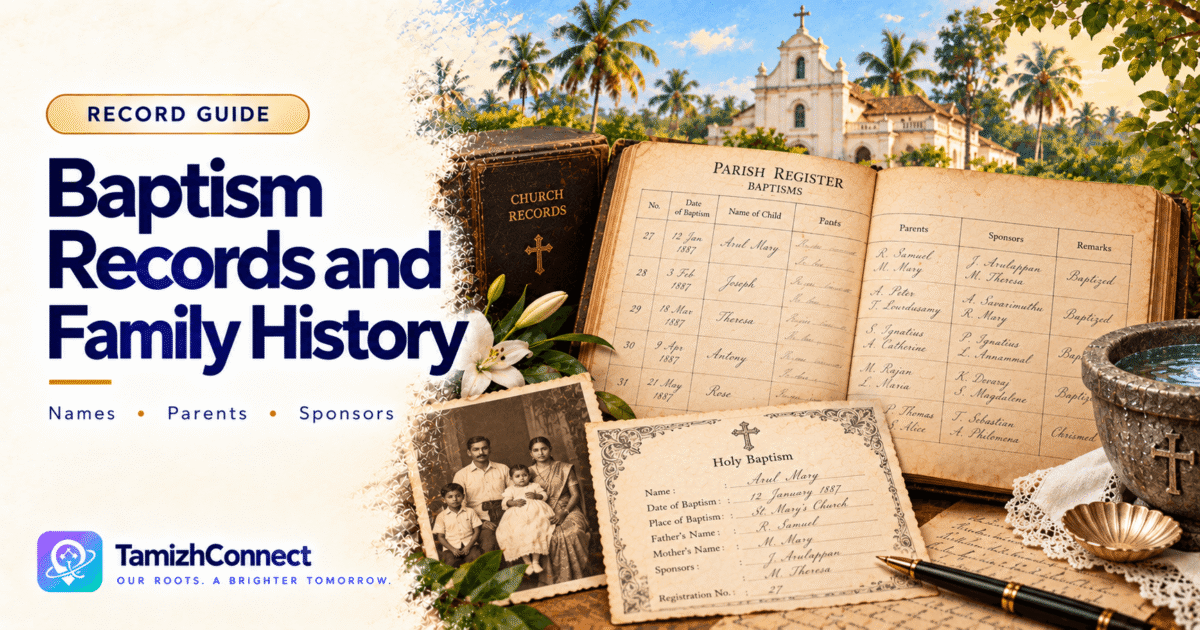
The typical Tamil-Christian baptism entry from the 1850s onward has these fields, filled in by the officiating minister at the time of the ceremony:
Date of baptism. The date the sacrament was administered. Distinct from the date of birth (usually recorded separately in the same entry).
Date of birth. The child’s actual birth date, as reported by the parents to the minister at baptism. Adult baptisms omit this or record it as reported at the time of conversion.
Full name of the baptised. The Christian name given at baptism, plus any Tamil name retained. For adult converts, the pre-conversion Tamil name was often recorded alongside the new Christian name — a genealogically valuable field because it links the person’s pre-conversion and post-conversion identities.
Parents’ names. Both mother and father, with the father’s occupation typically noted. For infant baptisms this is the biological family; for adult baptisms it may include the convert’s baptismal godparent or catechist as well.
Village and abode. The family’s residence at time of baptism. Not always the family’s ancestral village — a Tamil family that had recently moved to the mission station or plantation might be recorded at the new address.
Godparents (sponsors). Two or more named sponsors, typically from the extended family or the local Christian community. These names function like witnesses on marriage certificates — they document the social/family network around the baptised.
Officiating minister. The pastor, priest, or catechist who performed the sacrament. This identifies the specific mission district and, for post-1858 records, often ties the family to a specific missionary society (SPG, CMS, SPCK, LMS, Danish-Halle, Basel Mission, or the Roman Catholic Paris Foreign Missions Society).
The traditions that kept the best records
Different Christian traditions in Tamil Nadu kept baptism records with different levels of detail and different survival rates:
Roman Catholic parishes. The longest continuous records. Chennai’s Portuguese-era Catholic parishes (Saint Andrew’s, Saint Anthony’s) have baptism registers reaching into the 1700s. Nagapattinam and the Portuguese-influenced coastal parishes similarly. The Roman Catholic tradition insisted on Latin-language records with standardised fields until Vatican II — very consistent format across parishes.
Church Missionary Society (CMS). Active in Tirunelveli district from the 1810s under Rhenius. CMS records are dense, well-preserved, and typically kept in English with Tamil name transliteration. Most CMS records for the Tirunelveli district transferred to the Church of South India (CSI) Tirunelveli-Tuticorin diocese after 1947.
Society for the Propagation of the Gospel (SPG). Active in Nazareth, Sawyerpuram, and Ramnad. SPG kept records in English with sub-caste and community identifiers that neither CMS nor RC records preserved as systematically — valuable for distinguishing Nadar, Vellalar, and Pallar family lines within the same village.
Danish-Halle Mission (later Leipzig / SPCK). Active from 1706 at Tranquebar (Tharangambadi) under Ziegenbalg. Baptism records from Tranquebar for the 1700s and early 1800s are held partly at the Leipzig Mission archive and partly at Tranquebar’s own parish archive. Contain some of the oldest recorded Tamil Christian family lines.
Basel Mission. Active in the Nilgiris and Coimbatore from the 1830s. Basel Mission records survive well at the Basel Mission archive in Basel, Switzerland, plus at the Karnataka Theological College archive. Distinctive because they include Kannada-language records for the Nilgiri-adjacent parishes.
Lutheran (Tamil Evangelical Lutheran Church). Descendant of the Danish-Halle mission, active continuously in Tirunelveli and Ramnad from the 1750s. Records mostly held in local parish archives; a subset transferred to the TELC archives at Tranquebar.
Where surviving records live today
CSI diocesan archives. The Church of South India (formed 1947 from the merger of CMS, SPG, London Missionary Society and other Anglican-adjacent traditions) inherited most of the merged missions’ baptism registers. Each CSI diocese holds its own archive: Tirunelveli-Tuticorin (Palayamkottai), Madras (Chennai), Coimbatore, Nandyal, and others. Access is by application to the diocesan office.
Roman Catholic parish archives. Each active RC parish still holds its own baptism register. Older records (pre-1900) may have been consolidated at the diocesan archive (Chennai-Mylapore Diocese archive, Kottar Diocese archive for Kanyakumari). Direct parish contact is often the fastest route.
United States missionary society deposits. American Board of Commissioners for Foreign Missions (ABCFM) records for Madurai are at the Houghton Library, Harvard. Some field-level records including baptism registers are digitised through Harvard’s collection portal.
United Kingdom mission society archives. Church Mission Society (CMS) records are at the Cadbury Research Library, University of Birmingham. Society for the Propagation of the Gospel (SPG) records are at the Bodleian Library, Oxford. Both hold substantial Tamil-mission baptism registers as duplicates sent to the London home offices.
Diaspora Tamil Christian parishes. For post-emigration baptism records, the specific destination-country diocese holds the records. Anglican Church of Southern Africa for South Africa Tamil Christians. Catholic Diocese of Suva for Fiji. Trinidad’s Catholic and Presbyterian archives for Trinidad Tamil Christians. Diaspora baptism records are often more accessible than Indian-Tamil-Nadu records because destination-country dioceses maintain digital catalogues.
The pre-conversion name field
The baptism record’s most valuable field for Tamil family research is the “prior name” or “pre-conversion name” field, which appears on many adult-baptism records. When Muthusamy son of Perumal was baptised in 1878 as Peter Muthusamy Naidu, the register recorded:
“Peter Muthusamy Naidu (prior name: Muthusamy son of Perumal, Vanniyar), baptised 12 March 1878, sponsored by Rev. J. Ashton (CMS Missionary) and Cornelius Rajah (native catechist), at Palayamkottai Church.”
This single entry documents: the ancestor’s Christian identity (Peter), his pre-conversion identity (Muthusamy son of Perumal), his caste (Vanniyar), the mission that received him (CMS Palayamkottai), the specific missionary (Rev. Ashton), and the local Indian catechist (Cornelius Rajah, likely a prior convert who ministered to new converts). Cross-referencing all five of these pieces with other records extends the family tree substantially.
For descendants trying to work back before conversion, the pre-conversion name field is often the KEY link. A family that has been “Christian for as long as anyone remembers” and lost its pre-conversion identity in memory can often recover it through a baptism register entry, sometimes with three generations of Tamil ancestor names.
Baptism records and diaspora arrival timing
For Tamil families emigrated to Christian-majority destinations (South Africa, Trinidad, Guyana), baptism records from before and after emigration cluster around specific timing patterns:
Pre-emigration conversion. Families baptised in Tirunelveli or Chennai BEFORE emigration. Their pre-emigration baptism records are in Indian mission archives; their arrival records to the destination country may already show Christian names. The pre-emigration baptism records are the earliest documentation of Christian identity in the family.
On-voyage baptism. A small number of labourers were baptised at sea by ship’s chaplains (Anglican-tradition ships) or on arrival by destination-country missionaries. These baptisms are recorded in either the ship’s manifest annotations or the destination-country mission archives.
Post-arrival conversion. Many indenture labourers converted to Christianity in the destination country over the first 10-30 years of their stay. Baptism records at destination-country mission churches document these later conversions. The pre-conversion name field is especially valuable here because it preserves the pre-emigration Tamil identity even for families that then became Christian post-emigration.
Cross-referencing with civil registration
Where both a baptism record and a civil birth record exist for the same person, cross-referencing them is standard verification. The civil record’s parents’ names should match the baptism record’s parents’ names. The birthdate on both should agree (with the baptism date being some days or weeks later). Any inconsistency needs investigation using the framework in our conflicting records guide.
For pre-1890s Tamil Christian families, the civil birth record often DOESN’T exist — civil registration for Indian Christians in Madras Presidency wasn’t standard until the 1890s. In that case, the baptism record IS the birth documentation. Genealogically this is fine; the baptism record is a contemporary primary source recorded by the officiating minister who typically knew the family.
The specific research technique
For descendants with Christian ancestors in Tamil Nadu, the systematic baptism-record research workflow:
Step 1: Identify the tradition and mission district. Family oral history usually identifies “Anglican/Catholic/Lutheran,” and often the specific mission district. If not, the family’s village-of-origin narrows the likely mission — Nazareth = SPG, Tirunelveli = CMS, Tranquebar = Danish/TELC, Nagapattinam = RC, and so on.
Step 2: Identify the specific parish. Mission archives usually catalogue by parish. Family oral history or church-attendance memory identifies the parish.
Step 3: Request the baptism register. Contact the diocesan archive (or the parish directly) with the specific request: “Please search the baptism register for [Parish Name] for [year range] for the family of [ancestor name].” Fees vary; response times vary.
Step 4: Extract every field. When the entry surfaces, extract every field including sponsors, minister, and pre-conversion name. Each field is a potential cross-reference to another record.
Step 5: Cross-reference sponsors and minister. Baptism sponsors are often extended family or community members. Their own baptism records may extend the tree further. The minister’s name identifies the specific mission cohort and often ties to other records that missionary compiled.
The reward
For Tamil Christian families, baptism records often outperform every other pre-1900 record type in genealogical density. A single well-preserved baptism register entry documents the individual, their parents, their village, their community, their sponsors (often family), and their conversion history. Multiple entries from the same parish across decades reconstruct the shape of the Christian community and the family’s place within it.
Combined with land records (see land records guide) and the verification methodology (see verification guide), baptism records let a Tamil Christian family tree reach several generations deeper than a purely-secular-record tree could — often into the mid-1800s or earlier for families connected to the older mission districts.