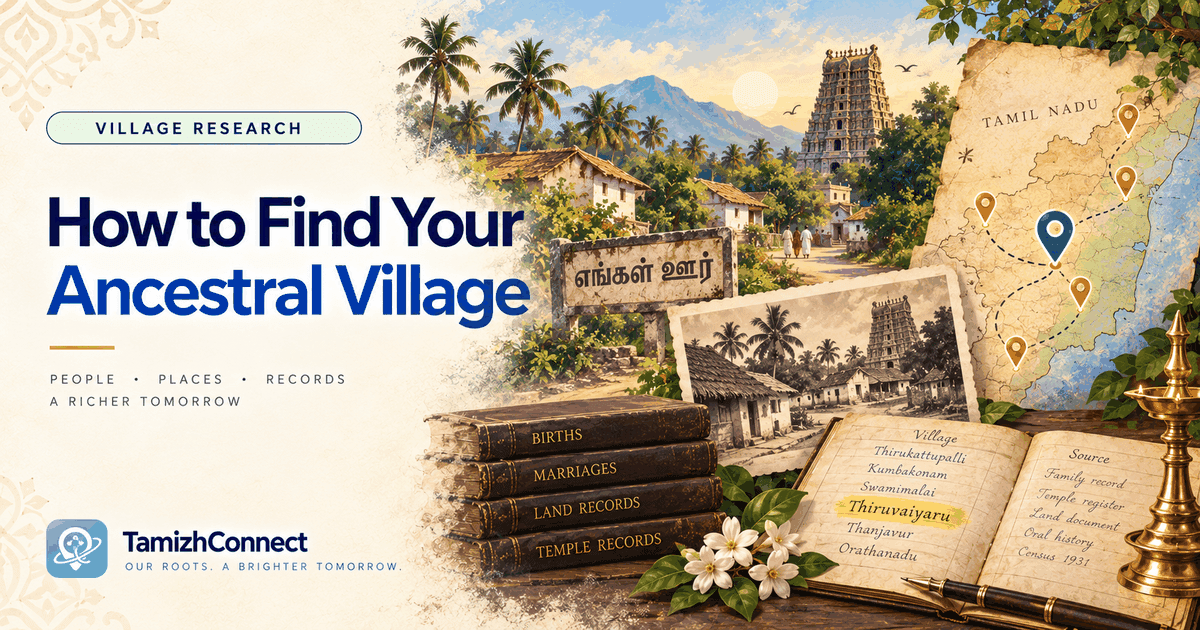
The ancestral village is the anchor point around which the entire Tamil family tree gets built. Without it, you’re searching by surname alone against records that use spellings your family no longer uses. With it, you can walk the voter roll house-by-house, ask elders who still live there, check the temple register for kula deivam confirmation, and cross-reference land tenure records that name your ancestor’s grandfather. It’s the single highest-value piece of information for anyone building a Tamil tree.
The problem is that “the village” is rarely written down anywhere the family currently has. For diaspora families it usually died with the emigrant ancestor a century ago; for Tamil Nadu families it may be present only as an oral tradition that’s been passed through three or four generations with each transmission losing a syllable. This guide walks the sequence of steps that reach the village name reliably, in the order that usually works.
Step 1: exhaust what the family already knows
Before touching any archive, ask the oldest person in the family. Village names live in the memory of the generation immediately preceding your emigrant ancestor — grandparents and great-grandparents who heard the village named in conversation as children even if they never went there. That memory is decaying fast: every year an oral-history interview isn’t done, another village name goes with the person who last knew it.
The questions to ask are specific. Not “where are we from” (which usually gets “India” or “Tamil Nadu”) but “where did your father say his father was from” and “what did he call the place.” Also ask about temple names, festival memories, and food traditions — a family that keeps a specific temple deity or celebrates a locally-specific harvest feast is telling you something about the village of origin even when the place name is lost.
Write it all down verbatim, with the date and who told you. Even a fragmentary answer (“something like Chetp— Chettu— Chetput maybe”) is enough to start the search in Step 2. Family myths are also worth recording; the myth “we came from a village near a big river with a shrine on a hill” is exactly the sort of clue that gets confirmed later by a photo or a temple record.
Step 2: use every colonial record that carries the village
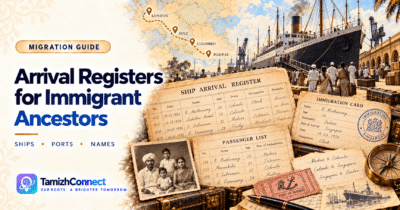
The colonial-era indenture records are the single largest source of Tamil village names for diaspora families. Every arrival register (see the arrival-registers guide) recorded “native village” and “native district” for each labourer at the point of departure. If your family emigrated between 1834 and 1917 to Natal, Mauritius, Fiji, the Caribbean, or the smaller destinations, one of these records almost certainly names your ancestor’s village.
Start at the TamizhConnect indenture search and enter the ancestor’s name. If you get a match, click through to see the full record — the village name (with the colonial-era spelling) will be there. It might be a common form (Chetput, Wandiwash, Vellore) or an unfamiliar one (Ambur, Puttur, Tirupattur). Either way, that name is the anchor.
If the arrival register only names the district and not a specific village, that’s still useful — a district-level anchor narrows the modern search from all of Tamil Nadu to one of about thirty administrative regions. Combine it with the family surname and Step 3 can often close the gap.
Step 3: normalise the colonial spelling to a modern village name
The village name in a colonial record is unlikely to match how the same village is spelled today. British administrators used inconsistent phonetic transliterations; the Indian government has reformed place names multiple times since independence; some villages have been renamed entirely (e.g. Madras → Chennai, Trichinopoly → Tiruchirappalli, and hundreds of smaller changes).
Three techniques get you from colonial spelling to modern spelling:
Direct search. Put the colonial name into a Tamil-language search engine (Google.com/webhp?hl=ta) and Google Maps. Modern algorithms are surprisingly good at matching “Puddoocotta” to “Pudukkottai” or “Chittor” to “Chittoor”. Google Maps will show you the modern village position if it survives; India’s Village Directory (also on data.gov.in) confirms the current administrative status.
Old-map cross-reference. The Survey of India’s colonial-era maps (available scanned online through the University of Chicago’s Digital South Asia Library) show village names as they were spelled in the 1900-1930 period. A village that appears on an old map at coordinates X,Y and doesn’t appear on a modern map at the same coordinates has usually been renamed rather than depopulated — search for what’s at X,Y now.
District gazetteer. The Imperial Gazetteer of India (published 1908) is a district-by-district description of every place with population above a threshold. If your colonial-era village name is in the gazetteer, the gazetteer will describe its location relative to modern-recognisable landmarks (railway stations, larger towns, rivers) that let you place it on a modern map.
TamizhConnect maintains a village-name concordance that pre-computes this old-to-new mapping for the villages the indenture archives most frequently reference. If the colonial name is on that list, the match is done for you.
Step 4: verify by cross-checking a living family
Having a modern village name is not the same as having proof your family came from there. Two independent sources should agree before you treat the village as confirmed. The strongest cross-check is finding a present-day family with the same surname living at the same village today.
The Tamil Nadu Election Commission publishes annual voter rolls at village-level detail. TamizhConnect’s voter search lets you query the roll by village name and surname simultaneously. If a family with your surname still lives at the village your colonial record named, that is a strong indicator (not proof — but strong indicator) that they descend from the siblings and cousins your ancestor left behind.
The next step is contact. If the voter roll surfaces a family, TamizhConnect can help you draft an outreach message in Tamil that explains you’re researching family history and would like to know if they remember any relatives who emigrated. Living families vary widely in how much history they’ve retained, but a surprising number remember specific generations — “yes, my grandfather’s uncle went to Natal on a ship, we lost contact after his son’s letters stopped in the 1920s” is not an uncommon response.
Step 5: confirm with a second, independent source
Voter-roll match is one source. For the second, aim for a documentary record independent of the colonial indenture papers. The strongest candidates are:
Temple records. Many Tamil villages have a temple that keeps a kula deivam (family deity) register. If your family’s kula deivam identification (from Step 1’s family memory) matches the temple record at the modern village, that’s a strong second source. Small village temples aren’t always accessible — some registers require the priest to look up on your behalf — but many are willing.
Land / patta records. The Tamil Nadu land-records portal (patta.tn.gov.in) lets you search land tenure by village and family name. A family that owned land in the village in the pre-emigration period (1850s-1900s) will often still show up in the modern land record as heirs to the original patta. Note: this only confirms an ownership lineage, not necessarily descent — but for landed families it’s often the cleanest lineage record.
Old letters or photographs. If any letters or photographs survive from the pre-1950s period showing the village name (on a return address, or in a caption identifying where the photo was taken), that’s a legitimate second source. Family photograph collections are often the most under-searched source because they were passed down as heirlooms and never catalogued.
What if there is no colonial record?
Not every Tamil family emigrated during the indenture period, and not every emigrant made it into the arrival registers. If you have no indenture record to give you a colonial-era village name, the search runs backwards from the destination country’s civil records:
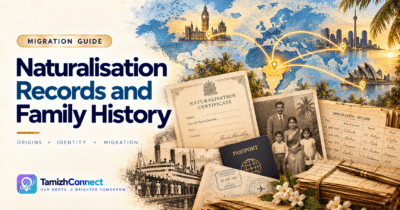
Naturalisation records (Britain, USA, Canada, Australia) often name the applicant’s village of origin as part of the identity documentation. See our naturalisation records guide for what to look for. Passport applications from the 1920s-1970s period sometimes include a village-of-origin field. Marriage certificates from Christian and civil marriages in the diaspora sometimes name the bride’s or groom’s village.
For families whose emigration was pre-indenture (before 1834), the paper trail thins dramatically. Pre-1834 Tamil emigration was mostly commercial — traders and craftsmen moving between Southeast Asia and Tamil Nadu — and left far fewer records. Family memory and temple kula deivam identification become the primary sources.
What to do once you have the village
Having the confirmed village opens up a set of next-step research angles the guide-writing community rarely names. Once you have a village, you can:
Search the village-specific portion of the voter roll for every family with the same surname — those are your extended cousins at various removes. Contact them, share your genealogy work, and see what family memory they carry that your line doesn’t.
Visit (or arrange for a proxy to visit) the village temple and inspect the kula deivam register. This confirms the family’s original deity identification, which matters religiously and also carries genealogical weight (kula deivam identifications are surprisingly stable across generations).
Request a copy of the village revenue map (nakshai) from the tahsildar’s office. The map shows every household plot with the owner’s name; a family plot map from the 1890s (some tahsildars still hold copies going back that far) will name your ancestor’s grandfather.
Cross-reference the village name against the Tamil Nadu State Archives holdings for that district — court records, land-transfer registers, and pre-independence government correspondence sometimes mention specific villages and specific families in ways that fill in the pre-1900 tree.
Common blockers, and how to unstick
Three failure modes account for most stuck village searches. The first is a colonial spelling so mangled that phonetic normalisation can’t find the modern equivalent — this needs district-level context (from the arrival record) plus a manual scan of the district gazetteer’s village list. The second is a village that has been physically absorbed into a larger town over the last century, so its historical name doesn’t appear on modern administrative lists — old maps and the Imperial Gazetteer are the fix. The third is a family memory that carries the wrong district (the emigrant remembered the port of departure rather than the village of birth), and the actual village turns out to be several districts away — this needs a fresh look at the colonial record.
Whichever blocker you hit, the general principle holds: the village lives in colonial records with an old spelling, in living memory with a fading transmission, and in modern administrative databases under a different name. Reconciling those three views takes patience but is almost always solvable if the family emigrated during the well-documented 1860-1917 window.
The rest of the family history — names, birthplaces, migration routes, occupations — flows outward from the village. It’s worth the search.