The instruction “just build a family tree” hides a lot of practical decisions. Which person do you start with? How far back do you go before switching from memory to archives? When do you commit an ancestor to the tree vs. leave them as a probable-but-unverified lead? A tree built without answering these questions well becomes a mess — either wildly incomplete or wildly speculative.
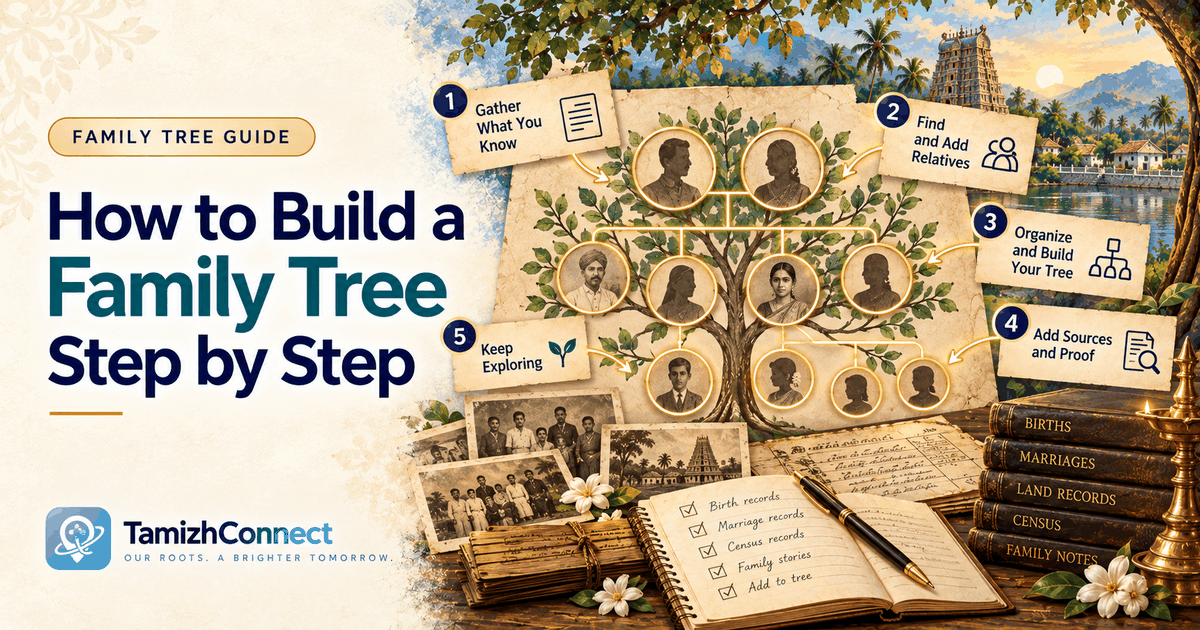
This guide is a step-by-step Tamil genealogy checklist for building a family tree systematically. Each step names the specific action, the specific expected output, and the specific quality check before you move to the next step. Follow it and you’ll finish month one with a working 4-generation tree; follow it consistently and you’ll finish year one with 6-8 verified generations.
Checklist item 1: Define the “start node”
Every family tree needs a starting person. This is usually you, or your oldest living relative, or the ancestor whose life the tree is centred on. Pick one. Write down:
- Full name (with all Tamil naming variants)
- Birth date and place
- Current location (or death date and place if deceased)
- Relationship to you
Quality check: can you produce one civil document (birth certificate, passport, voter ID) for the start node? If yes, move on. If no, get the document first — the whole tree hangs from this anchor.
Checklist item 2: Add the immediate family
The start node’s parents, siblings, spouse, and children. For each person, record the five essential fields (name, relationship, birth year, origin place, source). See our basic family tree guide for the fields-per-person structure.
Quality check: can you name every immediate family member, and can you cite a source (memory of the start node, or a civil record) for each? If yes, move on.
Checklist item 3: Interview both parents (or their siblings if parents deceased)
The 60-120 minute structured interview covered in our living memory guide. The output is not just names — it’s:
- Names of grandparents (all four) with rough birth years and origin villages
- Names of parents’ siblings and their spouses
- Any mention of great-grandparents, however vague
- The family’s original village if diaspora
- Migration story if diaspora (ship, year, port, destination)
Quality check: after this step, do you have at least 3 names in the great-grandparent generation? If not, schedule a second interview with a different relative before proceeding.
Checklist item 4: Add the grandparent generation to the tree
All four grandparents. For each: full name, birth year range, origin village, spouse (each other), children (including your parents and their siblings), source.
Quality check: are the origin villages specific (village name, not just “South India” or “somewhere near Madras”)? If not, follow up with the interviewees before extending further back.
Checklist item 5: Search civil records for the grandparent generation
For each grandparent, search:
- Birth certificate at the district Registrar of Births and Deaths (if born after 1890)
- Marriage certificate at the district Registrar (usually the marriage that produced your parent)
- Death certificate at the district Registrar
- Voter roll at the Tamil Nadu Electoral Commission (for post-1951 records)
- Land record at patta.tn.gov.in (for landholding families)
Quality check: does the record data agree with what the interview said? Where it disagrees, note the discrepancy — don’t silently overwrite either version.
Checklist item 6: Add the great-grandparent generation from interview + records
Up to eight great-grandparents. Some will be well-attested; some will be partial names only; some may be unknown. Fill in what you can. Mark unknowns as “unknown” not blank.
Quality check: for great-grandparents attested in oral history but not yet in records, note the specific research question (“find birth record of Ramasamy s/o Perumal, Wandiwash, ~1855”) for later resolution.
Checklist item 7: Search pre-emigration records (for diaspora families)
If your family emigrated during the indenture era (1834-1917), this is where the archive trail gets rich. Search:
- Destination-country arrival register — NARSSA/GLDC for South Africa, MGI for Mauritius, National Archives of Fiji, NALIS for Trinidad, Walter Rodney Archives for Guyana, Nationaal Archief for Suriname. TamizhConnect indexes many of these at indenture-search.
- Departure depot manifest — Tamil Nadu State Archives at Egmore (for Madras departures), Archives Nationales d’Outre-Mer at Aix-en-Provence (for Karaikal departures)
- India Office Records at the British Library (for duplicate depot manifests sent to London)
Quality check: is the emigrating ancestor confirmed on both a departure record AND an arrival record? Both should exist for indenture-era emigration; matching them across the two archives is a strong verification.
Checklist item 8: Extend into pre-emigration village records
Once the departure village is confirmed via the depot manifest, extend backwards into the village’s own record set:
- Historical patta and settlement registers (district Collector’s office)
- Temple records for the village (via HR&CE if state-managed; direct parish contact otherwise)
- Church records for the village (CSI, RC, TELC diocesan archives)
- Old voter rolls (Tamil Nadu Electoral Commission archives)
Quality check: can you extend the tree to great-great-grandparents (generation 5) via village records? For families with continuous village land ownership, this is usually possible.
Checklist item 9: Verify every ancestor before extending
The rule that saves the most research time: verify each ancestor by the three-source method before treating them as confirmed. See our verification guide.
For each ancestor added to the tree, ask:
- Do I have three independent sources for this person?
- Are the sources genuinely independent (not derived from each other)?
- Do the sources agree on the key fields (name, dates, place)?
An ancestor with three independent, agreeing sources is confirmed. Extend backwards from confirmed ancestors, not from unverified ones.
Checklist item 10: Cross-reference cluster relatives
Every extended-family relative named alongside your direct ancestor is a potential tree member. See our cluster research guide. Common cluster relationships:
- Ship-cohort passengers (people who arrived on the same ship as your ancestor)
- Estate co-workers (people assigned to the same plantation)
- Marriage witnesses (usually family members)
- Baptism sponsors (usually kin)
- Adjacent-plot land owners (often related)
Add cluster relatives to the tree only when their relationship to the direct ancestor is verified. Speculative cluster relatives clutter the tree.
Checklist item 11: Document conflicting evidence
When two records disagree, record both and mark the conflict. Common Tamil-family conflicts:
- Age discrepancies between arrival records and civil registration (arrival records typically wrong; labourers often lied about age)
- Village discrepancies (usually resolvable — Chennai vs. Chetput describe the same place at different granularities)
- Father’s-name discrepancies (may reflect conversion, adoption, or naming-convention shifts)
Silent resolution is worse than documented conflict. Future descendants inheriting a documented conflict can investigate; inheriting silent resolution, they don’t know there’s a question.
Checklist item 12: Plan the next research question
Every completed pass through the checklist ends with the next research question queued up:
- Which ancestor is only partially attested and needs a second source?
- Which village has been named but not yet searched for records?
- Which extended family branch has been mentioned in interviews but not yet added to the tree?
A good practical Tamil genealogy checklist is cyclic, not linear. Every completion cycles back to the next research question, which starts the cycle again.
The checklist as ongoing discipline
Building a family tree isn’t a one-time project. It’s an ongoing discipline. Every year: interview the elders (some are new; others’ memories have deepened), search records that have newly come online, verify existing tree entries against new sources, extend into branches you haven’t yet worked on.
A family tree that gets systematic attention once a year is better than one that gets frantic attention once, then decays. The checklist above compresses to about 40 hours of first-pass work. Repeat it — in whole or in pieces — every year and you’ll compound decades of family history into a genuinely comprehensive record.