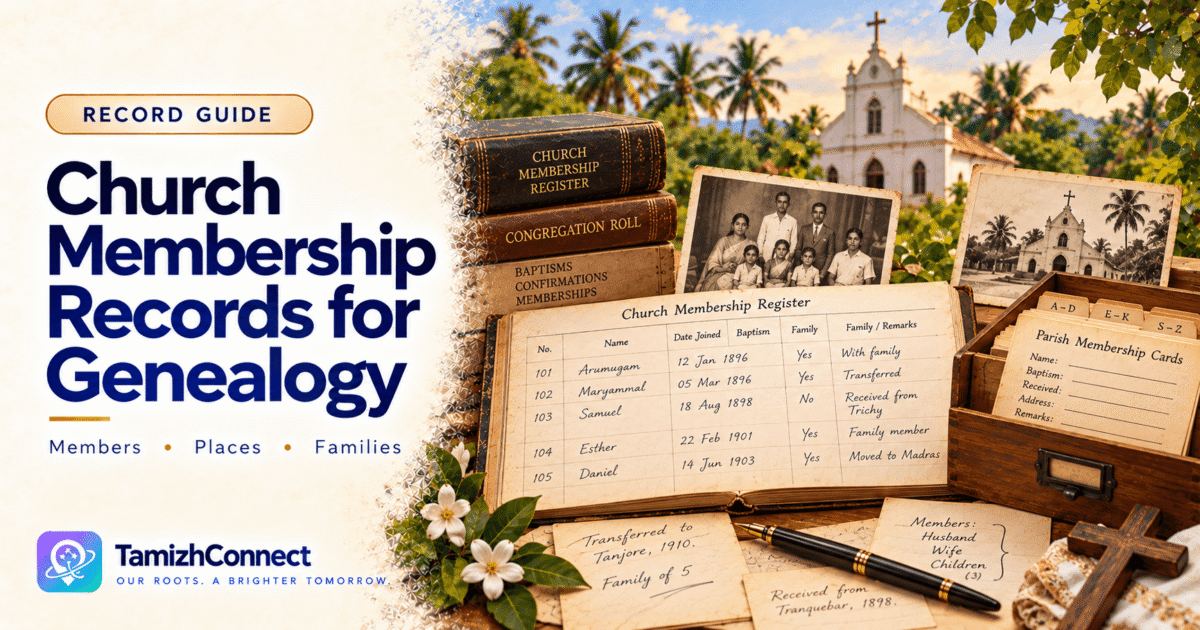
Beyond the individual sacramental records (baptism, confirmation, communion, marriage, burial), most Christian parishes kept a fourth category of documentation: general membership rolls. These went by different names in different traditions — the Anglican “communicant register,” the Catholic “status animarum” annual family survey, the Lutheran “Kirchenbuch” household ledger, the CSI “communicant roll.” All served the same purpose: a running record of who belonged to the parish community and where they stood in it.
For Tamil Christian family research, church membership records fill a specific niche between sacramental records (which document specific events) and civil records (which document legal status). They document ongoing community membership — how long a family belonged to the parish, what community role they played, and how the family composition evolved. This guide walks the specific types, where they survive, and how to extract genealogically useful patterns from them.
The main types of membership records
Communicant rolls. Anglican / CSI tradition. A list of confirmed adults eligible to receive communion at the parish. Updated annually — new confirmations added, deaths and transfers marked. Reading a communicant roll for a specific parish for a specific year gives you the parish’s adult Christian population at that moment. The roll is often organised by household, making family units directly readable.
Status Animarum registers. Roman Catholic tradition. An annual house-by-house survey of the parish, listing every Catholic family with the family members, their ages, and their sacramental status (baptised / confirmed / married). Historically kept for the annual Easter obligation — the priest visited each household to verify who had confessed and communed during the Lenten season. Genealogically dense — an entire family, household composition, ages, sacramental history in one entry per year.
Kirchenbuch household ledgers. Lutheran (TELC) tradition. Following the German Kirchenbuch model, TELC parishes kept a running household ledger with entries for each family. Included baptisms, confirmations, marriages, and burials for family members plus general notes about family life events (moves, illness, community roles).
CSI communicant rolls. Post-1947 CSI parishes inherited and continued the Anglican-tradition communicant rolls. Updated with modern conventions (English or Tamil), still typically organised by household.
Sunday school registers. A subset of membership records tracking children’s attendance and progress. Historically kept in most active parishes; less commonly preserved in archives than the adult-focused main membership rolls.
Church committee minutes and vestry records. Meeting minutes of parish governing bodies (vestries, church committees) that named committee members and often family members appointed to specific parish roles. Not primarily genealogy records but capture community-role information.
The Status Animarum advantage
Roman Catholic Status Animarum registers deserve specific mention because they are, when they survive, among the richest single-page family documents in the whole Christian archive tradition.
A typical Status Animarum entry from a 1885 Tamil-Catholic parish looks like this:
“House of Peter Muthusamy Naidu. Peter Muthusamy Naidu, aged 32, husband, baptised 1878, confirmed 1880. Mary Muthusamy, aged 28, wife, baptised at birth 1857. John Muthusamy, aged 8, son, baptised at birth 1877. Anna Muthusamy, aged 6, daughter, baptised at birth 1879. Grace Muthusamy, aged 2, daughter, baptised at birth 1883. Old Perumal, aged 62, father-in-law (of Peter), non-Catholic, resident with family.”
That single entry captures: family head and spouse with ages and baptism dates, three children with names and ages, an extended family member (non-Catholic father-in-law) noted as resident. Comparing consecutive years’ entries shows the family’s composition changing (children born, elders dying, married-in spouses joining, family members moving out). It’s essentially a decadal micro-census specific to Catholic families.
Not all parishes maintained Status Animarum consistently — the practice was more consistent in Portuguese-tradition parishes (Chennai, Nagapattinam) than in later mission-era parishes. But where they survive, they’re the densest single-family document available.
What communicant rolls add
Anglican / CSI communicant rolls document the parish’s confirmed adult community year by year:
Roll additions. New adult members added — typically newly-confirmed candidates or transferred communicants from other parishes. A roll addition entry usually notes where the person came from (previous parish or “confirmed here on X date”).
Roll removals. Members removed — typically deaths (with burial register cross-reference), transfers out (with destination parish), or discipline cases. Removal entries document why the person left the parish community.
Role annotations. Some rolls noted parish roles — sidesman, deacon, choir member, catechist. These annotations identify community-role history for the specific ancestor.
Family clustering. Rolls organised by household make family units directly readable. Muthusamy Naidu, his wife Mary, and their adult son John appear as three consecutive roll entries, telling you these three were the confirmed adults in the household at that date.
Where surviving membership records live
CSI diocesan archives. Historic communicant rolls from Anglican-tradition parishes now under CSI diocesan control. Most CSI dioceses in Tamil Nadu (Palayamkottai, Chennai, Coimbatore, Nandyal) hold selected historical rolls.
Roman Catholic diocesan / archdiocesan archives. Chennai-Mylapore archdiocese, Kottar diocese, and various suffragan dioceses hold Status Animarum registers from historic parishes. Coverage is uneven — some parishes kept registers meticulously, others sporadically.
TELC (Lutheran) central archive. Located at Tranquebar with a subset at Chennai. Kirchenbuch household ledgers from historic TELC parishes.
Mission society archives. CMS (Birmingham) and SPG (Oxford) archives hold selected communicant rolls sent as duplicates by mission-era parishes.
Active parish archives. Many parishes retain their historical rolls locally — often in a parish office cupboard rather than a centralised archive. Direct parish contact often surfaces registers not catalogued at the diocesan level.
Using membership records for family research
The systematic approach to membership record research:
Step 1: Identify the parish and year range. Family oral history or baptism records identify the parish. The year range depends on what you want to document — a specific decade of active parish life, the years before emigration, the years of a specific ancestor’s adult life.
Step 2: Request access to the relevant register class. Different traditions have different record types (see above). Contact the parish or diocesan archive with the specific request: “Please make available the [Status Animarum / Communicant Roll / Kirchenbuch] for [Parish Name] for [Year Range].”
Step 3: Read family cluster patterns. Locate your family’s entries. Note household composition, entry dates, and any annotations. Compare across multiple years to see composition evolve.
Step 4: Cross-reference with sacramental records. Roll additions typically cross-reference to confirmation or baptism records; roll removals to burial or transfer records. Following the cross-references extends the tree.
Step 5: Note community-role annotations. If the ancestor held any parish role (sidesman, catechist, deacon), the annotation is a directly-readable historical role that can be documented in family narrative.
The specific diaspora value
For Tamil Christian families in diaspora destinations, membership records in destination-country parishes are often more accessible than the Indian originals:
Diaspora parishes were typically smaller than Indian ones, so the membership rolls are shorter and more readable. Destination-country diocesan archives (Anglican Church of Southern Africa, Catholic Diocese of Suva, Trinidad Anglican archives) are often better catalogued digitally.
Membership rolls in destination-country parishes document how the Tamil Christian community formed after arrival — who joined, when, in what proportion, from what emigration cohorts. This community formation is a distinctive part of the Tamil diaspora Christian story that few other records capture.
The under-searched category
Church membership records sit below baptism/marriage in professional genealogy attention because they don’t document specific life events. But they document the LIFE — the ongoing community membership across decades — that individual sacramental records punctuate.
For Tamil Christian family research aiming for depth beyond the sacramental record hits, membership records are the next-level source. They reveal not just when things happened but who was there, in what community, playing what role, for how long.
Combined with sacramental records (baptism, confirmation, communion) and civil records, membership records complete the Tamil Christian family documentation. See our baptism records, confirmation records, and communion records guides for the parallel sacramental structures.