TamizhConnect Blog
19 Apr 2026 · TamizhConnect
Who Are the Tamil People? A Foundational Overview
Tamil genealogy article
The Tamil people are an ancient ethnolinguistic group with a rich history spanning millennia, primarily rooted in South India and Northeastern Sri Lanka.
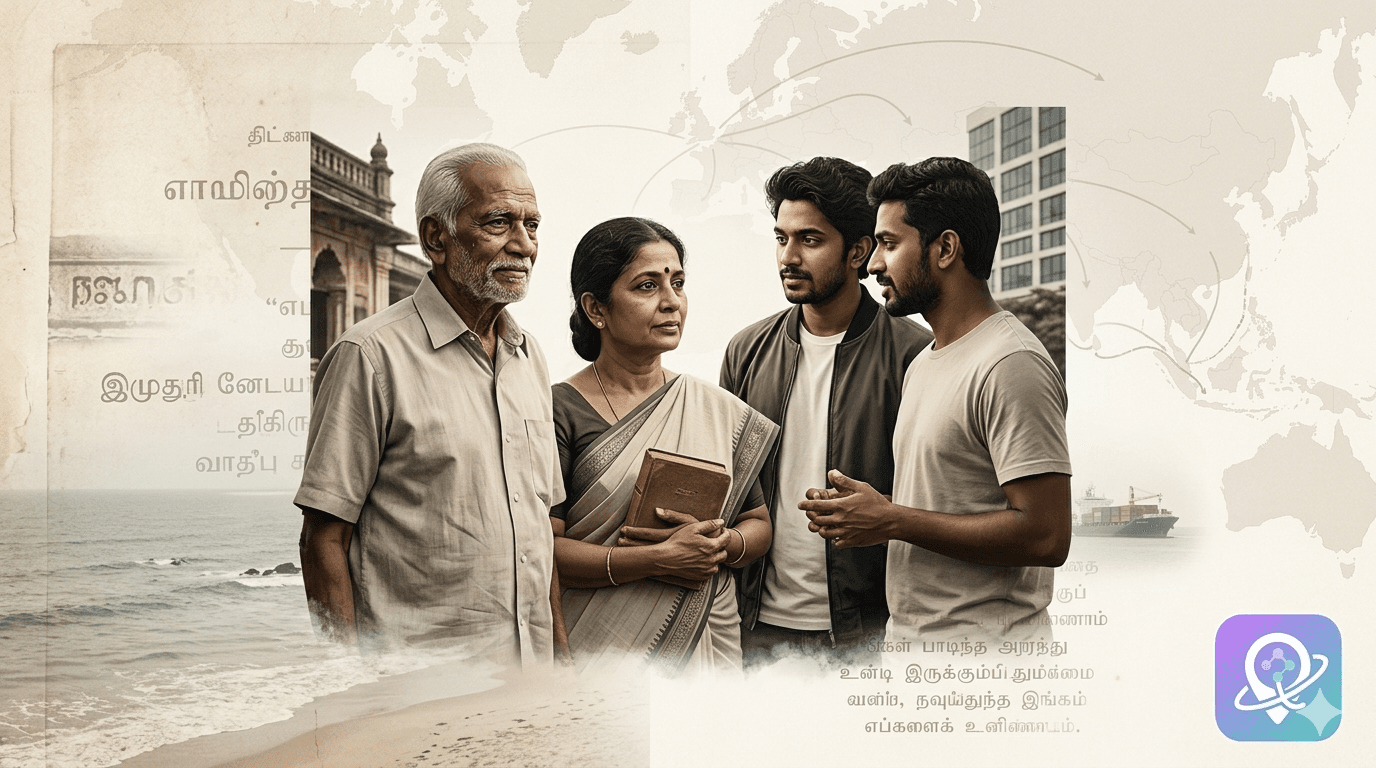
Document Digitisation
Turn documents into verified Tamil lineage.
Choose the depth you need. One-time service, results stay in your account.
The Tamil people are an ethnolinguistic group of roughly 80 million today, whose identity is anchored to the Tamil language — one of the world's oldest continuously spoken and written languages, with an unbroken literary tradition from c. 300 BCE Sangam literature through the present. Their historical homeland is the southern tip of the Indian subcontinent (Tamil Nadu and Puducherry in modern India) and the Northern and Eastern provinces of Sri Lanka. Significant Tamil communities also exist in Singapore, Malaysia, Mauritius, Fiji, South Africa, the Gulf states, UK, Canada, and the USA — products of migrations ranging from medieval trade to 19th-century indentured labour to post-independence professional movement.
The Roots of Tamil Identity: Language and Land
Tamil identity is first and foremost defined by the Tamil language, a member of the Dravidian language family. Unlike Indo-Aryan languages which trace their origins to migrations from Central Asia, Dravidian languages are indigenous to the Indian subcontinent. Classical Tamil, with its literary tradition dating back to at least 300 BCE, boasts a continuous literary history that is unique in its antiquity and vitality. This linguistic heritage is not merely a tool for communication but a cornerstone of cultural pride, embodying ancient poetry, philosophy, and ethical texts like the Thirukkural.
Geographically, the historical homeland of the Tamil people is Tamil Nadu, a state in southern India, and the Northern and Eastern Provinces of Sri Lanka. These regions, often referred to as Thamizhagam in ancient texts, have nurtured a distinct civilization that developed largely independently from the northern Indian cultural sphere for much of its early history. The unique ecological diversity of this land, from coastal plains to fertile river deltas and mountainous regions, also influenced the development of distinct agricultural practices, trade networks, and social structures.
Empires and Dynasties: A Legacy of Power and Patronage
Tamil history is marked by the rise and fall of powerful dynasties that were not only military and political forces but also great patrons of art, architecture, and literature. The three most prominent ancient Tamil kingdoms were the Cheras, Cholas, and Pandyas. These 'Moovendhar' (Three Crowned Kings) frequently vied for supremacy, yet collectively contributed to a golden age of Tamil civilization.
- The Cholas (c. 300 BCE – 1279 CE): Perhaps the most renowned, the Cholas established a vast maritime empire that extended across Southeast Asia, influencing kingdoms in present-day Malaysia, Indonesia, and Sri Lanka. Their reign saw the construction of magnificent stone temples, notably the Brihadeeswarar Temple in Thanjavur, a UNESCO World Heritage site, and a flourishing of bronze sculpture and classical dance forms.
- The Pandyas (c. 6th century BCE – 1345 CE): Known for their literary patronage and their capital city of Madurai, a historic center of learning and culture. The Pandya kings were instrumental in the development of Sangam literature, a vast corpus of classical Tamil poetry.
- The Cheras (c. 3rd century BCE – 12th century CE): Primarily controlling the western coast of South India (modern-day Kerala), the Cheras were significant maritime traders, establishing connections with the Roman Empire and other ancient civilizations.
Later, the Vijayanagara Empire (14th-17th centuries) also played a crucial role in shaping the political and cultural landscape of the Tamil region, even as it was centered further north. These dynasties left an indelible mark through their administrative systems, monumental architecture, and the promotion of Tamil arts and sciences.
Cultural Contributions: Art, Literature, and Philosophy
Tamil culture is a vibrant tapestry woven with threads of ancient traditions and continuous innovation. Its contributions span various fields:
- Literature: Beyond the Sangam literature, Tamil has a rich tradition of devotional poetry, particularly the Bhakti movement, which saw saints like the Alvars and Nayanars compose hymns that revolutionized religious expression. Modern Tamil literature continues to thrive with a vibrant contemporary scene.
- Art and Architecture: Tamil Nadu is dotted with thousands of temples, from the ancient rock-cut caves to towering gopurams (temple gateways) adorned with intricate sculptures. The distinctive Dravidian style of architecture, characterized by pyramidal multi-storied vimanas and elaborate carvings, is a hallmark of Tamil artistic genius. Bronze sculptures, particularly those depicting Hindu deities, are also celebrated for their fluidity and artistic merit.
- Performing Arts: Classical dance forms like Bharatanatyam and folk dances like Karagattam are integral to Tamil cultural expression. Carnatic music, a highly structured system of classical music, also has deep roots in the Tamil region, with numerous composers and performers contributing to its evolution.
- Philosophy and Religion: While Hinduism is the predominant religion, Tamil spiritual thought has unique characteristics. Shaivism and Vaishnavism, two major branches of Hinduism, have flourished in Tamil Nadu, with distinct philosophical schools and rich devotional practices. The concept of Aram (righteousness) and Porul (wealth/material prosperity) along with Inbam (pleasure) and Veedu (salvation) forms a foundational ethical framework.
The Tamil Diaspora: A Global Presence
In recent centuries, particularly during the British colonial era, economic opportunities and indentured labor led to significant waves of Tamil emigration. Today, a substantial Tamil diaspora exists across the globe, with large populations in Sri Lanka, Malaysia, Singapore, Myanmar, South Africa, Fiji, Mauritius, and more recently, in Western countries like the United States, Canada, the United Kingdom, and Australia. This global presence has led to a dynamic interplay between preserving traditional Tamil culture and adapting to new environments, with diaspora communities actively working to maintain their linguistic and cultural heritage while contributing to their adopted homelands.
Understanding the Tamil people means appreciating a civilization that has maintained its distinct identity, language, and cultural practices for millennia. From its ancient origins to its global reach today, Tamil heritage offers a profound narrative of resilience, artistic achievement, and enduring cultural pride.
Share this article
TamizhConnect
TamizhConnect helps Tamil families worldwide trace their ancestry using voter records, indenture archives, and origin village matching. Our research team combines genealogy expertise with digitised Tamil Nadu datasets to help you discover your roots.
Ready to start your Tamil family tree?
TamizhConnect helps you discover relatives, trace your origin village, and keep your family history alive for the next generation.
Create your free TamizhConnect accountGo to my family treeDocument Digitisation
Have old documents? Upload them and we'll verify, trace, and add them to your tree.
Was this article helpful?
Get new articles in your inbox
Tamil genealogy tips, research guides, and new feature updates.
You might also like
Unearthing Tamil Nadu Ancestry: A Comprehensive Guide (English)
Tracing Tamil Nadu ancestry requires navigating a rich tapestry of ancient history, diverse migrations, and a unique record-keeping landscape. This guide explores the distinct challenges and rewarding paths for uncovering your roots.
18 Apr 2026
Dravidian Identity: History, Language, and Genetic Roots (English)
Explore the distinct historical, linguistic, and genetic evidence that defines the Dravidian identity, separate from Indo-Aryan cultures. Uncover the deep roots of Tamil people in South India.
16 Apr 2026
Tracing Tamil Roots: The Distinctive Dravidian Heritage (English)
Explore the historical, linguistic, and genetic evidence that defines Dravidian identity, distinct from Indo-Aryan cultures and deeply rooted in South India.
26 Mar 2026
Tracing Deep Tamil Roots: Archaeology and Genetics (English)
Uncover how recent archaeological finds and genetic research are reshaping our understanding of Tamil origins, exploring both indigenous development and ancient migrations within Tamil Nadu.
28 Jan 2026
Tamil ancestry research: Complete guide for genealogical methods (English)
All our deep-dive guides on Tamil genealogical methods, records, ethnography, and heritage validation for TamizhConnect.
14T09:02:50.514Z Sep 2026
தமிழ் மூதாதையர் ஆய்வு நூலகம் (Tamil)
TamizhConnect-க்கு தேவையான தமிழ் வம்சாவளி முறைகள், பதிவுகள், இனவியல் மற்றும் பாரம்பரியச் சரிபார்ப்புக்கான அனைத்து ஆழமான வழிகாட்டிகளும் ஒரே இடத்தில்.
14T09:02:50.514Z Sep 2026
Related by topic
Understanding Tamil Naming Conventions: Beyond 'Last Names' (English)
Tamil naming conventions traditionally do not feature fixed, inherited 'last names' in the Western sense, instead relying on a system of patronymics, village names, or caste indicators.
26 Apr 2026
Diaspora Tamils: How Language Policies Shape Identity (English)
Explore how language policies and community efforts in Malaysia, Singapore, and Sri Lanka impact Tamil identity across generations, examining challenges and successes.
21 Apr 2026
More from TamizhConnect
Tamil Elder Interview Kit: Ready-to-Use Questions & Prompts (English)
A ready-to-copy interview kit for capturing Tamil family history from elders — grouped by topic, sequenced from easy to sensitive, with recording tips and follow-ups that unlock the stories behind the names.
21 Aug 2026
The Tamils of Dharavi: A Hundred Years from Tirunelveli to Mumbai (English)
From the droughts of Tirunelveli to the tanneries and textile mills of Mumbai, the Tamil community of Dharavi has built one of the largest Tamil cities outside Tamil Nadu. With redevelopment underway, here's how families can preserve their migration story for the next generation.
15 May 2026
Core topics
What is Tamil, really? Language, identity, and where it comes from
A clear, human explanation of what Tamil is-language, identity, people, and history-plus how to talk about it without stereotypes.
4 Feb 2026
What Defines Tamil Identity Beyond Borders and Sub-Groups? (English)
Tamil identity is primarily defined by shared language and cultural heritage, rather than by geographic borders or internal sub-group affiliations. This core identity persists across the diaspora and within Tamil Nadu.
17 Apr 2026
Continue reading
How to Trace Your Tamil Roots: Step-by-Step Guide for Beginners (English)
15 Apr 2026
Tracing Telugu Roots in Tamil Nadu: A Journey Through Time and Heritage (English)
15 Apr 2026
Understanding Your Roots: The Ancient Tamil Kingdoms (English)
13 Apr 2026
Tracing Telugu Ancestry Within Tamil Nadu (English)
11 Apr 2026