TamizhConnect Blog
26 Feb 2026 · TamizhConnect
Tamil Migration to Burma and the Andamans: A Colonial Legacy
Tamil genealogy article
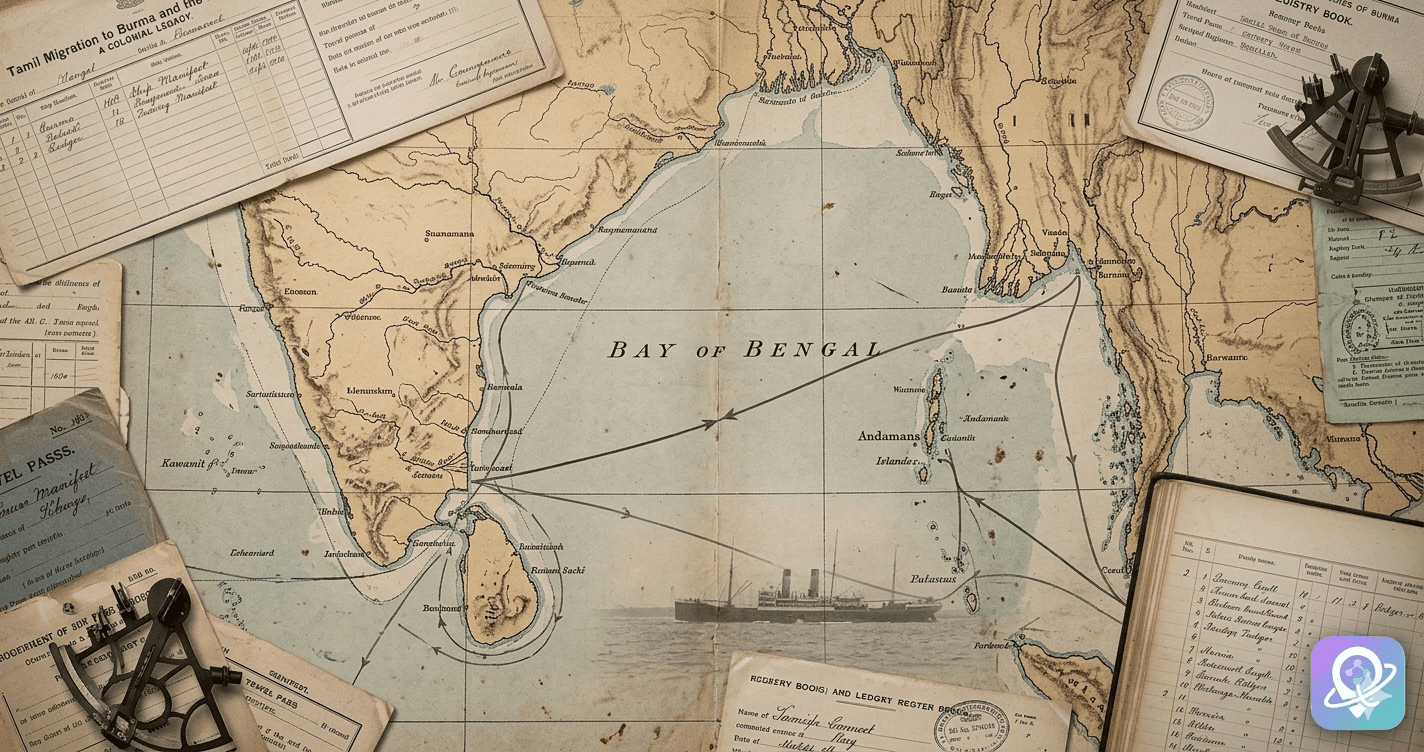
Tamil migration to Burma and the Andaman Islands during the colonial era was primarily driven by economic opportunity under the Kangani system, shaping distinct diasporic communities.
Document Digitisation
Turn documents into verified Tamil lineage.
Choose the depth you need. One-time service, results stay in your account.
Tamil migration to British Burma (1826–1948) and the Andaman Islands (1858 onward) was driven by the Kangani and Maistry labour-recruitment systems — semi-indentured, headman-led migration from the Madras Presidency to paddy estates and docks in Rangoon, Mandalay, and Moulmein, and to penal + labour colonies in Port Blair. Peak Tamil populations: roughly 1 million in Burma by the 1930s (Chettiar banking families, rubber estate workers, dock labourers), and a few thousand in the Andamans. The 1937 separation of Burma from British India and the 1948 Burmese independence triggered mass Tamil return-migration to Madras and displacement within Burma. Genealogy for these families routinely crosses three record systems: British India, British Burma, and post-1948 Indian + Burmese national records.
The Kangani System: A Modified Indenture
The Kangani system, while often associated with Ceylon (Sri Lanka) and Malaya, also played a crucial role in funneling Tamil labor to Burma and, to a lesser extent, the Andaman Islands. Unlike the more formalized indenture system, the Kangani system relied on a headman, or kangani, who was typically a former laborer himself. The kangani would recruit workers from his own village or region, often advancing them money or promising better wages and conditions abroad. This created a personalized, yet often exploitative, chain of recruitment, as laborers were indebted to the kangani who, in turn, was beholden to the estate or timber owner.
For many Tamils in the late 19th and early 20th centuries, particularly from the southern districts of Madras Presidency, the promise of work in Burma's burgeoning rice fields, timber forests, and port cities, or in the Andamans' nascent logging and penal colony infrastructure, offered an escape from rural poverty, drought, and famine. The system, though less rigidly documented than indenture, still subjected workers to arduous journeys and often harsh conditions upon arrival, with wages frequently lower than promised and deductions for housing and provisions.
Tamils in Colonial Burma: Chettiars and Laborers
Burma (modern-day Myanmar) was a major destination for Tamils, attracting both agricultural laborers and a significant merchant class. The most prominent among the latter were the Nattukottai Chettiars, a banking and moneylending community from Chettinad. They played a pivotal role in financing Burma's rice economy, extending credit to Burmese farmers and acting as intermediaries for British trade. Their financial acumen led to substantial wealth and influence, and they established a distinct cultural presence with their own temples and institutions.
Alongside the Chettiars, a much larger wave of Tamil laborers arrived, primarily to work in agriculture, particularly in the Irrawaddy Delta's rice paddies. They also found employment in the bustling port of Rangoon (Yangon), in railway construction, and in the burgeoning timber industry. These laborers often faced discrimination and were seen by some Burmese nationalists as economic rivals. Despite the challenges, they built communities, established cultural associations, and maintained ties with their homeland. Their integration into Burmese society was complex, marked by both economic contribution and social tension, which unfortunately culminated in mass expulsions during the post-independence period, particularly in the 1960s.
The Andaman Islands: A Penal Colony and Logging Frontier
The Andaman Islands, administered as part of British India, served a dual purpose: a penal colony for political prisoners and hardened criminals, and a source of timber. Tamil migrants, both voluntary laborers and those sent as convicts, contributed significantly to the development of the islands. The infamous Cellular Jail at Port Blair held many Indian freedom fighters, some of whom were Tamils. Beyond the penal system, free Tamil laborers were recruited for logging operations, road construction, and the nascent agricultural sector.
Life in the Andamans was exceptionally harsh. The dense forests, tropical diseases, and isolation presented formidable challenges. Laborers often worked under difficult conditions, clearing land and felling timber. Despite the adversity, these communities persevered, establishing small settlements and contributing to the islands' infrastructure. The descendants of these early Tamil migrants continue to form a significant part of the Andamanese population today, maintaining aspects of their cultural heritage despite generations of separation from mainland Tamil Nadu.
Legacies and Diaspora
The migrations to Burma and the Andaman Islands represent distinct chapters in the broader story of the Tamil diaspora. In Burma, the Tamil community, particularly the Chettiars, left an indelible mark on the economic landscape before their eventual displacement. Their temples, architecture, and financial systems were deeply intertwined with Burma's colonial-era economy. In the Andamans, Tamil labor was foundational to the islands' development, creating a resilient community in a challenging environment.
Today, tracing ancestry to these regions can be complex due to the nature of colonial record-keeping, subsequent political upheavals, and the passage of time. However, oral histories, family traditions, and what fragmentary records exist provide valuable clues. These migrations highlight the enduring spirit of the Tamil people in seeking opportunity and building new lives, often against immense odds, across the vast expanse of the British Empire.
Share this article
TamizhConnect
TamizhConnect helps Tamil families worldwide trace their ancestry using voter records, indenture archives, and origin village matching. Our research team combines genealogy expertise with digitised Tamil Nadu datasets to help you discover your roots.
Ready to start your Tamil family tree?
TamizhConnect helps you discover relatives, trace your origin village, and keep your family history alive for the next generation.
Create your free TamizhConnect accountGo to my family treeDocument Digitisation
Have old documents? Upload them and we'll verify, trace, and add them to your tree.
Was this article helpful?
Get new articles in your inbox
Tamil genealogy tips, research guides, and new feature updates.
You might also like
Beyond 'Madras': Unpacking South Indian Ancestry in the Diaspora (English)
The colonial term 'Madras' often obscured the distinct linguistic and regional identities of South Indian indentured laborers. Learn how descendants can trace their specific Tamil, Telugu, or Malayalam heritage.
21 Apr 2026
Diaspora Tamils: How Language Policies Shape Identity (English)
Explore how language policies and community efforts in Malaysia, Singapore, and Sri Lanka impact Tamil identity across generations, examining challenges and successes.
21 Apr 2026
Tracing Indentured Tamil Ancestry: Records and Realities (English)
Uncover the specific challenges and available records for tracing Tamil ancestors who emigrated under the indentured labor system, connecting diaspora families back to their origins.
21 Apr 2026
Who Are the Tamil People? A Foundational Overview (English)
The Tamil people are an ancient ethnolinguistic group with a rich history spanning millennia, primarily rooted in South India and Northeastern Sri Lanka.
19 Apr 2026
தமிழ் மூதாதையர் ஆய்வு நூலகம் (Tamil)
TamizhConnect-க்கு தேவையான தமிழ் வம்சாவளி முறைகள், பதிவுகள், இனவியல் மற்றும் பாரம்பரியச் சரிபார்ப்புக்கான அனைத்து ஆழமான வழிகாட்டிகளும் ஒரே இடத்தில்.
02T21:31:40.701Z Sep 2026
Tamil ancestry research: Complete guide for genealogical methods (English)
All our deep-dive guides on Tamil genealogical methods, records, ethnography, and heritage validation for TamizhConnect.
02T21:31:40.700Z Sep 2026
Related by topic
Tracing Telugu Roots in Tamil Nadu: A Journey Through Time and Heritage (English)
Unravel the fascinating history of Telugu-speaking communities in Tamil Nadu, exploring migrations, cultural integration, and how to research your dual heritage.
15 Apr 2026
Tracing Your Tamil Ancestry: A Beginner's Guide (English)
Embark on a journey to uncover your Tamil roots. This guide provides a starting point for genealogical research, addressing common challenges and relevant records for those in Tamil Nadu and the diaspora.
9 Apr 2026
More from TamizhConnect
Tamil Elder Interview Kit: Ready-to-Use Questions & Prompts (English)
A ready-to-copy interview kit for capturing Tamil family history from elders — grouped by topic, sequenced from easy to sensitive, with recording tips and follow-ups that unlock the stories behind the names.
21 Aug 2026
The Tamils of Dharavi: A Hundred Years from Tirunelveli to Mumbai (English)
From the droughts of Tirunelveli to the tanneries and textile mills of Mumbai, the Tamil community of Dharavi has built one of the largest Tamil cities outside Tamil Nadu. With redevelopment underway, here's how families can preserve their migration story for the next generation.
15 May 2026
Core topics
What is Tamil, really? Language, identity, and where it comes from
A clear, human explanation of what Tamil is-language, identity, people, and history-plus how to talk about it without stereotypes.
4 Feb 2026
What Defines Tamil Identity Beyond Borders and Sub-Groups? (English)
Tamil identity is primarily defined by shared language and cultural heritage, rather than by geographic borders or internal sub-group affiliations. This core identity persists across the diaspora and within Tamil Nadu.
17 Apr 2026