TamizhConnect Blog
8 Mar 2024 · TamizhConnect · 16 min read
Tamil Genealogical Research
Tamil genealogy article
A 5-step framework for Tamil genealogy: go beyond a family tree diagram, track sources, build timelines and maps, and separate proven facts from family stories.
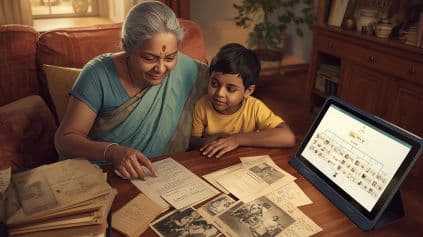
Document Digitisation
Turn documents into verified Tamil lineage.
Choose the depth you need. One-time service, results stay in your account.
Tamil Ancestry Research | Family Tree Guide
Most Tamil families start with the same sentence:
“We want to connect everyone in the family into one big tree.â€
That’s a good ambition.
But genealogical research is not just:
- drawing lines between people, or
- typing names into an app.
Serious Tamil genealogy means:
- working with sources, not just stories
- building timelines and maps
- keeping track of what is proven and what is still only a family belief.
This article gives you a 5-step, very practical framework for Tamil genealogical work:
- Clean up the data you already have at home
- Normalise names, initials, and “surname†chaos
- Hunt for records: e-roll, certificates, IDs, etc.
- Build maps and timelines: who lived where, when
- Validate, document, and label what is proven vs unproven
1. Start at home: clean the data bundle on your shelf
A common mistake is:
“We’ll start after we find old records in some government office.â€
In reality, your first archive is at home:
- grandmother’s notebook
- school/college certificate bundles
- old ration cards
- land documents
- diaries with random notes and phone numbers
1.1. Capture basic data for each person
For every person you include in the tree, capture at least:
- full name (Tamil + the English spelling used in IDs)
- date of birth (or at least approximate year)
- place of birth (village/town + district, or hospital)
- date and place of marriage (if applicable)
- occupation history (major changes)
- migration: “In which year did they move to which place?â€
Even if you are using TamizhConnect or another app,
this raw data must be entered carefully:
- be explicit about which dates are exact vs approximate
- keep notes like “year guessed from school recordsâ€
1.2. Separate stories from facts
Family stories are precious:
- “Our grandfather first went to Ceylon, then to Burma.â€
- “We are from a royal lineage.â€
In genealogical terms, each story has:
- a story layer
- fact candidates hidden inside
- and a lot of interpretation.
Write the story fully, then list possible facts below it.
Example:
“Thatha worked in Ceylon and later moved to Burma during the war…â€
Possible fact candidates:
- At some point he lived in (colonial) Ceylon
- Later he lived/worked in Burma (now Myanmar)
- The timing may be linked to World War II
You will verify or correct these later with records.
2. Name chaos: initials, caste names, village names – normalise calmly
In Tamil families, the worst headache is:
- one person, many name spellings, and
- multiple initial systems across documents.
TamizhConnect has a naming intelligence layer to deal with this at scale.
For your own manual research, do this.
2.1. Define one “canonical†research name
For each person, maintain:
- one “canonical research nameâ€,
- and a list of actual name variants from documents.
Example:
- Canonical:
Sivasubramanian Kandhasamy - Variants:
- S. Kandhasamy
- S. Kandasamy
- S. S. Kandhasamy
- Sivasubramaniam Kandhasamy
Your family tree software or your notes should clearly say
“These are all the same personâ€.
2.2. Handle caste/community names discreetly and clearly
For research, you often need:
- community/jati name
- sub-sect (if relevant)
- traditional occupation or role
Record them in a way that is:
- useful for later research, but
- respectful and privacy-aware for living people.
In TamizhConnect and in your own notes, you might mark:
- “private – not for sharingâ€
- “OK to share within close relativesâ€
so nobody accidentally broadcasts sensitive labels to the public.
3. Records hunt: without sources, it is only a story
For Tamil genealogical work, your backbone sources are:
- electoral rolls (e-roll)
- death certificates
- marriage certificates
- school and college certificates
- land records / patta / sale deeds
- temple/mosque/church records
3.1. Use e-roll to build address timelines
An electoral roll entry usually has:
- house/door number
- street name
- relation (father/husband)
- age (approximate)
If you have multiple years of e-roll data for the same family:
- you can see when the address changed
- roughly when a person first appears in that locality
- when elder generations disappear (indicating death or migration).
TamizhConnect is ingesting e-rolls at scale, so:
- it can match spelling variations,
- handle duplicate names, and
- cluster people into family groups more reliably.
3.2. Death & marriage certificates: gold for relationship proof
When elders have passed away and memories are weak,
death certificates are often your strongest starting point.
Typically they give you:
- full name of the deceased
- age or date of death
- place of death
- sometimes father’s or spouse’s name
- name of the informant
Marriage certificates:
- bridegroom & bride names
- fathers’ names
- occupation
- address at the time of marriage
For genealogy, these are high-value, high-priority documents.
4. Build a map and a timeline, not just a tree
If everything is just in narrative form,
you will quickly lose track and repeat the same questions.
You need both:
- a timeline (by year), and
- a map (by place).
4.1. Timeline
Even a simple spreadsheet works. Typical columns:
- Year / time period
- Person
- Event type (birth, school, job, marriage, migration…)
- Location
- Source (e-roll, certificate, story…)
- Confidence (High / Medium / Low)
Low-confidence entries should be marked clearly like:
- “Story only – needs proofâ€
so that any future cousin or researcher knows where to dig.
4.2. Map
Use any tool you like:
- Google My Maps
- a rough sketch in a notebook
- a digital map inside a research app
Important aspects:
- rivers, hills, borders
- older village names that no longer exist officially
- direction and distance between ancestral and current places
Patterns only become visible when you visualise movement.
5. Validation & documentation: what can you say confidently?
At the end of a first phase, ask:
- Which branch is well supported by documents?
- Which branch is still mostly story?
- Where do you have contradictory stories?
5.1. Flag contradictions explicitly
Example:
- Two cousins give completely different migration stories
for the same grandfather.
Note it clearly:
- “Version A: from Sri Lanka to Chennai in 1960sâ€
- “Version B: from Burma to Chennai after the warâ€
This is normal.
What matters is that you do not silently choose one version
without saying so.
5.2. Where TamizhConnect helps
A notebook and scattered PDFs are fine for a while.
But over years, you need:
- a place to anchor people to places and documents,
- intelligent matching of names, villages, and relations, and
- the ability for future generations to pick up the work.
TamizhConnect aims to give you:
- e-roll + family tree + relation proofs in one place
- village and community intelligence layers
- graph-based suggestions of possible relatives
so your Tamil genealogical work becomes:
“A living, documented history – not just one person’s private tree file.â€
Continue Your Tamil Genealogy Journey
To further explore Tamil genealogy and heritage preservation, consider reading about Tamil language origins, understanding Tamil migration patterns, or collecting family history from elders. Our family tree builder includes specialized features designed to help Tamil families document their connections across generations and geographies.
Share this article
TamizhConnect
TamizhConnect helps Tamil families worldwide trace their ancestry using voter records, indenture archives, and origin village matching. Our research team combines genealogy expertise with digitised Tamil Nadu datasets to help you discover your roots.
Ready to start your Tamil family tree?
TamizhConnect helps you discover relatives, trace your origin village, and keep your family history alive for the next generation.
Create your free TamizhConnect accountGo to my family treeDocument Digitisation
Have old documents? Upload them and we'll verify, trace, and add them to your tree.
Was this article helpful?
Get new articles in your inbox
Tamil genealogy tips, research guides, and new feature updates.
You might also like
Tamil genealogical research – Where to start? (Tamil)
“எங்க வம்ச மரம் full ஆ map பண்ணணும்…” – family tree app மட்டும் போதாது. Tamil genealogical researchல actualா வேலை எப்படி பண்ணணும் பார்ப்போம்.
09 Mar 2024
Tamil family tree – building and sharing it with TamizhConnect (English)
A practical guide for Tamil family historians to collect names, map relationships, and turn scattered memories into a clear Tamil family tree using...
03 Mar 2024
The Tamils of Dharavi: A Hundred Years from Tirunelveli to Mumbai (English)
From the droughts of Tirunelveli to the tanneries and textile mills of Mumbai, the Tamil community of Dharavi has built one of the largest Tamil cities outside Tamil Nadu. With redevelopment underway, here's how families can preserve their migration story for the next generation.
15 May 2026
The Tamils of Karachi: Tracing Roots from Madrasi Para Back to Tamil Nadu (English)
A century after they migrated from Madras Presidency, the Tamil community of Karachi's Madrasi Para still preserves South Indian traditions. Here's how their descendants can begin tracing their ancestral villages and family deities in Tamil Nadu.
15 May 2026
Tamil ancestry research: Complete guide for genealogical methods (English)
All our deep-dive guides on Tamil genealogical methods, records, ethnography, and heritage validation for TamizhConnect.
29T12:08:47.600Z Aug 2026
தமிழ் மூதாதையர் ஆய்வு நூலகம் (Tamil)
TamizhConnect-க்கு தேவையான தமிழ் வம்சாவளி முறைகள், பதிவுகள், இனவியல் மற்றும் பாரம்பரியச் சரிபார்ப்புக்கான அனைத்து ஆழமான வழிகாட்டிகளும் ஒரே இடத்தில்.
29T12:08:47.600Z Aug 2026
Related by topic
Batticaloa – Lagoon, border violence and shared Tamil-Muslim memory: A complete guide to tracing your roots (English)
Complete guide to understanding Batticaloa's complex history, geography, and cultural landscape for Tamil genealogy research. Learn how to trace your Batticaloa roots through war, displacement, and diaspora patterns.
13 Jan 2026
Thanjavur: Chola capital, rice bowl, and family archives (English)
Thanjavur is more than Big Temple photos and ‘rice bowl’ slogans. It’s a long-running centre of irrigation, land records, music, painting and migration.
2 Apr 2024
More from TamizhConnect
Tamil Elder Interview Kit: Ready-to-Use Questions & Prompts (English)
A ready-to-copy interview kit for capturing Tamil family history from elders — grouped by topic, sequenced from easy to sensitive, with recording tips and follow-ups that unlock the stories behind the names.
21 Aug 2026
The Tamil Caribbean: Tracing Indenture Roots from Guadeloupe to Guyana (English)
From Pondicherry and Karaikal to the sugar plantations of Guadeloupe, Martinique, Trinidad, and Guyana — a guide to the Tamil indenture story in the Caribbean and how descendants can trace their roots back to Tamil Nadu today.
15 May 2026
Core topics
What is Tamil, really? Language, identity, and where it comes from
A clear, human explanation of what Tamil is-language, identity, people, and history-plus how to talk about it without stereotypes.
4 Feb 2026
What Defines Tamil Identity Beyond Borders and Sub-Groups? (English)
Tamil identity is primarily defined by shared language and cultural heritage, rather than by geographic borders or internal sub-group affiliations. This core identity persists across the diaspora and within Tamil Nadu.
17 Apr 2026
Continue reading
Tamil food online: Recipe blogs and cooking channels for UK Tamils
7 Mar 2024
தமிழ் உணவு ஆன்லைனில்: ரெசிபி ப்லாக்ஸ் மற்றும் குக்கிங் சேனல்கள் (Tamil)
6 Mar 2024
Tamil folklore in family: Paatti stories & history
5 Mar 2024
குடும்பத்துக்குள் தமிழ் நாட்டுப் பாடல்கள், பேய் கதைகள், பாட்டி கதை (Tamil)
4 Mar 2024